
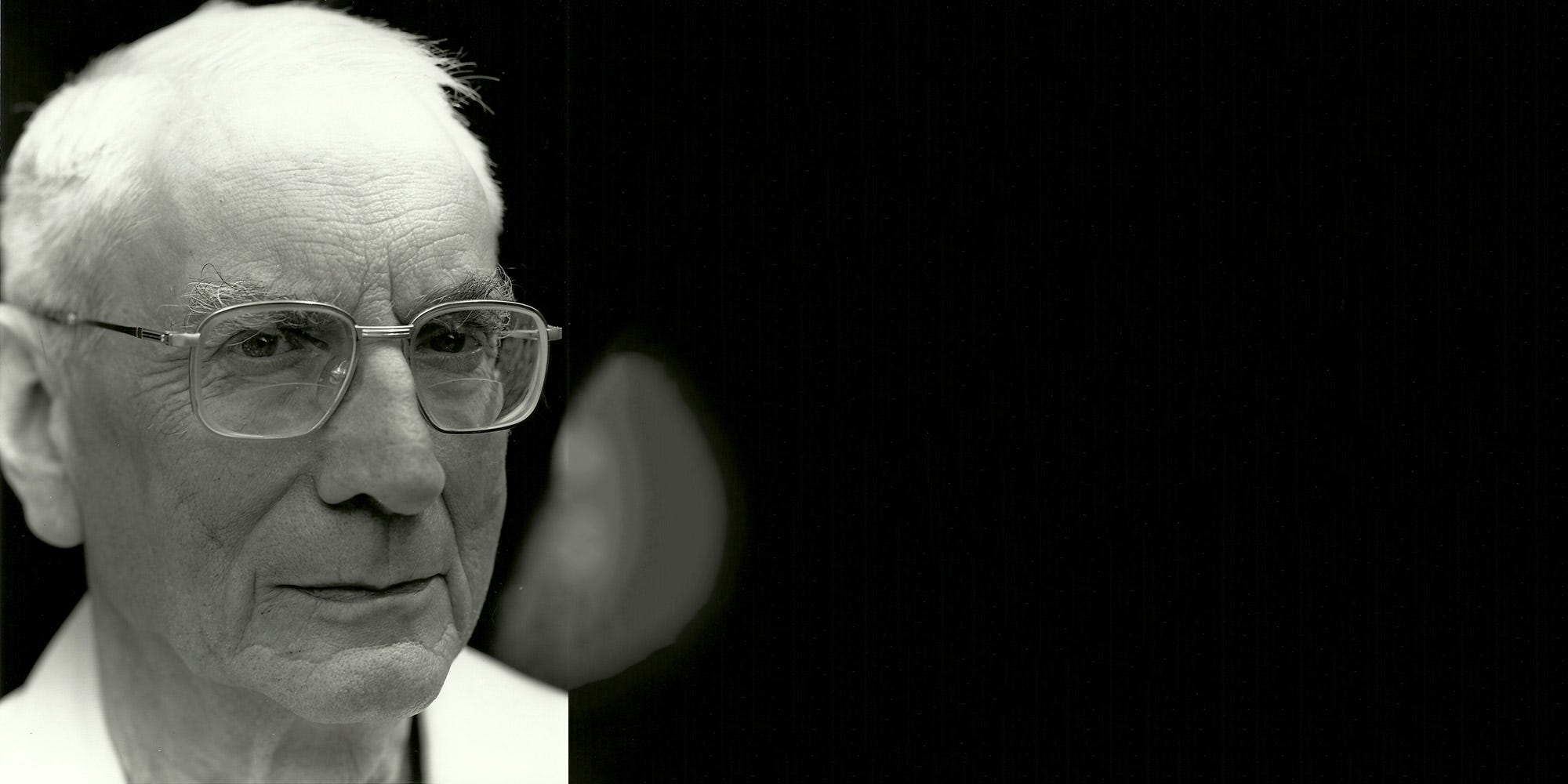
To the ancient Greeks, philosophy is about more than thinking. To be an Epicurean is to change how you live. One modern thinker is more responsible than any other for clarifying this stark difference between the ancient and contemporary ways of practicing philosophy.
The late Pierre Hadot (1922–2010) was a celebrated scholar most well-known for centering the Greek philosophical tradition around the idea of “philosophy as a way of life,” rather than viewing it as a purely theoretical pursuit analogous to the modern practices of academic philosophy. According to this understanding, to be a philosopher is not to be a “writer of philosophic books” or a “presenter of lectures on philosophic books,” but rather to be a committed adherent to certain precepts that would shape one’s whole life: how one eats, dresses, earns a living, participates in society and politics, and much more. One of the most central concepts in Hadot’s revitalization of this mindset is that of “spiritual exercises,” practices which extended beyond merely reading texts in order to shape the minds of philosophical practitioners.
Although Hadot is most famous for applying this lens to Stoicism (he has written extensively on Marcus Aurelius and Epictetus, while his generally like-minded wife Ilsetraut Hadot published on Seneca), he argues that spiritual exercises were a key practice of all the ancient philosophical schools, including the Epicureans. These exercises were first discussed at length in his article “Spiritual Exercises” from 1977, included in the translated anthology Philosophy as a Way of Life, and then again in 1995 in one of his most important books, What is Ancient Philosophy?1
I agree with Hadot: to read ancient philosophy as if it were a merely intellectual exercise, akin to the work of modern university philosophers, would be a serious error. The Epicureans, as with the Stoics, Platonists, Aristotelians, and Cynics, thought of philosophy as a way of shaping who one was as a human being. So how did they do it?
What are spiritual exercises? What is their goal?
In What is Ancient Philosophy, Hadot describes spiritual exercises as “voluntary, personal practices intended to cause a transformation of the self. These are inherent to the philosophical life.”2 A wide range of activities fall within that definition: modifications to one’s everyday lifestyle (such as a regular practice of fasting or vegetarianism), daily meditations on certain topics or doctrines, memorization of sayings, submitting to a philosophical teacher’s spiritual guidance, or engaging regularly in “Socratic” dialogue are all exercises in this sense. All extend beyond the mere passive reading of a text or listening to a lecture and are intended to shape one’s thoughts, emotions, and way of existing in the world.
In “Spiritual Exercises,” Hadot eloquently summarizes the goal of Epicurean exercises, a goal which is broadly parallel with that of all the ancient schools:
… Finally, this is true in Epicureanism. By removing the unnatural and unnecessary desires, one returns to our original core of freedom and independence that is defined by the satisfaction of the natural and necessary desires. All spiritual exercises are thus, fundamentally, a return to one’s self, a liberation of our being from the alienation to which worries, passions, and desires had carried it. The self, thus liberated, is no longer constituted by egoistic, impassioned individuality; it is our moral being, open to universality and objectivity, a participant in nature or in universal thought.3
Other thinkers have put their finger on this true philosophic experience over the millennia. In antiquity, when drawn to reflection on the subject, philosophers would return an unambiguous verdict: “Philosophy teaches us how to act, not how to speak,” said Seneca.4 Today, the philosophy most students encounter consists overwhelmingly of speaking. Take a half dozen philosophy professors from your nearest university: they may have very different areas of scholarly expertise, but they probably live in roughly the same way as each other, and the same way as their colleagues in the English or Art History departments. Their specific philosophic affiliations are rarely fundamental to how they lead their daily lives.
Hadot agrees with Thoreau’s famous sentiment: “There are nowadays professors of philosophy, but not philosophers. Yet it is admirable to profess because it was once admirable to live.” That insight continues to be true today.
The spiritual exercises of Epicureans
According to Hadot, then, what exactly did “being an Epicurean” involve in the ancient world? It meant to subscribe to a set of doctrinal teachings, yes, but also to integrate the following practices in one’s life.
Self-awareness of our spiritual state
The knowledge of our errors is the beginning of our salvation.5
– Seneca
In all schools, the beginning of philosophy means becoming aware of the state of alienation, dispersion, and unhappiness in which we find ourselves before we convert to philosophy.6
– Hadot
The starting point and precursor to all the spiritual exercises proper is the development of a strong sense of contrast between the philosophic life and the life of non-philosophers. Today, students may attend classes in philosophy, but most do not think of themselves as philosophers. When used at all in contemporary settings, the word usually means “someone who writes or teaches philosophy.” In the ancient world, one could adopt the beliefs and lifestyle of a philosophical school and hence be considered, for example, “an Epicurean,” without being a writer or teacher. Although this may seem like a one-time choice or decision, rather than an ongoing “exercise,” I think Hadot is right in asserting that one’s self-conception as a philosopher has a dramatic ongoing impact on how one interacts with the world and daily decision-making. I think of myself as an Epicurean. This influences my life choices much more than if I thought of myself as “a person who enjoys reading ancient philosophy.”
Closely allied with this awareness of our starting point is awareness of our progress. In Stoicism, there is explicit testimony of “progress-check” type exercises, such as daily morning and evening reflections on one’s intentions, failures, and successes. While we don’t have direct evidence of that kind of exercise for Epicureanism, Hadot thinks a parallel phenomenon is implicit in the Epicurean emphasis on frank philosophic discussion, openness to correction, and acceptance of spiritual guidance from one’s masters. Philosophers notice when they fall short of a certain model of conduct, they welcome correction of their shortcomings, and they strive to have fewer such shortcomings in the future.
Meditation on core doctrines
Today, philosophy students read books of philosophy. Ancient Epicureans read books too, of course, but they did so in a different way. In addition to studying the longer treatises, Epicurean students would be expected to read and reread shorter texts, memorize maxims, and work to deeply internalize the core doctrines. One of our core surviving texts is Epicurus’ Principal Doctrines—these forty sayings are not just a random assemblage of aphorisms that happened to be compiled together and published, but an original, intentional selection of central principles that Epicurean students would read, reread, memorize, and meditate upon. The famous tetrapharmakon (fourfold remedy) represents a later tool in this vein, a striking compression of core doctrines into a memorable, easily repeatable form:
The gods are not frightening.
Death is nothing to worry about.
The good is easy to obtain.
The bad is easy to endure.
“Meditate” in this sense is not the attempt to clear one’s mind or still one’s thoughts, now familiar from eastern traditions. It is a combination of the conscious thinking-through of the maxim’s justification and implications, literal repetition or memorization, and the ongoing assertion to oneself of the truth of the statement.
Of course, this kind of contemplation is not restricted to singular maxims, but can also be practiced generally on a set of teachings about a particular topic. For example, an Epicurean might meditate on death, meaning not a vague, wandering rumination, but an intentional review of the school’s core teachings: there is no divine punishment or reward, there is no afterlife or posthumous sensation, death is nothing to us, and our mortal life is where pleasure is experienced. As Hadot summarizes:
The Epicurean meditation on death is intended to make us aware of both the absolute value of existence and the nothingness of death, to give us the love of life and to suppress the fear of death.7
Relaxation into pleasure, gratitude, and tranquility
Hadot argues that the conscious decision to appreciate the pleasures of life is the fundamental exercise of Epicureanism. I agree. While some spiritual exercises occur across multiple schools, this is one of the starkest contrasts within ancient philosophy: the fundamental Stoic exercise involves a tension, a constant vigilance over one’s thoughts, while the essential Epicurean practice is one of relaxation, of releasing our fears, anxieties, and desires. To be an Epicurean, you must practice “the deliberate choice, constantly renewed, of relaxation and serenity, and a deep gratitude towards nature and life, which, if we knew how to find it, constantly offers us pleasure and joy.”8 Or as Hadot expresses it in this interview, in a manner that is less elaborate but even more French, when asked if pleasure itself constitutes a spiritual exercise among the Epicureans:
Ah oui, oui, oui, oui, oui, oui, oui.
Other writers have elaborated on the many objects of Epicurean gratitude.9 Some of the innumerable things we gratefully enjoy are:
The satisfaction of the necessary desires (feeling warm, fed, etc.)
Easy-to-obtain indulgences in natural but unnecessary desires (fancier food and drink, comforts, entertainments)
The serenity that comes from scientific understanding (see PD 11–13)
The practice of philosophy
Friendship
The memory of past pleasures
The wonder-filled contemplation of the universe (see Lucretius)
The simple pleasure of existence in the present moment
Discipline of desire
This is a term Hadot made famous in his discussion of Marcus Aurelius and Epictetus, but Epicureans also had their version of reviewing their desires and pruning away the undesirable ones. Some schools were much stricter in their ascetic practices, eliminating all luxuries or demanding vegetarianism, for example. Epicureans were not like this. They advocated for eliminating the “unnatural desires,” such as those for wealth, power, and fame—many people have happily lived without those things, while those who orient their lives around them never find tranquility. But when it came to the “natural but unnecessary desires,” such as those for certain kinds of food or drink, or other non-essential little indulgences, they advocated moderation: enjoy them without guilt when they come to you easily, but avoid taking on greater pains in their pursuit.
In practice, then, Epicureans avoid organizing their lives around making money or achieving fame, obtaining political power or achieving political goals. A belief in the truth of the school’s tenets rules these out as reasonable courses of action. It also means that Epicureans will tend to be moderate consumers: while not strict ascetics, they will typically spend less on food, clothing, cars, and home furnishings than the average non-philosopher. Such things do not fundamentally increase our happiness and their acquisition often requires an unnecessary investment of time and energy in making money.
Seek and accept spiritual guidance
This has multiple levels of practice, all of which are often omitted in the lives of non-philosophers. First and ideally, we will find a spiritual guide: a real, live teacher who can advise us, correct us when we are mistaken, and provide an example of wisdom. In ancient times, students would go to the Garden to study under Epicurus and his successors, which included directly personal advice on how they should live (Vatican Saying 51 seems to be an example of such personal guidance, possibly by Metrodorus). Outside of Athens, there were probably other Epicurean communities, such as the contemporary community in Lampsacus where Idomeneus and others lived.
Second, the vision of the philosophic life in antiquity was not simply a one-to-one relationship of master and disciple, but involved a whole community of fellow learners. Epicureans in particular were known for emphasizing the importance of “frank speech,” which involved directly pointing out the errors and shortcomings of one’s philosophic comrades, and accepting their corrections in turn, with humility and sincere good faith. In the world of non-philosophers, most people hate to be corrected and refuse to acknowledge anyone’s right to judge their conduct.
Finally, and perhaps especially important for those of us in the modern world who don’t have the opportunity to join an Epicurean community, we can adopt a spiritual guide indirectly, through a study of the writings of past masters with an attitude of trust and humility. Just like it was popular for a time for Christians to wear “What would Jesus do?” wristbands, the Epicureans advised students to “live as if Epicurus were watching you.” While some of the practices of personal reverence towards Epicurus seem excessively cultish to unsympathetic modern eyes (the abundant statues and other images, the ritual celebration of his birthday), the object of envisioning and remembering an iconically good person is our own improvement. Seneca testified to this Epicurean advice:
“Love someone good, and picture him always before your eyes. Do everything as if he saw you; live as if he were watching.” This, my dear Lucilius, was the advice of Epicurus… Happy is the man who can so revere another that the mere thought of the one he admires brings calm and order to his mind. The man capable of such reverence will soon be worthy of reverence himself.10
Spread the philosophy
Finally, while those hostile to Epicureanism often criticize a strawman version of the school that simply “withdraws” from the world, the reality is that historical Epicureanism was a missionary philosophy, one that strove to spread its teachings and attract new converts. Epicureans “withdraw” from some fields of competitive prestige—the usual culprits of wealth, fame, and power—but that doesn’t mean they were entirely insular and cut off from the world.
To some degree, new adherents to the school would appear naturally, as an outgrowth of the communal activities described above, which then attracted those in search of a spiritual home. Current members of the Garden would draw their friends, family, and offspring into the Epicurean orbit. And to some degree, the statues and images of Epicurus and the other leaders of the school also performed this missionary function, not just serving as valuable reminders of wisdom for existing followers, but making the schools’ models visible to the world at large.
But one final activity was practiced both in antiquity and into the present day: writing. By reiterating and expanding on the core doctrines, and sending those words out into the world, we hope to both help others find peace and pleasure, and to do the same for ourselves. To write Epicurean essays is itself to perform a spiritual exercise.
Links go to our Bookshop.org affiliate shop and benefit this site.
Most of Hadot’s work has been translated into English, as in the above titles. Quotations here from What is Ancient Philosophy? are from the published translation by Michael Chase (the English translator of most of Hadot’s work, who does a fine job). I only have the 1977 “Spiritual Exercises” essay as included in the French collection Exercises spirituels et philosophie antique, so quotations from that essay are in my own translation and may vary slightly from the published English text.
What is Ancient Philosophy?, 179
Exercices spirituels et philosophie antique, 63
“Facere docet philosophia, non dicere.” Letter 20.
Letters 28.9
What is Ancient Philosophy?, 198
What is Ancient Philosophy?, 197
Exercices spirituels, 37
See Norman W. DeWitt, “The Epicurean Doctrine of Gratitude,” The American Journal of Philology 58, no. 3 (1937) and Benjamin A. Rider, “The Ethical Significance of Gratitude in Epicureanism,” British Journal for the History of Philosophy 27, no. 6 (2019).
Letters 11