

Before getting to the meat of today’s concrete advice, I’d like to both relay an announcement from the world of contemporary Epicurean writing and present a quibble with relevance for today’s post. The announcement is that Jonny Thompson, popular philosophy Substacker at Big Think, has an upcoming Epicurean book entitled The Art of Enough scheduled for release next April, and has started a weekly newsletter on Substack entitled The Sunday Epicurean. The first post is free and is a solid reflection on the Epicurean enthusiasm for logismos, a kind of practical calculation or reasoning-out of things.
My quibble, however, is with something Thompson said in his separate announcement post, and which seems to underlie the approach of his book. (Though perhaps my sense of his emphases will change once it actually comes out.) According to him, Epicureanism is in large part about acceptance, about finding ways to adequately “live with” our problems. He introduces this idea in the context of impairments to physical health:
I would bet my house that you’re living with something. There is some sickness, pain, or condition you’ve learned to deal with. Because there is no such thing as “perfect” health. Everyone you talk to, everyone you see on the street, everyone in the line at the coffee shop, has something they have to adapt to… I am the way I am, and I have learned how to live with that. We all grow to deal with the world as best we can.
Thompson presents this scenario of living with imperfect physical health as analogous to how he views Epicurean teachings when it comes to mental health. He seems to consider Epicureanism a more expansive but generally continuous extension of modern therapy, as an ongoing practice through which we can better learn to “live with” our seemingly ineradicable obsessiveness or anxiety, for instance. Thompson encourages a willingness “to speak the language of therapy” and “commit to where we are right now.”
While Epicurus does present some teachings for dealing with unavoidable physical pain, I think this significantly misplaces the Epicurean emphasis, especially when it comes to mental struggles. Epicurus does not present himself as offering a set of more-or-less effective coping mechanisms, but confidently proclaims that his teachings will result in a state in which “you will never be troubled, neither waking nor asleep, but will live like a god among men.” He is striking among ancient philosophers in his insistence that we can not merely “learn to live with” our most serious fears (of death, or of the gods) and our most frustrating desires (for wealth, fame, or political success, for instance), but that such harmful beliefs can be entirely dispelled. When it comes to mental health, our goal is not coping, but complete and god-like tranquility. Achieving this is not easy, but Epicurus is in my view particularly inspiring in his unwavering assertion that it is possible.
I think the same is often, though not always, true in the realm of physical sources of pain. Sure, it’s possible to have a terminal, untreatable disease. But I think a proper modern Epicureanism would note that while “perfect health” is essentially unobtainable (as Thompson argues), something like “top quintile” health may be a perfectly reasonable target for the physically average person who applies an above-average degree of well-calculated effort—and leads to a life of significantly less pain. A large share of modern ailments are “lifestyle diseases” stemming from overeating, inactivity, stress, and substance abuse. Some conditions that would have been untreatable in Epicurus’ day can be easily defeated with modern medicine. In some cases, focused interventions of diet or physical therapy can address issues that would have been obscure in the past. Accepting “where we are right now” is not our only option. We can do things!
At the core of Epicurean practical advice is the elimination of eliminable pain and the avoidance of avoidable pain. Despite the limits of medical knowledge in his time, he explicitly included physical health as a central goal worth pursuing within his hedonistic framework:
For those capable of reasoning, the healthy condition of the body and a dependable confidence in keeping it contain the highest and most infallible joy. (Usener fragment 68)
Accustom yourself, then, to a plain rather than an extravagant way of life: this is integral to health... (Letter to Menoeceus 130)
To wrap up this preface: Don’t resign yourself to physical pain too quickly! Don’t decide to “live with” pain that can actually be resolved! “Love of fate” is for Stoics. The wise Epicurean thinks that a lot of things are not really fated, but instead are either up to us or up to chance. And when we are dealt suboptimal cards, the proper attitude is not to passively accept poor outcomes, but to “stand firmly against fortune” (τύχῃ ἀντιτάξεται), employing practical reason to overcome all that can be overcome.
Acceptance? When necessary. Avoiding certain fields of activity altogether? When that makes sense. But our foremost strategy? To use science and sober assessment of costs and benefits to expel pain from our lives. To systematically identify and actively eliminate pains whenever possible.
As with many other topics, we can apply this mindset to our physical health.
Five Concrete Suggestions for Epicurean Health
Obviously, I’m not a doctor. Circumstances vary, consult a medical professional, yadda yadda yadda. I offer these suggestions drawn from mainstream, consensus sources not out of any claim to personal medical expertise, but to suggest a general mindset: which health metrics, based on your best estimate of the evidence, seem like they are truly the most important? Are there practical, time- and cost-effective ways of improving them? Then do those things, rather than being distracted by fads and fearmongering, or being overwhelmed into disempowered apathy.
There is an endless proliferation of health advice in the world. I think specifically Epicurean health advice should 1) focus on areas of maximum benefit, 2) be inexpensive in time and money. I’m assuming that you don’t do obviously harmful things such as smoke, drink excessively, or engage in other harmful substance abuse. This is also a very general summary, so individuals will, of course, sometimes have more pressing but fairly unique issues. If you have an injury you need to rehab, do that. If you are iron deficient, supplement iron. If you have a rare disease, treat that. And so on.
If you are a roughly average person, however, then striving to be in, say, the top 20% of the following mainstream metrics will be highly likely to reduce the net pain of your life.
1. Body Composition
“Body composition” is a unifying term for two basic directives: don’t have too much fat or too little muscle. The first is the most obvious and widespread component and has a multitude of well-known detrimental effects: obesity is associated with higher blood pressure, higher blood glucose, and worse cholesterol scores, for instance. In addition to those more subtle effects that then increase one’s long-term risk of heart disease, diabetes, cancer, and other nasty things, being overweight also incurs short-term downsides like increased joint stress and difficulty in physical activity.
The standard guidelines are often based on BMI (body mass index) which is just a simple ratio based on your weight and height. Being in the healthy BMI band is indeed almost always better than being out of it, though some particularly muscular types may also appear “overweight” based on this simple metric. Another no-cost proxy for “don’t be too fat” is a simple waist measurement: if you are heavy due to your overall musculature but have no build-up of abdominal fat, you are probably fine. “Keep your waist circumference under half of your height” might be a good simple formula.
The second aspect of body composition is muscle mass. This is in part a proxy for strength: it is possible to be very lean and strong, and that will secure a large share of the health benefits. But having above average muscle mass is probably independently good: muscle mass tends to decline in old age, and you don’t want to be a frail old person who has wasted away.
There isn’t as much of a universally-used metric for “enough” muscle. The fancier way of checking-in on both your fat and muscle is a DEXA scan, which is a kind of low-dose x-ray scan increasingly available to consumers through gyms and sports medicine type places. In my area, I was able to get one of these for $35, which seemed fairly reasonable and kind of interesting: you can then compare your numbers to some population benchmarks and make sure you are at least above average. This also gives some more objective numbers, such as measurements of your bone density and visceral adipose tissue (the particularly harmful intra-abdominal fat).
Outside of such a scan, the best practical proxy might be measurable progress in some kind of strength training. There isn’t really a single accepted standard of “strong enough,” in part because preferences in resistance training modalities vary widely. Find something you like and set yourself some goals. A calisthenics enthusiast might aspire to doing one-arm pushups, one-leg squats, and sets of ten pullups, for instance. If you can do that, you’re definitely stronger than average. Personally, I like using kettlebells. In the kettlebell world, some common standards for men are being able to press a 70 lbs. kettlebell overhead and do 100 swings in five minutes with the same weight. When I started using kettlebells, I couldn’t do that. Now I can. I feel stronger and less fragile, which I feel confident will have a net positive impact on the pleasure I experience in life.
2. Cardiovascular Fitness
A lot of ways that humans die involve the heart, vascular system, and lungs. It’s unsurprising, then, that high cardiovascular fitness greatly reduces all-cause mortality (and the various painful conditions that precede death).
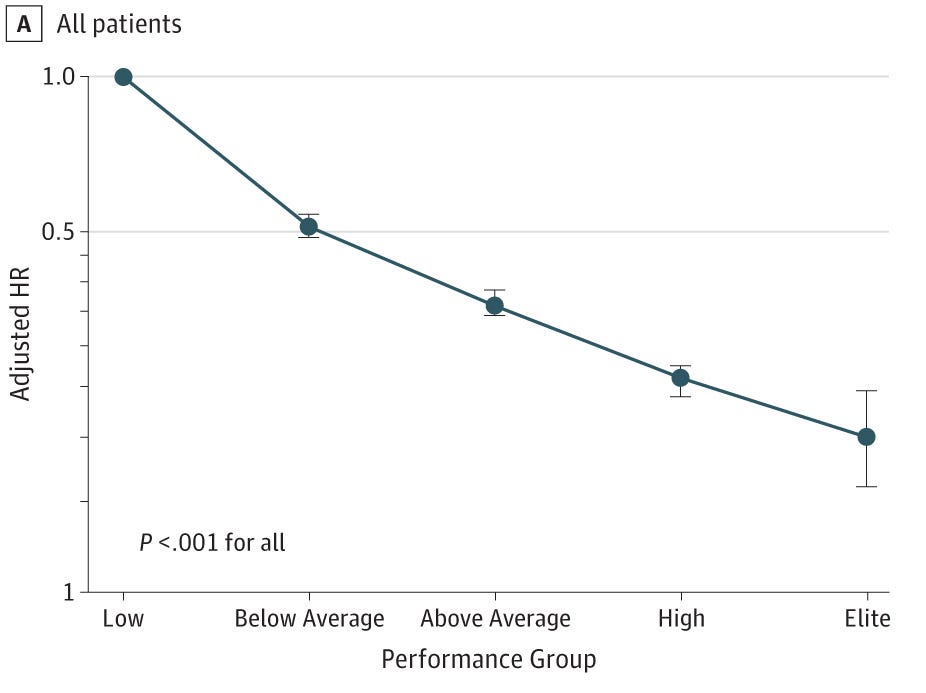
This chart is based on performance on a treadmill test. The true exercise fanatics will track their “VO2 max” score based on a highly uncomfortable lab test, while the more mildly fanatical will estimate their score based on do-it-yourself equivalents like a 12-minute or a 1.5 mile run (two forms of the “Cooper test”) or from a wearable device. As with strength training, however, I think there is substantial room for individual variation in how you go about improving your cardiovascular fitness.
Some people like running. That’s convenient for measuring yourself against standardized benchmarks. Some people like cycling. That’s also relatively compatible with standardized tests (using a stationary bike). Some people like swimming. Some people like sports with lots of running around. Some people like hiking up steep hills with weight on their back. As with strength training, there is of course plenty of more tailored advice out there to be found depending on your goals and preferences, but you should find some kind of activity that regularly elevates your heart rate for a sustained amount of time.
3. Blood Pressure
Now that I’ve presented those two most obvious categories of trainable “fitness,” I can move on to the standard medical metrics that are most often assessed in normal annual physicals. The good news is that addressing the two previous entries will go a long way towards ensuring a healthy status on the last three.
Blood pressure basically represents the force of blood pushing against the walls of your arteries. High blood pressure therefore mechanically damages the arteries and means your heart has to work harder against that resistance, cumulatively increasing your risk of heart attack and stroke. The standard threshold for “elevated” blood pressure is 120/80. If your blood pressure is higher than that, losing excess fat and getting more cardiovascular exercise can be highly effective at reducing blood pressure, and may be all that needs to be done. It’s also valuable to practice Epicurean philosophy in order to reduce stress and sleep like a baby (the metaphorical kind, that sleeps soundly all night long). If those factors are all dialed in, but your numbers remain elevated, there are more specific dietary or pharmacologic interventions available as well.
4. Blood Sugar
Average blood sugar (HbA1c) is one of the most common blood tests performed routinely on the general population. There are some (somewhat arbitrary) thresholds that have been given names: 5.7% or above is considered “pre-diabetic” and 6.5% or above is considered diabetic. Full-blown diabetes has direct downsides, but even pre-diabetic status is harmful and increases one’s risk of various serious conditions, including heart disease and cancer. Fancy people do more precise tests, but the easy HbA1c marker is a pretty solid one: keep this under 5.7.
Again, addressing the first two items above may be all you need to do. People become overweight by consuming more calories than they burn on an ongoing basis—that alone will tend to raise your blood sugar. Having more muscle will help to regulate blood sugar on an ongoing basis, while basically any exercise will immediately draw glucose into the muscles, quickly tamping down spikes. Beyond that, while people can get very obsessive about their specific dietary choices, the basics are not too controversial: sugars and other simple carbohydrates raise your blood sugar more, so you should reduce those things if your blood sugar is too high. Reducing sweet drinks and sugary snacks is the obvious place to start.
Personally, I’ve never required more intensive efforts than this to keep my blood sugar in a healthy range, but if yours isn’t, then more significant dietary modifications may be necessary. There are drugs as well, but my impression is that they shouldn’t be necessary for most people.
5. Cholesterol
The other common entry on a routine blood test is a “lipid panel,” which gives a series of numbers relating to cholesterol-carrying particles. This is where we have the famous “good cholesterol” (HDL-C), “bad cholesterol” (LDL-C), and triglycerides (also “bad”). The simplified version is that having too many of these harmful particles can lead to narrowing or clotting of the arteries, leading to heart attacks, strokes, and other highly undesirable events.
Diet and exercise play some role here as well (being overweight can definitely contribute to high triglycerides, for instance), but these numbers are significantly impacted by genetics and are often hard to impossible for some people to get into “optimal” range through lifestyle interventions alone. Fortunately, this is an area where modern medicine has made major strides, most notably through the very cheap and widely used class of drugs known as statins, which reduce LDL-C very effectively.1
Epicureans appreciate simple means, but we have no reluctance to take advantage of scientific advances when they offer the easiest route to a desirable outcome. Accordingly, a daily low-dose statin is the one pill I take. Despite being fairly young (still in my 30s), my LDL-C was solidly into the 140s (“borderline-high”) and climbing. So I talked with my doctor and began taking a statin, an essentially free daily pill that caused me no side effects and immediately dropped my LDL-C into the 50s, well within “optimal” range. Some people take weird supplements or vigorously excise all saturated fats from their diet without achieving objectively equivalent results. Epicureans prefer real numbers.
Conclusion
This is not a medical newsletter and I am not a medical expert. But some people are seemingly unaware of these basic guidelines for human health, and most of us have neglected one or more of these well-evidenced facets of bodily maintenance whether we have heard this advice before or not. Overall, I think that a practicing modern Epicurean shouldn’t neglect their health in this way: this is a philosophy that places a uniquely large emphasis on avoiding physical pain, and health is the avoidance of pain. Let me close with two last reminders regarding the specifically Epicurean pursuit of health.
First, keep things in perspective and don’t get too obsessive. My five-item list may represent more attention than many give to their health protocols, but in many ways it is quite simple. There are so many people shopping in the supplement aisles, adopting weird diets, acquiring faddish exercise equipment, or popping a wide variety of pills. Most of that is unnecessary. Simplicity is integral to an Epicurean health program: we don’t want unhelpful expense, we don’t want to do things for which a sober cost-benefit analysis is unconvincing, and at the end of the day, we aren’t afraid of death. We do things that make sense. We don’t grasp at straws out of fear or reluctance to perform a quantitative analysis.
Second and finally, simplicity is integral to an Epicurean health program because we have other, more important concerns. As I alluded to in the intro, physical health is foundational: unnecessary physical pain is a real (though not unsurpassable) obstacle to happiness. But unnecessary mental pain is the even more widespread problem, and one which is nearly entirely avoidable. Physical fitness is valuable; mental hygiene is irreplaceable. Accordingly, I take five seconds a day taking my statin, 30 minutes a day exercising, and do my blood tests once a year or so. The rest of my time is spent not on my current physical well-being, but on the many facets of mental well-being: increasing my concrete security regarding the future, dispelling unwarranted fears and empty desires, and appreciating the many pleasures of the present moment.
For some reason, statins are one of those drugs that have elicited suspicion in certain pharma-skeptical circles. I think such concerns are much overblown. Some studies find reported side effects (most commonly immediately-reversible muscle aches) in around 10% of users, but double-blind trials generally find that the vast majority of side-effects are illusory “nocebo” results. Overall, I find the evidence quite convincing that maintaining low long-term LDL-C (or ApoB) dramatically lowers the risk of future heart disease.