
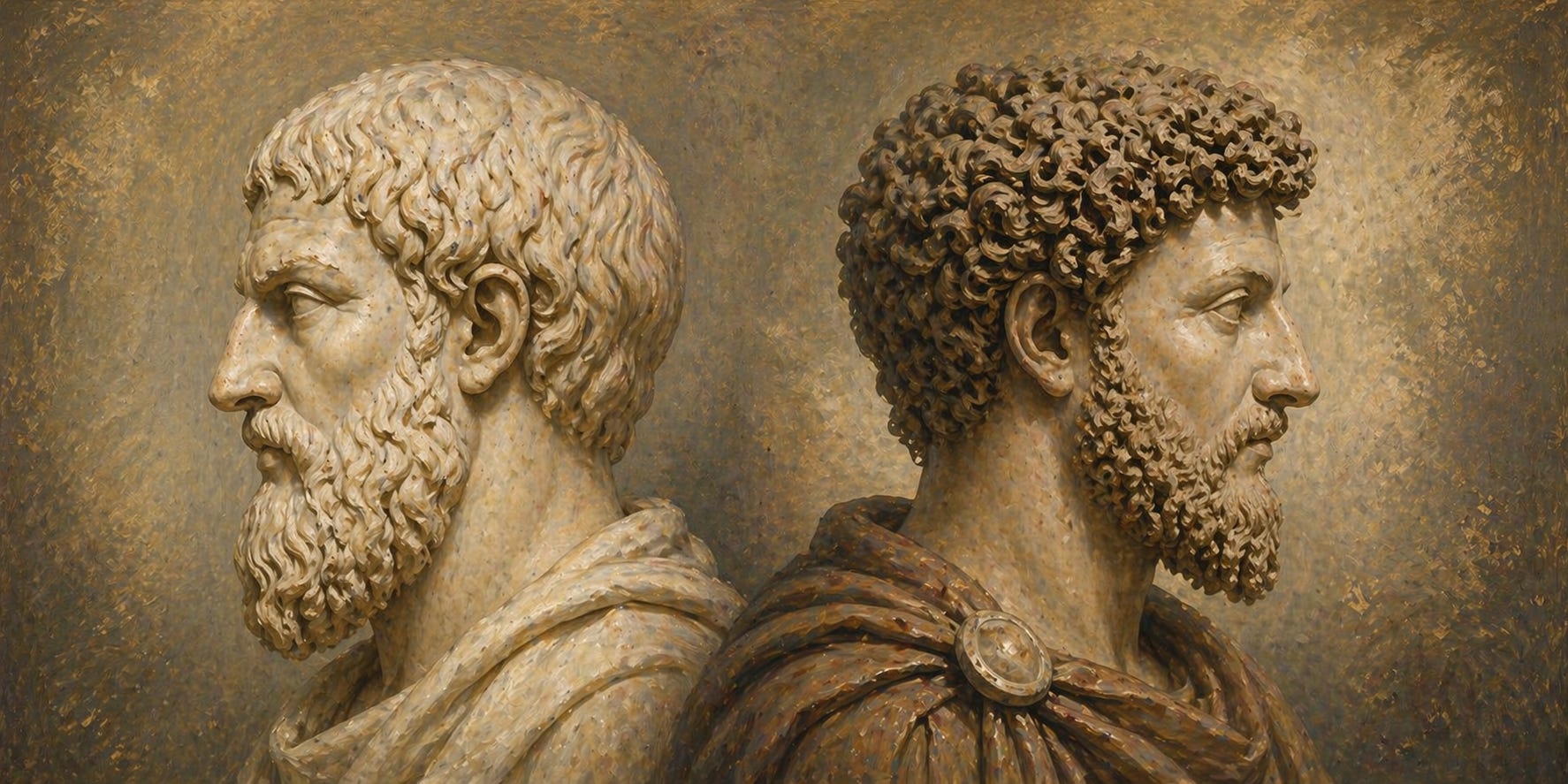
Stoicism is having a significant revival these days. Popular Stoicism books crack the best-seller lists, Stoic entries populate Substack’s top philosophy newsletters, and more people simply seem aware of Stoicism’s existence as a philosophical school than are aware of Epicureanism. Oddly enough, however, I think a good chunk of the modern fans of Stoicism are simply mistaken about the appropriate philosophical label for their beliefs: many of them would probably feel more at home with Epicureanism.1
I would base this argument on three claims. First, I think that many of the aspects of Stoicism to which people are drawn—the redirecting of our desires through reason, fearlessness in the face of difficulty, and the endurance of current discomfort for more important ends—are equally present in Epicureanism. Second, I think that many modern “Stoics” do not believe in the theological and metaphysical underpinnings of the school: a majority of the Stoic-sympathizers I have encountered actually have beliefs closer to the Epicurean position (a belief in scientific method, evolution, and a lack of divine guidance for physical phenomena) than that of the Stoics (that a divine force instilled humans with a special capacity for reason so that we could serve as witnesses to the rational cosmic plan behind every seeming misfortune). Third, I think most modern Stoics do not actually accept the irrelevance of pleasure to happiness, either for themselves or for others. The ancient Stoics don’t think that helping others to avoid pain is ultimately valuable in itself—that would be the position of universal hedonists, or Utilitarians. In reality, Epicureans are better aligned with Utilitarians when it comes to both final ends and matters of public policy or communal endeavor. They simply curtail universal concerns with commonsense individual prudence.
Let’s take these one by one.
Stoicism and Epicureanism have significant overlap
There are several aspects of Stoic ethics that I find appealing. It is good to question our desires and emotional reactions, inquiring whether seemingly bad events will truly harm us or seemingly positive outcomes will truly benefit us. It is good to accustom oneself to certain hardships, recognizing that temporary discomfort is often worth enduring for some larger purpose. It is good not to let fears of difficulty, loss, or death dominate our life or disturb our well-being. I whole-heartedly support all those who turn to these teachings in preference to the unreflective short-termism that dominates the world.
The thing is… all of those counsels are present in Epicureanism as well. We get caricatured as short-sighted, selfish hedonists (including by the ancient Stoics), but that just isn’t true. We constantly question what is truly good or bad for us:
Pose this question to every desire: what will happen to me if it is fulfilled, and what will happen to me if it is not fulfilled? (Epicurus, Vatican Saying 71)2
We must not spoil the things we have through desire for things we don’t have. Rather, we must use our reason to remind ourselves that these also were things we once wished for.(Epicurus, Vatican Saying 35)
We accept temporary hardship and use austerity as a tool:
We do not choose every pleasure, but there are many times when we pass over pleasures, when greater difficulty follows from them… Just as also every pain is a bad thing, but not every pain is always of a nature to be avoided. (Epicurus, Letter to Menoeceus 129)
Epicurus, the teacher of pleasure himself, used to have certain days during which he would do the bare minimum to quiet his hunger… The food the executioner gives to those on death row is more generous than [what he chose to eat]. So how great must be the soul of one who descends to such fare of his own free will, who faces privation that those sentenced to the most extreme penalties need not fear! Thus indeed can one forestall the harsh arrows of fortune. (Seneca, Epistles 18)
And when faced with the inevitable difficulties of life and death, we proceed without fear:
‘When I was sick,’ says Epicurus, ‘I never used to talk about my bodily ailments… my life merely went on its normal way, smoothly and happily.’ In sickness, then, if you are sick, or in trouble of any other kind, be like Epicurus. (Marcus Aurelius, Meditations 9.41)3
Death is nothing to us. (Epicurus, Principal Doctrine 2)
In addition to the direct quotes, did you notice who else testified above to the wisdom and integrity of Epicurus? Seneca and Marcus Aurelius. They understood that many of the things they valued and admired in philosophy were also taught by Epicurus. So if these are the types of attitudes that attract you to Stoicism, there is so far no reason to declare yourself one way or the other in your philosophical allegiance. The differences lie elsewhere.
Stoics are on the side of faith. Epicureans are on the side of science.
For many hundreds of years, Stoicism was viewed more favorably by the western world than Epicureanism. Perhaps the biggest factor in this differing reception was due to Stoicism’s greater perceived degree of compatibility with Christianity: the Stoics argued that there was a cosmic order to the world and devalued our material existence and its pleasures in favor of more idealistic virtues, while Epicureans were painted (not altogether accurately) as pleasure-loving atheists. Personally, I find this train of events regrettable (if only we had preserved as much of the Roman Epicureans as we did of the Stoics!), but historically understandable. What is stranger is the renewed popularity of Stoicism today, in an increasingly secular world.
If you are indeed committed to a belief in divine providence and are looking for an ancient philosophical school that is generally compatible with that idea, then I have no objection if you find yourself drawn to Stoicism, at least on this ground. But if you are in practical terms an atheist, agnostic, or simply secularly-minded person, you should be aware that Stoicism’s ethical teachings are strongly dependent on the conviction that the world operates in inevitable accordance with the divine logos and that our primary task is to assent to that rational design. In these teachings, to try to make the material circumstances of ourselves or others better is merely a “preferred indifferent” that is ultimately irrelevant to human well-being.
Whatever happens, happens rightly... as from the hand of one who dispenses to all their due. (Marcus, Meditations 4.10)
Since I am a rational creature, it is my duty to praise god. (Epictetus, Discourses 1.16.20)4
Realize that the most important factor in piety towards the gods is to form right opinions about them as beings that exist and govern the universe well and justly. (Epictetus, Enchiridion 31)
Personally, I find it more likely that the existing state of the world has come about without any grand design and that we should feel free to acknowledge its imperfections and try to make things better where we can, confident in the commonsensical belief that poverty, violence, and fear truly are detrimental to human happiness. I think that the galaxy and planet came to be through purely material chains of events. I think humans evolved as other animals did (a subject on which the Epicureans were quite prescient) and were not placed in the world as the special embodiment of divine rationality. I don’t think the world is directed by providence, and I don’t find my position to be a recipe for despair.
Either the world is a mere hotch-potch of random cohesions and dispersions, or else it is a unity of order and providence. If the former, why wish to survive in such a purposeless and chaotic confusion? (Marcus, Meditations 6.10)
Each of the animals is constituted by god for a purpose, one to be eaten, another for husbandry, or for the production of cheese… But god has introduced man into the world as a spectator of himself and of his works. (Epictetus, Discourses 1.6.18–19)
God is near you, he is with you, he is inside you. (Seneca, Epistles 41.1)
If all of these statements from the Stoics are reflective of your beliefs, then Stoicism may be right for you. But if you are skeptical that humans were intelligently designed for the purpose of witnessing the ongoing rational governance of the world by divine forces, then you will probably find yourself more at home with the Epicureans.
Pleasure is good. Don’t you agree?
Epicurus is straightforward: pleasure is good and pain is bad. This is a commonsense position that most people hold. We consider it perfectly reasonable to choose something tasty when handed a menu, we think that ibuprofen was a very helpful invention, and we believe that if people are starving it is good to give them food. If we can help a friend to these kinds of benefits, we will. If the state helps people to these kinds of benefits, it is furthering natural justice.5
The Stoics are less straightforward. According to them, the things commonly considered good—health and money, for instance—are merely “preferred indifferents,” since only virtue is truly good.6 I don’t get the impression that all the modern fans of Stoicism truly believe this. Take one common vein of Stoic critique of Epicureanism: the accusation that Epicureans are insufficiently engaged in politics. I often find the enthusiasm of such people for their chosen political cause to be very earnest. They seem to place a very high value on the advancement of their cause. But essentially all of their causes would actually be categorized as “indifferent” by the Stoics, and, in their teaching, whether they progress or not should be accepted with tranquility as part of the divine order of the world.7
Or consider another archetypal example of Stoics making a normal benign activity a little weird: friendship. Epicurus is a famously enthusiastic exponent of friendship. While he very clearly endorses all the standard behaviors necessary to be a good friend—trustworthiness and material assistance, even to the point of dying for a friend—he also considers a primary value of friendship to be the fact that friends can help us. The knowledge that we have friends who will come to our aid is a good thing. (There is no reason not to apply this position to spouses and family members as well.) Stoics find such reliance on others distasteful; according to Seneca, the purpose of friendship is that it gives you an opportunity for virtuous action—friends are unnecessary for the wise man’s happiness and their aid is indifferent.8 I think this is a very strange way of thinking about friendship and that few modern “Stoics” would truly be comfortable stating to their friends that the reason they engage in the relationship is because they appreciate them as opportunities for righteous conduct.
Epicurean hedonism has often been caricatured. But in this respect, it is the position of obvious common sense, controversial only to certain philosophers: every normal person actually recognizes that and acts as if pleasure is good and pain is bad, just as they know that fire is hot and act accordingly.9 My impression is that many more modern people would be willing to assert that “alleviating poverty and pain is good” and “friends make my life more pleasurable” than would choose the Stoic formulae “alleviating poverty and pain is reasonable to do, but it would be better for those unhappy people to recognize that the death of their child is an indifferent thing” and “the value of friends is that they let me practice virtue.”
Epicureans are psychological hedonists. We think that “seeking pleasure and avoiding pain” is simply the best description for whatever it is that humans do, although the everyday person’s tactics for pursuing pleasure are often misguided. Stoics are more radical and believe that normie intuitions about pain and pleasure, friendship and loss, are all mistaken. Both philosophies endorse living virtuously. So are you truly a Stoic, who considers the pleasure and pain of others to be fundamentally indifferent things, relevant to you solely as opportunities for virtuous conduct? Or are you closer to the Epicurean position, which considers increasing the pleasure or alleviating the pain of others to be the very real stakes that makes an action virtuous in the first place?
In Conclusion
Perhaps much of the contemporary confusion simply stems from the evolution of the English language. “Stoic” has become a synonym for patient, stiff-upper-lip endurance of suffering. “Epicurean” has been adopted in colloquial English as a term for those who love fine dining and other sensual indulgence. Many people then simply have impulsive reactions towards those words, independent of any consideration of the actual ancient doctrines.
If you’ve read all this and still feel like a Stoic, that’s fine. Go ahead! But if you don’t believe that suffering is part of a divine plan, but rather something we can reduce through prudent decision making and mutual aid, you might be an Epicurean. If you think that humans evolved like other animals, rather than being created to be witnesses to the perfect logos, you might be an Epicurean. If you think that pain inhibits happiness, you might be an Epicurean. If you are not convinced that the reason to have friends is so that you can practice your virtuousness upon them, you might be an Epicurean. Don’t be misled by modern misappropriations of the name—you can still practice moderation, control your emotions with reason, and live proudly above fear, for all of these are Epicurean practices too.
This point has been made before. Emily Austin wrote an article called Are the Modern Stoics Really Epicureans? focusing on the anti-scientific underpinnings of Stoicism. Catherine Wilson wrote one called Why Epicureanism, not Stoicism, is the philosophy we need now, which points out that the point of self-control and virtuous action is ultimately pleasure, in the minds of most moderns. I agree with most of what they say; in this article I’ll touch on some of their points and add some more.
Translations from Epicurus and Seneca are my own.
Marcus Aurelius, Meditations, trans. Maxwell Staniforth (New York: Penguin Books, 2005). All quotations from Marcus Aurelius are from the Staniforth translation.
Epictetus, Discourses, Fragments, Handbook, trans. Elizabeth Carter, rev. Robin Hard (London: J. M. Dent, 2000). All quotations from Epictetus are from the Carter/Hard translation.
Epicurus, Principal Doctrines 37
Cicero, On Moral Ends, 3.51–56
I lay out the Epicurean position on political engagement here. It is, I think, more lucid than that of the Stoics. The Epicureans would reject some political causes as irrelevant or counterproductive to human happiness. Others I think they would support as contributory to security or to the reduction of material deprivation—in such cases, I think Epicurus would often be fine with someone supporting such causes, as long as they did not make their peace of mind contingent on the campaign’s success. This strikes me as more naturally comprehensible than the Stoics’ simultaneous insistence on the value of political engagement and on the ultimate irrelevance of political outcomes to human well-being.
Seneca, Epistles 9
Cicero, On Moral Ends, 1.30
Solid summary of the issues at play. Your "... you might be an Epicurean" reminded me of the old Jeff Foxworthy routine "... you might be a Redneck." I may have to try to write up a few of those for the Epicurean side of things. :-D
Even Epictetus had this to say about his students: "You will find that most of you are Epicureans and some few Peripatetics" (Discourses 2.19).
Here's how I think it happened that all of these people who call themselves "Stoics" but without belief in actual Stoicism came about: https://ataraxiaorbust.substack.com/p/the-stoicism-scam