
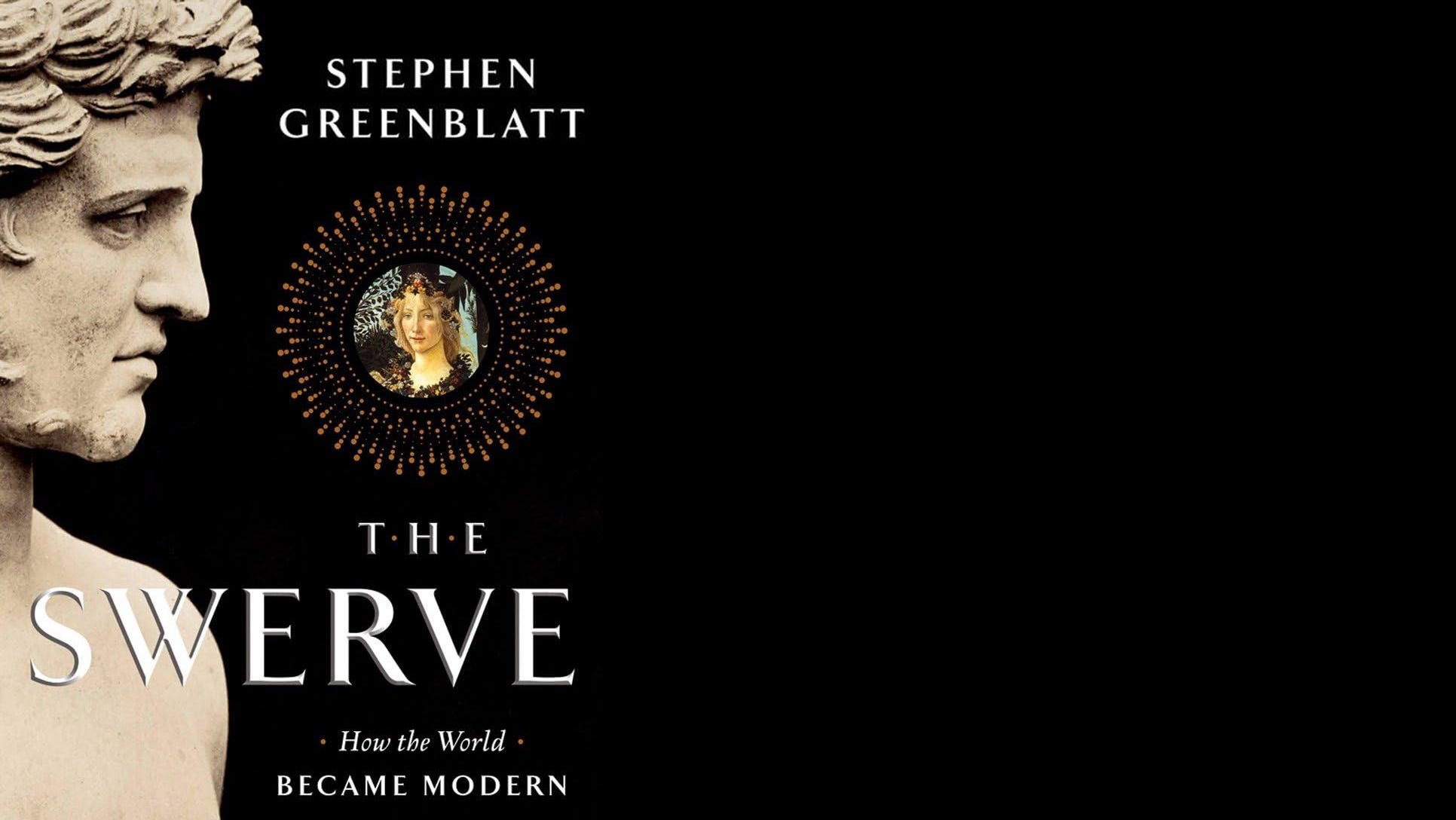
I’ve talked about both obscure old editions of Epicurean primary sources and about well-done modern treatments of Epicurean ethics for general audiences, but neither of these genres of books has commanded truly widespread public attention. Actual philosophy books don’t win the latest prizes and climb the bestseller lists. But one Epicurean-adjacent book did do so in recent memory: Stephen Greenblatt’s 2011 volume The Swerve: How the World Became Modern. The book was very popular, rather contentious, and takes as its premise the idea that the rediscovery of Lucretius’ On the Nature of Things constituted a crucial turn away from a long shadow of superstition towards modernity. It’s a bold and valuable thesis that ruffled lots of feathers in a way that epitomizes the still vivid emotions that Epicurean ideas can still provoke.
First, let me outline what The Swerve actually covers. The central through-line is a narrative of how the Renaissance humanist Poggio Bracciolini uncovered a copy of Lucretius’ On the Nature of Things in a remote monastery in 1417, thereby reintroducing it to the learned world after centuries of invisibility, during which it lingered unread in a handful of monastic libraries. (Additional manuscripts were found later.) Along the way, Greenblatt tells stories of Bracciolini’s years of papal service, provides historical background of and a philosophical introduction to Lucretius, and traces the influence of the poem in the subsequent centuries after its rediscovery.
The Swerve is an undisputed success in several respects. The story is engaging and well-written, turning what could easily have been dry historical content into a lively, readable narrative populated by a host of vivid characters. This basic verve and storytelling panache are probably big elements in its National Book Award and Pulitzer Prize accolades. I think it’s also fairly uncontroversial to acknowledge that Greenblatt’s book is an intentionally popular tome—it isn’t a formal or comprehensive study, and so readers should expect some simplified narratives, modest levels of footnoting, and yes, some degree of “shallowness” compared to a more hefty academic work. For some readers, this is a limitation. For others, it means it’s an engaging and approachable work.
In the eyes of some academics, however, Greenblatt goes beyond mere simplification in his quest for popular readability and actual distorts the history—this was the book’s first level of controversy. I am no expert on the Renaissance or Middle Ages, so I can’t really pass definitive judgment on the severity of Greenblatt’s scholarly sins, but I did take a look at some of these critiques. My impression is that some of them are clearly over the top (Laura Miles calls the book’s portrayal of the Middle Ages an “abuse of power”), and some are probably a little on the harsh side (John Monfasani termed it “entertaining but wrong-headed”), while more balanced accounts seem to recognize positive and negative aspects to Greenblatt’s approach. Colin Burrow’s take seems about right to me:
… A dazzling retelling of the old humanist myth of the heroic liberation of classical learning from centuries of monastic darkness... This book makes that story into a great read, but it cannot make it entirely true.
Greenblatt joins his protagonist Poggio in proudly proclaiming the value of learning and antiquity against a medieval culture that placed less value on those things, and which definitely did at times suppress scientific inquiry in the name of Christian theological dogma. Although there undoubtedly were still some men of learning and scientific advances, as the offended medievalists points out, Greenblatt is correct in noting that texts were lost and veins of inquiry were deemed off limits during the period. Responding to his critics, he concisely summarizes his position as simply believing “that something significant happened in the Renaissance.” If one goal of the book is to teach historically-uninformed general readers something about the time period in the course of an entertaining reading experience, this doesn’t seem like the worst or most misleading takeaway.
Then there is a second battlefront. Somewhat aside from that sectarian battlefront of medievalists versus Renaissance afficionados is the deeper conflict between defenders of organized religion and scientific secularism. Greenblatt’s narrative makes many different passing critiques of the world of 15th century Christianity, accusing the religious community of passive ignorance, active scientific suppression, flagellatory fanaticism, widespread hypocrisy, and deep corruption in the formal bodies of the Catholic Church. Some contemporary Christians took this personally. One widely read iteration of this critique came from Jim Hinch in the Los Angeles Review of Books:
The Swerve presents itself as a work of literary history. But really it is a salvo in the culture wars; an effort to lend an aura of historical inevitability to the idea that religious faith has no place in a modern democratic society.
In the ancient world, Epicurus and Lucretius lamented the pervasiveness of false ideology and dogmatic ideas about how the world works that had no basis in rational inquiry. Their rejection of divine order, life after death, and all the rest made them unpopular with Platonists, Stoics, and Christians, leading to the loss of many texts. In the Renaissance, the conflict between scientific materialists and dogmatic idealists continued. And in our contemporary setting, such disputes still carry on, with organized religion attempting to defend a shrinking patch of land as the world grows less and less convinced by biblical accounts of the past and future. In this ancient war of ideas, Greenblatt is firmly on the side of Lucretius, the Renaissance, and modern secularism. Some people really don’t like that.
Personally, I don’t really embrace a straightforward identification of Epicureanism with any side in contemporary culture wars. We are against superstition and fantastical accounts of how the world works, but we are not opposed to traditionalism, the comfort of old forms, or social order more broadly. We think that societies naturally form their own conventional virtues and that those virtues by-and-large are good. We aren’t particularly enthused about overthrowing the established order—what we want is to free individual minds from their burdens of unnecessary fear, guilt, and illusion into a life of constructive prudence and stable pleasures.
So, does The Swerve fall more into that old Epicurean model, or more into the role Hinch claims, that of a contemporary culture-war diatribe? I think the former. Greenblatt’s book is not particularly bashing traditionalism or modern conservatism. It is fighting against the same old and harmful illusions that were prominent in 1400 and which still survive today. What The Swerve does is to take a medieval detective story written for popular audiences and stick a well-written summary of Lucretian science that foregrounds the ethical implications right in the middle. Chapter Eight, “The Way Things Are,” gives a first-rate modern paraphrase of twenty vital claims of Epicurean science that largely continue to stand up today, things like:
Everything is made of invisible particles, essentially indestructible, which are combined in different ways to form the objects of our perception.
The universe has no creator or designer. All living beings have evolved through natural trial and error. The world was not created for humans and humans are not unique.
The soul dies, there is no afterlife, and death is nothing to us.
Organized religions are founded on superstitious delusions (there are no angels, demons, or ghosts) and rely on stories and structures of cruelty. They valorize completely unnecessary sacrifice, retribution, and anxiety.
Pleasure is good. Pain is bad.
The quest for knowledge is not contrary to God. A truer understanding of the world does not produce heresy, but wonder.
As a comprehensive account of how the Renaissance differed from the Middle Ages, I am quite willing to grant that The Swerve streamlines and simplifies, omitting nuance in favor of catchy narrative. That’s what I would expect from a Renaissance literature scholar aiming at the best-seller market. It’s solid entertainment and passable history. But from an Epicurean perspective, I would say that the relevant goal of the book is simple and successful: it argues that ideas like those listed above represent highly contested ground in the historical war of ideas, that the Epicureans were the wise people whose accurate insights on these topics were buried for centuries, and that the recovery and promulgation of those truths is a still-ongoing project.
If unsuspecting readers looking for an engaging historical yarn walk away with that insight—that ancient Epicureanism first formulated the truths so many live by today, in a coherent and convincing philosophy of happiness that is still available to us—then The Swerve will have accomplished something far more valuable than the average work of pop history.
This is the book that started me on the path of Epicurean studies years ago. Whether or not it was entirely historically accurate didn't really bother me. Previously my only knowledge of Epicurus and his teachings was through a modern Stoic lens, so you can imagine that my opinion of this philosophy was neither informed or positive. The Swerve was the first nail in the coffin of my brief enchantment with Stoicism, and reading the extant writings of Epicurus as well as writings by modern Epicureans buried it completely.
It seems to me the biggest problem with the book is that it exaggerates the impact of the discovery of Lucretius's book. The Renaissance was (in part) set off by the "crise pyrrhoniane" - the Pyrrhonian crisis resulting from the discovery of the works of Sextus Empiricus. There was no corresponding Epicurean crisis.
That's not to say that Lucretius wasn't important. It was major. But it was in no way solely responsible for the Renaissance.