
Principal Doctrines 1–4
1. The blessed and incorruptible experience no disturbance, nor do they cause disturbance in others. Such natures are therefore not affected by either anger or gratitude, for all such feelings belong only to weaker and imperfect creatures.
2. Death is nothing to us, for what has been dissolved is incapable of sensation, and a state without sensation is nothing to us.
3. The greatest magnitude of pleasure possible is the removal of all suffering. And if our present state is pleasurable, then we are not experiencing pain, nor distress, nor both together.
4. Pain does not afflict the body continuously: either it has peaks that last only for the briefest moment, or it barely exceeds our baseline of pleasure and lasts for a matter of days. The long-lasting forms of sickness, meanwhile, allow more pleasure than pain to the body.
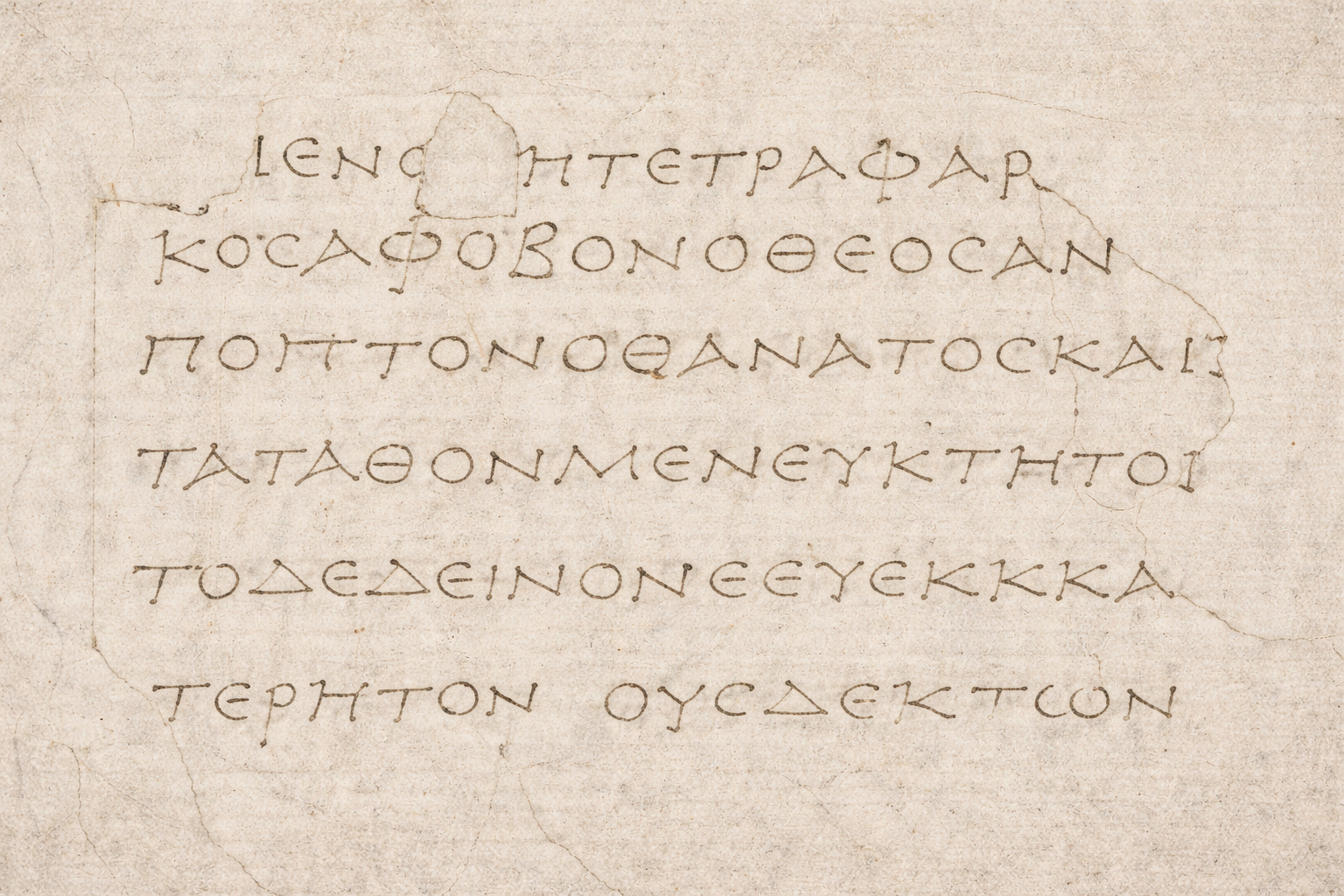
The tetrapharmakos
The gods are not frightening.
Death is nothing to worry about.
The good is easy to obtain.
The bad is easy to endure.
Commentary
Each Tuesday, I will present a text from classical Epicureanism, freshly translated into English and accompanied by commentary elucidating its philosophical significance, highlighting its implications, and addressing any controversies of interpretation. For our initial installment of Tuesday Translations, it makes sense to start at the beginning, with the first four of Epicurus’ forty Principal Doctrines (or Kyriai Doxai), along with their even briefer summation known as the tetrapharmakos, or Fourfold Remedy.
For those unfamiliar with Epicureanism, or who have only heard my opening pitch for Why You Should Be an Epicurean, these four maxims can seem underwhelming or opaque. If you are, say, a healthy young atheist with no chronic pain who rarely thinks about death, they may seem like a combination of irrelevance and technically dubious ideas about pleasure and pain. Is this really the core of Epicurus’ notorious egoistic hedonism?
In part, I can see where such reactions are coming from—for those who don’t worry much about the gods or death, the first two maxims may seem like irrelevant relics, and Epicureanism will have more interesting things to say to you in future installments on pain, pleasure, desire, prudence, egoism, hedonism, friendship, and more. That doesn’t mean that Principal Doctrines 1 and 2 should be dismissed. If fears of god and death do not afflict you, then you should recognize to what degree Epicurus has already won the argument—over 2000 years ago, he pioneered the claims leading to the greater peace of mind you enjoy today.
But that’s getting a little ahead of myself. Let’s briefly go through these famous first four sayings and reckon with their profound implications.
1. The blessed and incorruptible experience no disturbance, nor do they cause disturbance in others. Such natures are therefore not affected by either anger or gratitude, for all such feelings belong only to weaker and imperfect creatures.
This maxim is generally taken to summarize Epicurus’ views of divinity, which have been the subject of much debate over the ensuing millennia. On the surface, Epicurus says outright that “gods exist” (Letter to Menoeceus 123). However, he has often been accused of atheism, because he denies many of the traits and behaviors that popular religion has often ascribed to the gods (or God): according to him, if we actually believe in gods that are perfect and immortal, then we have to understand such beings as utterly imperturbable by any trivial little human misbehaviors or requests. Why would a perfect god feel any compulsion to punish you in an afterlife, or feel offended if you didn’t present the right offerings and sacrifices? Variations on such queries have vexed many religious minds over the years—why would a just and perfect God allow cruelty and injustice to exist?
Epicurus’ answer is that the gods must exist in complete independence from all earthly activity, uninterested in the punishment and reward of human beings. In a future installment, I’ll dive deeper into the debate over whether Epicurean gods actually exist or are merely an ideal, spoken of in literal terms to avert contemporary censure or persuade the religiously committed. For now, Epicurus’ main assertion is simple: there is no good reason to believe that there are gods who can be angered or appeased by anything we do.
2. Death is nothing to us, for what has been dissolved is incapable of sensation, and a state without sensation is nothing to us.
Epicurus believes there is no afterlife: our existence is entirely material, and when we die, the atoms that make up our being will be dispersed and no longer capable of sensation. Death should not be thought of as a fearful or painful state, but simply as neutral nonexistence, holding a position in our understanding equivalent to our nonexistence before birth.
Much more can and will be said about Epicurus’ therapeutic techniques concerning death, but this is the core teaching that denies one of the most prevalent fears on the subject—that we will be subject to an afterlife of punishment, reward, or eternal dissatisfaction. In today’s more secular world, many people don’t go through life oppressed by fears of eternal hellfire, instead assuming that existence will simply cease. If you are in this camp, welcome—you were already half-Epicurean, even if you were unaware of the fact.
3. The greatest magnitude of pleasure possible is the removal of all suffering. And if our present state is pleasurable, then we are not experiencing pain, nor distress, nor both together.
This maxim contains two claims, both of which can seem dubious to modern ears. Can’t we be in a painless state, and then experience more pleasure? If we are handed a delicious beverage or are informed that our bank account has just received an anonymous donation of a million dollars, won’t we experience pleasure? Meanwhile, aren’t mixed states possible, where we experience physical comfort, but have some nagging worries, for instance?
What Epicurus is doing here can be thought of as introducing more productive ways of thinking about pain and pleasure. His doctrines run counter to our normal, everyday way of talking about these words, but that isn’t a fault, or evidence of error—revising our standard thinking is the point. For now, set aside questions of absolute proof—discussion of that will come later—and instead consider how thinking in Epicurean terms would affect your typical perspective, decisions, and results.
In the first claim, Epicurus encourages us to think of pleasure in terms of the removal of pain. If we enjoy a beverage, we must be experiencing the pain of thirst—if we have no thirst at all (or any fear of future dehydration), then drinking will bring us no pleasure. If more money makes us happier, then it does so because we think it will alleviate some lack we are currently experiencing or fear experiencing in the future.
When we break down our desires into their most fundamental components, we will often find that they can be alleviated very simply (thirst is alleviated by water) or that some actions may not be productive towards our underlying goal (we often think money enhances security, but sometimes it attracts envy while being dissipated in pointless consumption, for instance). There will be more on this subject to come.
Epicurus’ second claim can easily seem unclear, especially in more literal translations. Inwood and Gerson, for instance, translate this passage as “Wherever a pleasurable feeling is present, for as long as it is present, there is neither a feeling of pain nor a feeling of distress, nor both together.” I think Norman DeWitt is correct in interpreting this maxim as an Epicurean version of what will come to be known as the “hedonic calculus” of the Utilitarian tradition:
Epicurus implies instead and elsewhere teaches [in the next maxim, in fact] that pain is subtractable from pleasure, leaving a balance of the latter.
A few more words would make this more obvious, without, I think, diverging from Epicurus’ intended meaning:
And if our present state is pleasurable [on net], then [we should consider that, on balance,] we are not experiencing pain…
The reason these two claims go together should now be clearer: both suggest, first and foremost, that pleasure and pain can be conceived as positive and negative values that can be compared to derive an overall state of pain or pleasure. What Epicurean hedonism means by “pleasure” primarily is pain alleviation. The other implication of this second claim is a bias towards a positive balance of pleasure over pain: Epicurus believes our normal state of health is a pleasurable one and encourages us to retain a perspective of contentment whenever our current balance of pleasure over pain is positive—our typical state, and a very achievable goal.
4. Pain does not afflict the body continuously: either it has peaks that last only for the briefest moment, or it barely exceeds our baseline of pleasure and lasts for a matter of days. The long-lasting forms of sickness, meanwhile, allow more pleasure than pain to the body.
Here, again, some modern sticklers will find reason to quibble. Presumably it is technically possible to suffer from a terrible chronic illness, in which condition every day is intensely painful and yet life continues for years. Fine—revise the maxim to “Pain does not typically afflict the body continuously” if you want. I think Epicurus’ advice as to a healthy perspective on normal discomforts remains sound.
Is your pain intense? It will abate soon. Is your pain not at a sharp peak, but still resulting in a negative balance? It will also abate soon, though perhaps on a pace typically measured in days or weeks rather than seconds or minutes. Do you have a long-lasting sickness? Then you are evidently living with it, and you should not cease from enjoying the pleasures that life still has to offer.
If anything, I would argue that modern medicine makes Epicurus’ advice more applicable today. Our ability to alleviate pain has greatly advanced and peaks can now be dulled, while our ability to address root causes has also advanced. Epicurus died of some kind of bladder stone, which caused him intense pain, and yet still found his dying weeks to be on balance happy. Today we could prevent most of that pain and our road to happiness is even easier.
Finally, the tetrapharmakos:
The gods are not frightening.
Death is nothing to worry about.
The good is easy to obtain.
The bad is easy to endure.
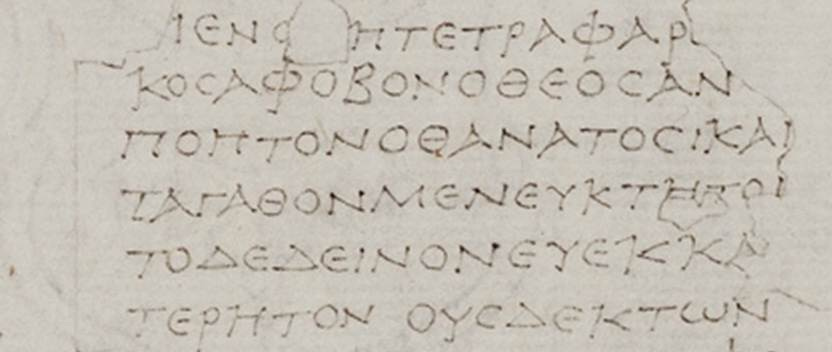
A scrap of papyrus has survived from an ancient library at Herculaneum, covered in lava during the eruption of Mount Vesuvius in 79 C.E. Deciphering the charred remains, scholars uncovered a brief passage described as the τετραφάρμακος, or fourfold remedy. These four lines are thought to be a mnemonic device devised by later Epicureans that summarize the first four Principal Doctrines, dealing in the most compressed form possible with their four respective subjects: the gods, death, pleasure, and pain. It should not be taken as a substitute for the detailed philosophical arguments that Epicurus made, but rather as a useful tool to help a student remember and internalize the core tenets of the school.
Read the complete series on the Principal Doctrines here.
Original Texts
Κύριαι Δόξαι
1. τὸ μακάριον καὶ ἄφθαρτον οὔτε αὐτὸ πράγματα ἔχει οὔτε ἄλλῳ παρέχει, ὥστε οὔτε ὀργαῖς οὔτε χάρισι συνέχεται· ἐν ἀσθενεῖ γὰρ πᾶν τὸ τοιοῦτον.
2. ὁ θάνατος οὐδὲν πρὸς ἡμᾶς· τὸ γὰρ διαλυθὲν ἀναισθητεῖ· τὸ δʼἀναισθητοῦν οὐδὲν πρὸς ἡμᾶς.
3. ὅρος τοῦ μεγέθους τῶν ἡδονῶν ἡ παντὸς τοῦ ἀλγοῦντος ὑπεξαίρεσις. ὅπου δʼἂν τὸ ἡδόμενον ἐνῇ, καθʼ ὃν ἂν χρόνον ᾖ, ουκ ἔστι τὸ ἀλγοῦν ἢ λυπούμενον ἢ τὸ συναμφότερον.
4. οὐ χρονίζει τὸ ἀλγοῦν συνεχῶς ἐν τῇ σαρκί, ἀλλὰ τὸ μὲν ἄκρον τὸν ἐλάχιστον χρόνον πάρεστι, τὸ δὲ μόνον ὑπερτεῖνον τὸ ἡδόμενον κατὰ σάρκα οὐ πολλὰς ἡμέρας συμβαίνει· αἱ δὲ πολυχρόνιοι τῶν ἀρρωστιῶν πλεονάζον ἔχουσι τὸ ἡδόμενον ἐν τῇ σαρκὶ ἤ περ τὸ ἀλγοῦν.
τετραφάρμακος
ἄφοβον ὁ θεός,
ἀνύποπτον ὁ θάνατος,
καὶ τἀγαθὸν μὲν εὔκτητον,
τὸ δὲ δεινὸν εὐεκκαρτέρητον.