
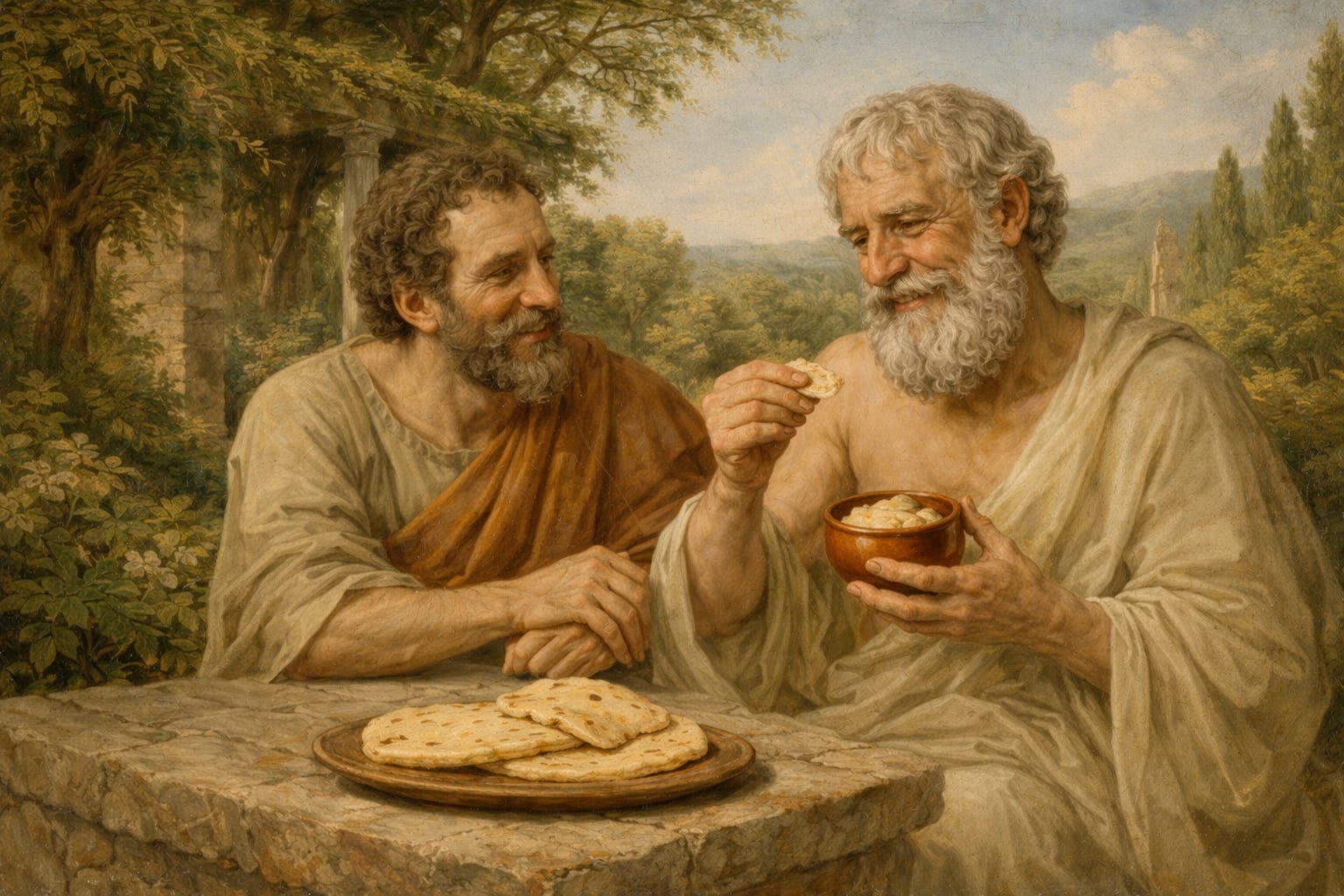
A philosopher’s words are empty if they do not assuage human suffering.1
Philosophy can be a very useful thing. It can help you to understand the world accurately and live a good and happy life. I believe that one ancient school of philosophy answers the most important questions better than any other unified ethical system that I am aware of and is now due for a revival in widespread popularity. That philosophy is Epicureanism.
The Greek philosopher Epicurus formulated these principles at his school known as the Garden, founded outside of Athens around 306 BCE. Why would a modern human being follow the teachings of an ancient Greek philosopher? Because they are correct, or more precisely, because they work—the principles laid out by Epicurus and his followers form a supremely useful guide to a less troubled and more joyful existence.
In future posts, I will explore a great many questions one could pose about this philosophy: Can a philosophy of hedonism—even a moderate, prudential type of hedonism such as this—really be the best way to achieve happiness? How does Epicurus respond to those who think that our personal happiness shouldn’t be our primary goal? And what does living as an Epicurean actually look like in the real details of modern life? I’ll consider all of these questions in the future, sharing philosophical essays, new translations and commentaries, and concrete proposals for what living as an Epicurean might look like today.
For now, I’ll start with an overview of one big question and this philosophy’s answer: what is the best way to achieve happiness? Epicureanism’s core advice can be divided into three parts: what it suggests we avoid, what it suggests we aim for, and how it suggests we approach the pursuit of our true good.
What to let go of: diminish fears and desires
Unhappiness is caused by fears, or by endless and empty desires, but he who is able to rein these in creates for himself a blissful understanding.2
Epicurus identifies two main sources of discontent: fear and unsatisfied desire. Unlike modern consumerism—which generally amplifies every passing impulse or aversion—he recognizes that “reining in” our feelings is a more fruitful path to happiness. Unlike the Stoics—who teach that all fears and other emotional responses are subject to rational control and that nothing should be desired except virtue—he believes that fears can often be addressed through prudent action and that many desires are perfectly natural and lead to benign sources of pleasure. Epicureanism therefore strikes a wise and humane middle ground between taking pragmatic steps to achieve security and adjusting our thought patterns when our fears or desires are misplaced.
Consider fear. In the ancient world, Epicureans spent a great deal of energy combatting “superstition,” which included things like fears of punishment in the afterlife or beliefs that celestial phenomena indicated divine displeasure. Many people still have similar worries: if you are suffering from religious guilt, believe in astrology, or ever find yourself cursing some more colloquial version of fate’s antagonism towards you, Epicurus would tell you to stop. These are not reasonably grounded fears and you are causing yourself unnecessary pain.
Other fears originate in real risks to our well-being. Violence and dangers do exist, crippling poverty would be bad, and our health is not invulnerable. It therefore makes sense to avoid conflict, provide for the future, and avoid self-destructive habits, for instance. Most of us understand this common-sense conception of fear as a response to dangers, the factual amelioration of which would be good.
Fortunately, the dangers have gone down! The world is safer, richer, and longer-lived than ever before, so it would make sense for fear and anxiety to also be at historically low levels. Unfortunately, our feelings don’t always match these facts. Consider the most anxious worrier and complainer you know—don’t you think she makes things harder for herself than she has to? Match your fears to reality. To a practiced Epicurean, everyone seems to be worrying excessively.
Many of our desires stem from fear—consider the popularity of security cameras, health supplements, and ever-growing bank balances. Some other desires, it may be argued, are simple: maybe someone wants to buy fancy food, fancy clothes, and a fancy car not because of any inner insecurity, but for the pure pleasure of their ownership. (In reality, motives are often mixed, but positively hedonistic pleasures certainly exist.) Here also, Epicurus’ advice is pragmatic and prudential rather than ideologically chastising. How great is the pleasure you obtain from those things? What does it cost you, all things considered?
Money is one of the most obvious costs: money requires work and many people work more than they would like to—maybe if you needed less money, you could work less, retire sooner, or choose a more enjoyable occupation rather than the most lucrative. So it’s worth asking: how closely does expense correlate with pleasure? I rarely buy expensive cheeses, because I enjoy cheap cheese quite a bit. I never buy fine wine, because the $4 bottles seem quite adequate. You’ll probably enhance your total pleasure more by considering factors besides maximizing consumption, Epicurus would suggest: making good use of your leisure time, achieving greater peace of mind, and finding good company with whom to share your life.
Diminish your fears, whether they are outright superstition or merely exaggerated images of reality, amplified by media, marketing, or popular opinion. Diminish your desires: they are a poor guide to what really brings pleasure, distorted as they are by all the same forces. And do both of these things, not through a guilt-driven process of self-flagellation, nor through a hyper-rational lens that denies the existence of fear or desire, but through undogmatic pragmatism and general reasonableness in your weighing of pros and cons.
Phronesis, the Greeks call it—“practical wisdom.” Epicureanism is the tradition that elevates phronesis above philosophy itself, because reasonable calculation is more helpful to one’s happiness than complex and arcane theory, more helpful than impossible ideals or worrying about fictitious afterlives.
What to hold on to: better pleasures
The good is easy to obtain.3
If you have heard a very little about Epicureanism, you might associate the philosophy with hedonism, the pursuit of pleasure. Which might leave you a little confused about the sections above recommending the limitation of desires and the avoidance of fancy wine. The answer is that both “hedonist” and “Epicurean” itself are frequently misused in general conversation: Epicureans are hedonists, but prudential hedonists, who recommend weighing the potential pains of a course of action against the pleasure it offers. On the simplest level, this means that they counsel against overeating, for instance, because even though food tastes good, the aftereffects of excessive consumption are unpleasant. Such estimations of net pleasure, as suggested above, often result in Epicureans advising not to pursue many things commonly thought of as pleasurable.
Fortunately, there are many pleasures that clearly exceed their accompanying or prerequisite pain. On the simple level of physical necessities, what our bodies actually want is very limited: not to be hungry, not to be thirsty, not to be cold. You may think this a very meager standard of existence, but it also has a lot of truth to it. Put in a hard day’s work of outdoor labor and a drink of cool water will be an intense delight. Come in out of the cold to snuggle in a cozy home, and you won’t care if it’s a cheap apartment with cheaper furnishings. More pleasure comes from the easy-to-obtain basics than from the extravagant upgrades, and their recognition of this fact means that Epicureans are far more enthusiastic enjoyers of the simple pleasures of life than are ascetically-inclined Stoics or Puritans. To my knowledge, Epicurus is the only ancient philosopher from whom we have letters recording his fondness for cheese.4
For Epicureans, the most valuable pleasure of all is that of friendship (including with spouses and family members). The company and conversation of like-minded individuals is worth more than any stuff. And the “cost” of friends is negative—their support adds to, rather than subtracts from, the total peace and security of our lives.
The nature of these approved pleasures—freedom from physical pain, simple food, security-enhancing friendship—points towards a core tenet of Epicureanism: the state of mind to aim for is not a constant bliss or euphoria (an impossible goal), but tranquility and peace of mind. The Greeks called this ataraxia; one who obtains this state is ataraktos, or untroubled. A person can increase their approach to ataraxia by discarding irrational fears and unsatisfiable desires, while practicing prudence, cultivating friendship, and focusing on easily obtained pleasures.
To some people, used to extravagant hopes of success, wealth, fame, or similar goals, mere tranquility can seem rather staid and unexciting. In reality, however, most people pursuing wealth and fame don’t achieve them, and even the wealthy and famous don’t tend to achieve a blissful and unworried existence. The most accurate frame of reference for evaluating the Epicurean goal of tranquility, therefore, is not what is promised by conventional standards, but what is delivered.
The actual state in which many people live is, to greater or lesser degree, one filled with worries, ground down by anxiety, and worn out with striving after always receding objects. Epicureanism promises peace of mind and a world of daily pleasures. Those pleasures aren’t based on fulfilling difficult-to-achieve desires sometime in the future, but are instead available right this instant.
Consider an illustrative example: I enjoy looking at birds. They are everywhere, they look pretty, they sing, they fly, and they do all kinds of interesting things. I can recognize many birds by sight or sound, and so any walk outside is filled with constant little points of interest. All birdwatchers are familiar with this phenomenon: they notice little things that other people don’t and derive pleasure from them, simply because they are used to paying attention to birds and feeling grateful when some unexpected piece of pleasure flies into view.
That’s how the whole world is to Epicureans. We practice enjoying all the tiny things of life—a sunny day, a simple meal, a smile. Tagathon euporiston, we say—the good is easy to obtain.
The strategy: develop practical wisdom, follow nature
I believe Epicureanism correctly guides us away from detrimental goals and behaviors and suggests alternative, more rewarding objects for our endeavors. Simply choosing the right ambitions will greatly increase your odds of success! But Epicurus also offers extremely wise advice on how to pursue these goals. Two maxims encapsulate his often-underrated approach:
The greatest good is practical wisdom.5
Nature cannot be forced, but must be persuaded.6
Many philosophical schools of thought or venerable religious traditions seem to ignore these points. They will debate ethical behavior while ignoring the fact that many people’s efforts to obtain happiness are hindered more by poor calculation and a lack of long-term prudence than erroneous ethical theory—basic principles like “it is unwise to fund your consumer habits with high-interest credit card debt” is not very interesting to philosophers, but consistent application of that guideline would help a great many people avoid real distress. Others will insist that “human nature” is fundamentally flawed, and that considering its limitations constitutes a logical fallacy when it comes to determining truly ethical behavior.
Epicureans don’t make these mistakes. They focus constantly on the prudential, recognizing that people often don’t achieve what they aim at, not due to some moral failing, but due to a lack of big-picture thoughtfulness. What is needed is not more theory or moral chastisement. What is needed is a little basic knowledge and calm consideration of the most helpful course of action. Epicureanism is practical.
And even ancient Epicureans have an understanding of human behavior that seems strikingly modern and evocative of contemporary evolutionary biology, an understanding that grapples with the basic truth that we are animals like any other, subject to basic biological impulses that cannot be erased by our more developed reasoning abilities. Forcing ourselves to act against our nature is very difficult, but it is possible for us to be persuaded as to what is true and reasonable. We cannot simply declare our fears and desires nonexistent, but we can analyze them, make their illogicalities stand out, and point out better alternatives. Moral standards that push directly against all our instincts are often doomed to fail. Epicureanism is realistic.
And that means that it works. In the years since I began seriously studying and practicing this philosophy, I have found that I have grown happier and happier. While other ancient philosophical schools are dominated by arcane debates about fantastical nonsense (see Plato’s Theory of Forms), or have a well-founded reputation for coldness and a nature-denying disconnect from human reality (see Stoicism), Epicureanism is marked by an attitude of warmth, friendliness, and conviviality. Members of the Garden had friends and families. Wives, courtesans, and slaves were welcome to participate. Epicureans enjoyed feasting on the 20th of every month (with cheap food and wine, of course).
Plato’s Academy stressed geometry. Stoicism required students to practice imagining the death of their family members. Epicureans had picnics. Which philosophy do you think is most likely to promote a joyful existence?
Different wisdom traditions rise and fall in popularity. The great monotheistic religions are now in decline in most parts of the world, in large part because much of their teachings are grounded in stories that modern science tells us simply cannot be true. And so I think the time is now right for the revival of an ethical teaching that does not posit any divine interference in the world or depend on claims about an unknowable afterlife. The time is right for a teaching that properly values practical wisdom and tries to work with our evolved human nature, not against it. Epicureanism is such a tradition.
To avoid unhappiness, recognize unfulfillable desires and practice prudence.
To enjoy the good, appreciate what you have and cultivate friendship.
To change your way of thinking, don’t fight against nature.
Epicurus, Usener fragment 221. All translations are my own. Many “quotes” from Epicurus were somewhat speculatively attributed to him in a landmark 1887 tome called Epicurea by Hermann Usener (this quote, for example, is from Porphyry’s Letter to Marcella and may be a paraphrase, or a quote from a follower of Epicurus, rather than the exact words of the main man). Usener’s numbered fragments are still the standard means of reference.
Usener fragment 485
A classic Epicurean maxim; I came across it in this condensed form (ταγαθόν εὐπόριστον) in Carlo Diano’s 1967 essay “Épicure: La philosophie du plaisir et la société des amis” but see Letter to Menoeceus 133 for the elaborated version or the tetrapharmakos for a very similar rendering.
Diogenes Laertius X.11
Letter to Menoeceus 132
Vatican Saying 21