
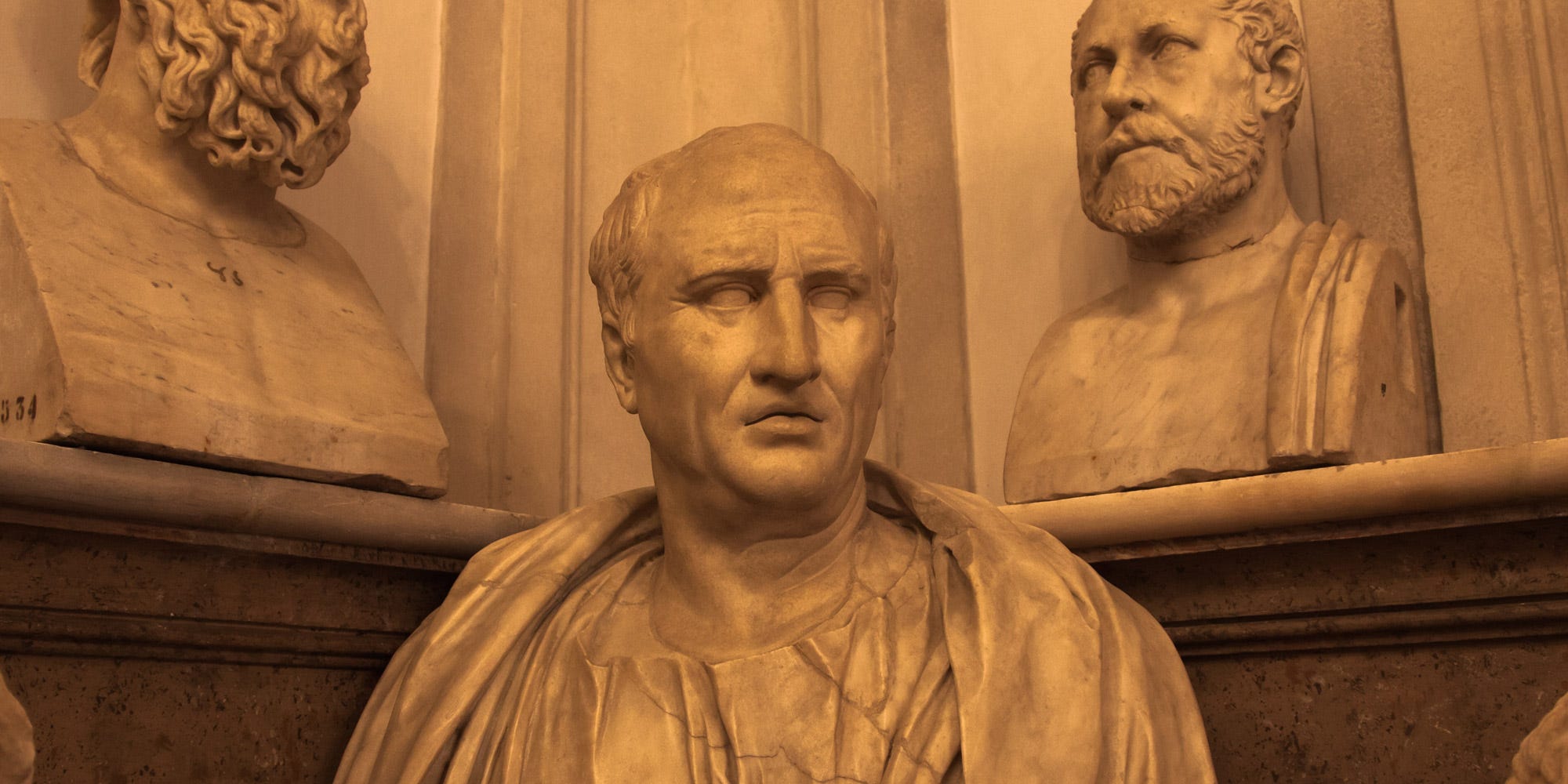
Cicero’s On Moral Ends (De Finibus) is an important source for Epicurean ethics, despite the fact that Cicero views our school quite unsympathetically. The work is in dialogue form, with the first of its five books largely dedicated to a speech by the Epicurean spokesman Torquatus. This passage is arguably the most extended, continuous exposition of Epicurean ethics that we have, and is generally accurate and well-informed. Book 2 of On Moral Ends, however, is where Cicero offers his own criticisms of Epicurean ethics. He has a lot to say.
I think it’s helpful to read both one’s philosophical allies and critics, so today I’ll be diving into all the things Cicero thinks are deficient in the Epicurean ethical system. Cicero is famously a man who loved to hear himself talk, so I won’t be able to address every one of his complaints. (They come pretty flying out at a pretty furious pace for about 40 pages, in response to Torquatus’ 12 pages of exposition.) What I’ve done instead is to pick out ten of his arguments that seem to be both significant to Cicero and routinely encountered among Epicurean critics down to the present day. If people have found the same things objectionable for 2000 years, then those points should probably be carefully considered and addressed.
At the end of Book 2, Torquatus says that he would like to consult Philodemus and Siro before responding to Cicero. Unfortunately, we don’t get to hear how contemporary Epicurean teachers would have answered these charges. We’ll have to make do with me.
1. Pleasure and absence of pain are different.
I would claim that Epicurus himself does not know what pleasure is… Everyone agrees that the Greek word hedone and the Latin word voluptas refer to an agreeable stimulus that gladdens the senses… you must surely concede that “pleasure” has a different meaning from “not being in pain.” (2.6–9)1
I would concede that in normal, casual use, “pleasure” and “absence of pain” typically refer to different things. However, it is very common for philosophers to use words in more precise and specific ways than we customarily do. Even Cicero acknowledges this when it suits him: “Philosophy is the art of life, and it cannot take ordinary language as the basis for its discussions,” he writes in the introduction to his account of Stoicism (3.4). To be a meaningful objection, then, I think one would have to argue that Epicurus’ deemphasizing of this distinction (he certainly still uses both the words “pleasure” and “removal of pain” when differentiation is useful) is pointless, confused, or unhelpful.
Personally, I think Epicurus’ point is a good one, and far from totally divorced from common sense. People enjoy receiving “agreeable stimulus,” certainly. But they also enjoy the alleviation of pain. The two phenomena often are joined in a single decision-making context, from the most simple (we stop putting pleasant-tasting food in our mouths if the discomfort of overeating becomes apparent) to the more long-term (we do unpleasant diet and exercise in order to access the pleasures of health, fitness, or feeling more attractive). It would be very strange to say that people should only consider one side or the other of such equations, and so putting pain down as a negative quantity of pleasure has become a standard philosophical practice running through the entire Utilitarian tradition.
2. Psychological hedonism is a bunch of hooey. Contrary to Epicurus, infants and animals don’t always seek pleasure, and neither do mature humans.
What a nest of fallacies! … In fact the young are not moved by nature to seek pleasure but simply to love themselves and to wish to keep themselves safe and sound. (2.32–3)
Even in the case of the animals, there are many activities that their own natures guide them to perform where it is readily apparent that their aim is something other than pleasure. Consider the devotion they show in giving birth to and rearing their young. (2.109)
When [Publius Decius] charged at the massed Latin ranks, entrusting himself to death and setting his horse at a gallop, did he have any thought of his own pleasure? Where and when would he enjoy it? He knew he was to die at any moment. (2.61)
Epicurus liked to demonstrate that pleasure (and the avoidance of pain) were universal and innate objects of pursuit by pointing to infants and animals. Cicero doesn’t buy it, but instead asserts that infants are motivated by a distinguishable phenomenon of self-preservation, while numerous animals demonstrate supposedly altruistic behavior. As with the previous criticism, such arguments reflect Cicero’s desire to reduce “pleasure” down to the most narrow usage of common language. Here, however, he portrays this as an objection to the substance of Epicurus’ doctrines, rather than just a quibble over his use of words. In reality, it’s still the latter.
One could say that “self-preservation” is a goal of evolution. Epicurus wouldn’t argue with that. But he would argue that sensations of pleasure and pain are the mechanism by which we are steered to self-preserving behaviors. If an infant feels pain, it cries. This brings assistance, which aids self-preservation, but that doesn’t mean it wasn’t responding to pain. An infant drinks milk because it’s pleasurable. This is undoubtedly good for its self-preservation, but again pleasure was the signal. Animals protect their young. This is good for ensuring their genetic survival, but they aren’t calculating that benefit—they feel a shock of painful fear when a predator threatens their offspring and feel an urge to alleviate that emotion.
Cicero’s citation of a Roman soldier facing certain death is responding to an earlier exchange with Torquatus, the Epicurean spokesman of the dialogue. Torquatus explicitly addressed such scenarios, arguing that instances of risky military valor must have offered counterbalancing pleasures such as the prospect of glory or avoiding the shame of not doing one’s duty (1.35). Cicero the writer is therefore aware of the basic structure of the Epicurean response, but insists that glory and shame are inherently non-hedonistic motives. He prefers to view such behaviors as the product of self-evident, intrinsic virtue. I think this introduces far more questionable premises compared to an evenhanded comparison of psychological urges.
More on the virtues below. More on psychological hedonism here.
3. Epicurus gets even basic, obvious things about pleasure wrong. Everyone knows that longer periods of pleasure are better and that more expensive things give more pleasure.
If one believes that the happy life is constituted by pleasure, then one cannot consistently maintain that pleasure does not increase with duration, or else the same will apply to pain. (2.88)
“The cheapest things provide just as much pleasure as the dearest”[Epicurus] cries. The man must have lost his taste as well as his wits. (2.90)
For some reason, Cicero is happy to grant (in the same passage) the Stoic contention that once complete virtue is achieved, it gains nothing from temporal extension. I don’t know why he is unable to grasp Epicurus making a similar distinction between the magnitude of pleasure and the duration of pleasure. We consider it an inevitable part of human nature that we will always want to increase our current level of pleasure; we are constantly motivated by the prospect of alleviating a pain or obtaining a pleasure relative to our state right now. The comparatively abstract concept of wanting to live for 90 years instead of 89 we hold to be substantially less central to human psychology and largely a learned habit, one that is unhelpful if it becomes an excessive point of focus. I’ve written more about this distinction here.
As for the hedonistic preferability of expensive things, this is one of the main points of Epicurus’ insistence on the centrality of pain alleviation. Compared to any of the major pains of life, the majority of them mental, the difference in pleasure between a fancy meal and a normal meal is trivial. I’ve written about the proper perspective on such “natural but not necessary desires” here.
4. The senses are not a valid judge for the desirability of pleasure.
A fair verdict can only be delivered by reason, assisted in the first place by knowledge of things human and divine, which is rightly called wisdom, and in the second place by the virtues… its first decision: there is no place for pleasure. (2.37)
Apparently, if you ask “reason,” “wisdom,” and “the virtues” to judge what is best in life, they will say themselves. If you ask “the senses,” they will say pleasure. Obviously, the first are to be believed and the second are not, according to Cicero. Personally, I think this position is almost entirely a product of positive connotations being attached to “virtue” and the like in public discourse, while negative connotations attach to “pleasure.” This was perhaps especially true in elite Roman circles, but the same basic prejudice persists today. Pleasure feels dubious as an avowable life goal. This is a largely vibes-based argument.
In reality, I would reverse Cicero’s instinctual favoritism. To me, the senses seem to say that “pleasure is good” and “pain is bad” very consistently, while human reason comes to a great variety of conclusions as to the nature of wisdom and the virtues, and the degree to which they should be sought, so I would incline towards having more trust in the first of these judges.
For the full argument on why pleasure is the most sensible and conservative candidate for a final end, see John Stuart Mill is smarter than his critics.
5. After all, pleasure is obviously bad and unworthy of the noble human soul.
[The idea of hedonist philosophy is] that this divine creature [man] was created to be a slow and lazy sheep, fit for grazing and the pleasures of procreation. What could be more absurd? (2.39)
We are born for higher and nobler things (2.113).
Speaking of Johnny Mill, I’ll let him respond to this old chestnut:
When thus attacked, the Epicureans have always answered, that it is not they, but their accusers, who represent human nature in a degrading light; since the accusation supposes human beings to be capable of no pleasures except those of which swine are capable. If this supposition were true, the charge could not be gainsaid, but would then be no longer an imputation; for if the sources of pleasure were precisely the same to human beings and to swine, the rule of life which is good enough for the one would be good enough for the other. The comparison of the Epicurean life to that of beasts is felt as degrading, precisely because a beast’s pleasures do not satisfy a human being’s conceptions of happiness. Human beings have faculties more elevated than the animal appetites, and when once made conscious of them, do not regard anything as happiness which does not include their gratification. (Utilitarianism, Chapter 2)
Epicureans do more than eat and have sex. We are just as capable as any virtue ethicists of, say, engaging in civilized conversation, appreciating the arts, and writing philosophy.
6. Everyone admits the pleasures are bad. We all admire those who don’t choose pleasure. Those who choose pleasure are ashamed to admit that they do.
Either you must denigrate their actions [those of the great heroes of the past], Torquatus, or you must give up your advocacy of pleasure. What kind of advocacy is it, what sort of case does pleasure have, if no witness or supporter can be found among those of greatest renown? (2.67)
As for you Torquatus… would any reward be great enough to induce you to declare that your sole aim in office will be pleasure? (2.74)
Pleasure does still have a bad reputation, though perhaps not quite as much as in Cicero’s day (especially when discussed under related terms such as “happiness” or “security”). If if I were entering political office like Torquatus, it’s true that I would not make a big speech about how my only goal in life is pleasure, in part because most people wouldn’t understand that, and in part because it wouldn’t be accurate in the way that Cicero is suggesting—Epicureans, like anyone else, do their jobs to the best of their ability, because the faithful and reliable discharging of our duties will lead to better personal results than if everyone is mad at us and we get fired.
This explains part of the Epicurean attitude towards “selfless benefactors” of humanity: when people accept a role of public responsibility, they should fulfill that responsibility. This is very similar to the Epicurean insistence on faithful friendship, even to the point of death if needed. To enjoy the trust and support of others requires that we stand by our own commitments and consistently demonstrate ourselves to be faithful and reliable.
That being said, it is true that we are less enthusiastic about “public-spirited” people than Cicero is. Often, such people just seem to be aiming at their own personal glory, which is no more admirable than any other way of pursuing one’s own happiness, and probably less effective. Dramatic self-sacrifice on behalf of the public is too exacting to serve as a standard for mass emulation, and so the elevation of such uncommon heroes as an ideal tends to exaggerate societal feelings of both self-importance and inadequacy, while unjustifiably denigrating more mundane ways of contributing to those around us. As I’ve argued before, Epicureans do help other people, in ways that I think are more substantial than most.
7. Friendship based on hedonistic advantage is no friendship at all.
How could you be a genuine friend without feeling genuine love? Love in turn is not created by a rational calculation of advantage… your friendships will last just as long as they are expedient, and if expediency brings a friendship into existence then it will destroy it too. (2.78)
Epicurus says that friendship originates in mutual advantage, and he often emphasizes the practical benefits of friendship—it’s good to have someone you can call on when facing difficulties! Cicero, like many others, dislikes even mentioning utility in the context of friendship, which he prefers to think of as a purely noble and selfless endeavor. In the process of advocating for this position, he either misunderstands or mischaracterizes the Epicurean idea of friendship, which clearly is “genuine” and not quick to desert a friend in need. Remember: the wise Epicurean will die for a friend if needed.
I describe the solution to this seeming paradox in my discussion of Tim O’Keefe’s comprehensive article, “Is Epicurean friendship altruistic?”
8. Virtue, in contrast to pleasure, is self-evidently choiceworthy to nearly everyone, especially to all of the best people.
Observe, rather, the common verdict of people in general, and the aims and actions of the finest individuals, who do a great many things not because they see any advantage ensuing, but for no other reason than that it is the decent, right and honourable thing to do. (2.45)
First, as described above, Epicureans don’t think people act this way. While the virtues are names for socially-approved and generally socially-beneficial behaviors, the way individuals actually make their decisions is based on a complex psychological web of motivations that varies from person to person. Some people fear legal punishment if they behave “wrongly.” Some people fear social disapproval. Other people hope for praise, either from society at large or from particular peers. Some people have internalized these standards very strongly, such that they continue to feel the motivating fears of punishment or disapproval even when observation is unlikely.
These psychological phenomena definitely exist. People acknowledge that we have legal punishments at least in part for their deterrent effect. People acknowledge that teachers and parents, for example, should use praise and blame to foster good behavioral patterns in children. Disentangling any “pure” motivation that is some kind of non-socially-mediated intuition of the true nature of virtuous action seems like a much more tenuous claim.
Second, despite Cicero’s insinuations, Epicurus strongly endorses following the conventional standards of virtue. Essentially all of his teachings work to underline, not undermine, the social sanctions that encourage “good” behavior. For more on that, see Principal Doctrines 5 and 17.
9. Humans are made for virtue.
Humans are born to do two things, as Aristotle says: think and act, like a kind of mortal god. (2.39)
This kind of simplistic teleology (“Rationality is what makes humans uniquely human, therefore reasoning is our highest purpose. Unlike stupid, dirty animals”) is mostly out of fashion among modern people, but it continues to have a strong afterlife in the high regard granted to Aristotle and the Stoics. Epicurus thinks this is silly: we are basically animals like any others, just more clever. We should therefore use our greater intelligence to pursue the normal animal desire for pleasure in a more thoughtful and effective manner. Humans are smarter than other animals, but that doesn’t make us exempt from being animals.
10. Epicurus’ claim that virtue is good because it leads to pleasure is false. It doesn’t. Only seeming virtuous does.
The deterrents to wickedness that you mentioned are really weak and feeble: the torments of a guilty conscience, the fear of the punishment that wrongdoers either incur or dread incurring in the future. (2.53)
There are innumerable injustices that anyone might commit without being caught. (2.58)
We will undoubtedly end up here with a preference to be thought good without being so, over being good but not being thought so. (2.71)
I alluded to these Epicurean teachings in my answer to #8. Some of the most concise encapsulations of the relevant ideas are Principal Doctrine 34 and 35:
Injustice is not bad in itself, but because of the fear and apprehension that one will not escape notice by those appointed to punish wrongdoing. (PD 34)
When someone secretly violates the covenants that men form to neither harm nor be harmed, it is impossible for him to be sure that he will escape detection, even if up to now he has escaped a thousand times… (PD 35)
As is widely acknowledged, legal punishment and social disapproval shape behavior. As is sometimes recognized, fears of these downsides (and hope for praise or reward) can become sufficiently habitual so as to retain a large part of their effectiveness even when enforcement is unlikely. Cicero claims, however, that the fact these external motivating forces are not 100% effective at generating good behavior undermines the Epicurean argument that the virtues can be regarded as instrumental tools, rather than things we need to insist are self-evident moral truths.
I don’t think this follows. Cicero’s preferred teaching is that the virtues simply exist and that following them often involves going against our own pleasure. Is this position really strengthened by the existence of conscienceless moral reprobates? Such people have evidently not been heretofore convinced by moralists extolling the importance of intrinsic virtue. Another sermon probably isn’t going to do it. But increasing the severity, likelihood, or salience of punishment might. Harsher legal classifications for certain misdeeds, or increasing cops on the street or cameras in the shops, leads to a decrease in undesirable behavior. Epicureans are practical, and favor practical enforcement over wishful pontificating. (Policy advice is not our main focus, but we recognize why cities have laws and think they make sense.)
It’s like crime boss Susie Glass said in The Gentlemen when explaining why she had to have the cheating bookie Sticky Pete beaten black and blue:
There’s a dog in a man that the man can’t control. So, we had to control it for him. D’you know what the fundamental challenge with the human condition is? … Too much untrained dog.
And we are in the dog training business.
If you’re particularly worried about people like Lucius Tubulus, Quintus Pompeius, and Sticky Pete, then you should probably advocate for more vigorous and consistent punishment, rather than spend your time lecturing the leading spokespeople of “crime doesn’t pay.” Since Epicurus isn’t in charge of law enforcement, but is giving individual advice, he does what he can to promote good behavior by highlighting the likelihood of bad consequences and emphasizing that socially-beneficial conduct will lead to outcomes that are clearly preferable on average. Cicero’s contrasting insistence that one has to choose either virtue or pleasure seems more likely to be counterproductive as crime-prevention rhetoric. “The consequence of law-breaking is pleasure” is a terrible slogan for a tough-on-crime politician.
Conclusion
To be fair to Cicero, he is not alone in most of his criticisms. Many of them are based on Epicurus’ redefinition of pleasure, a much-maligned word with quite different connotations in the vast majority of non-Epicurean moralism, and in popular use. A charitable reader could argue that while he has heard many Epicurean arguments (as evidenced by Book 1), he has not actually fully understood all of them. If this were a real dialogue, rather than an imaginary one, perhaps an intelligent Epicurean interlocutor could clarify various positions and nudge Cicero to give a less prejudicial consideration of our arguments. Personally, I think he often intentionally distorts Epicurean doctrine, but the borders are not always clear.
What does seem clear to me is that his arguments are not good. He quibbles over differences between the standard use of words and Epicurus’ preferred terminology, as if adopting particular formal definitions of common words were not standard philosophical practice. He often speaks reflexively against pleasure, simple spouting the common prejudices of his class against anything suggesting sensual indulgence, rather than engaging with the actually fairly austere lifestyle that Epicurus advocates. And where he does offer substantive challenges, I think the Epicureans have good responses to his objections.
Cicero pursued fame and ambition, faced political defeat and personal sorrows, and met a violent end due to personal enmity during the death throes of the Roman Republic. Throughout his life, he argued that he followed the path of virtue, and that that path would lead to greater happiness than a quiet life of tranquility and simple pleasures. Much could be said on behalf of his triumphs and accomplishments. But ultimately, neither his life nor his writings offer convincing testimony that he achieved the happiness he sought.
All parenthetical citations refer to book and section numbers for On Moral Ends (De Finibus), with quotations drawn from the excellent modern translation by Raphael Woolf.