
Here is today’s argument in a nutshell:
Educated modern people generally undervalue prudence.
Such people don’t particularly know about or respect Epicureanism—a philosophy which would correct this misvaluation—but they do respect literary icons and beautiful, eloquent writing.
Therefore, if I can show that prudence is highly valued not merely by Epicureanism, but by an array of widely respected, wise and intelligent writers with no explicit philosophical affiliation, some literarily-inclined people may find the underlying message more convincing.
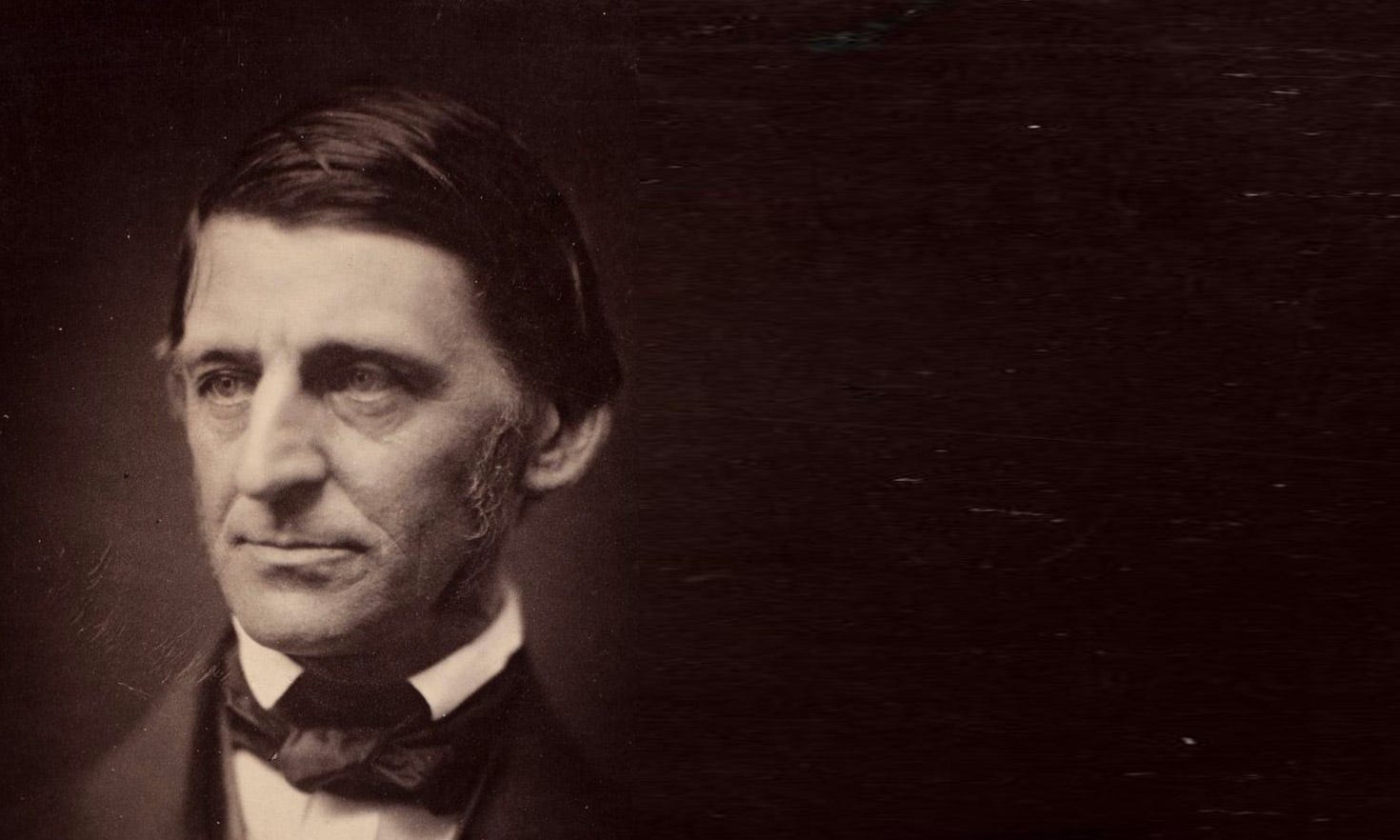
On this basis, I am today inaugurating a different kind of post, the first in an ongoing but intermittent series in which I draw attention to unexpected Epicurean allies from the world of letters. My strong sentiment is that Epicurean values are not particularly obscure or sectarian values, but are in many respects widely shared among the wise people of the world. To bolster this claim, I’d like to highlight some entirely unaffiliated thinkers who endorse some key Epicurean claims or virtues. The virtue in question today is prudence. The thinker in the spotlight is Ralph Waldo Emerson.
Let me say a few more words of preface. What do I mean by prudence, and in what way is it undervalued? In Greek, the word used is phronesis, sometimes also translated as “practical wisdom” to avoid the either somewhat stiff tone or narrowly financial connotations of “prudence” in modern English. In the Letter to Menoeceus, Epicurus states that phronesis is “the greatest good”—even above philosophy itself. While theoretical wisdom is often extremely valuable, nothing actually matches the importance of accurately weighing advantage and disadvantage when it comes to influencing the happiness of your life. It’s a very good thing if you understand the true nature of your postmortem fate, but if bad decision-making leaves you unhealthy, indebted, and unhappily married, you will still have a lot of trouble achieving eudaimonia.
Despite this importance, however, prudent decision-making gets relatively little love in modern philosophy, literature, or popular culture. I think a lot of people can go through, say, an elite university education without ever getting much sign that prudence is key to their happiness in life. Intense passions and commitment to abstract ideals are granted far more cachet, credentials and prestige are valued disproportionately to their worth, and when it comes to financial matters, the lion’s share of attention is given to boosting income rather than restraining spending. This is echoed in culture. Songwriters don’t write rousing anthems to prudence. Most heroes of novels and films are not marked for this quality.
I think this is somewhat of a modern quirk. If you rewind the clock by a mere century or two, you can find plenty of extremely eloquent and prestigious writers who did place an appropriately high value on this highest of all Epicurean virtues. This leads to the second natural question for this preamble: why Emerson? First, simply because he’s always been my favorite prose stylist in American literature. Second, because he’s a bit of an extreme case of seeming unlikeliness for an Epicurean ally: the leader of American Transcendentalism, Emerson falls quite strongly to the “Idealist” side of the Idealist-to-Materialist spectrum, seemingly far distant from Epicurus. Emerson loves Plato. Popularizations refer to him as “an American Stoic.” Overall, his essays are famous for their flights of grand, soaring rhetoric about the unbounded potentialities of the human soul.
However! He was still a 19th century New Englander, which meant both that he lived in an era of generally limited material abundance compared to modern times (while not being so distant as to be unrelatable), and that he contains a vein of Puritan intellectual heritage that is inclined towards suspicion of the same kind of low, impulsive hedonism which Epicurus was also generally disdainful of. As such, he did still maintain a distinctly higher opinion of the virtue of prudence than is commonly encountered today.
So there you have it: I think that prudence—financial frugality, careful cost-benefit analysis, the suppression of short-term impulses in favor of long-term satisfaction—is routinely undervalued in the culture of modern, educated persons. Since this demographic is preferentially inclined to listen to eloquent idealists, I wanted an idealist who would praise prudence with all the eloquence the virtue deserves. Emerson is that man.
Emerson’s “Prudence”
In his celebrated first volume of Essays—containing such Transcendentalist greatest hits as “Self-Reliance,” “Spiritual Laws,” and “The Over-Soul”—is a relatively neglected essay on “Prudence.” Here, as he would do increasingly in his later books The Conduct of Life and Society and Solitude, Emerson sings the praises of conducting one’s private life with skill.
The domestic man, who loves no music so well as his kitchen clock, and the airs which the logs sing to him as they burn on the hearth, has solaces which others never dream of. The application of means to ends insures victory and the songs of victory, not less in a farm or a shop than in the tactics of party or of war. The good husband finds method as efficient in the packing of fire-wood in a shed, or in the harvesting of fruits in the cellar, as in Peninsular campaigns or the files of the Department of State.
In highbrow settings, people are more often praised for their elevated aspirations, intelligent taste, or commitment to abstract ideals. But Emerson, comparing what we value in good people with the realistic groundedness a great artist is attentive to in painting human figures, thinks that our more honest esteem is granted to people to have their feet on the ground:
This perpendicularity we demand of all the figures in this picture of life. Let them stand on their feet, and not float and swing. Let us know where to find them. Let them discriminate between what they remember and what they dreamed, call a spade a spade, give us facts, and honor their own senses with trust.
The arts are generally inclined to worship the “artistic,” granting most respect to those who “feel deeply,” but when such people lack basic prudence, then such admiration is mistaken. Emerson, a man of deeper thought and artistry than any modern songwriter or other performative bohemian, knew this:
We have found out fine names to cover our sensuality withal, but no gifts can raise intemperance. The man of talent affects to call his transgressions of the laws of the senses trivial, and to count them nothing considered with his devotion to his art. His art never taught him lewdness, nor the love of wine, nor the wish to reap where he had not sowed. His art is less for every deduction from his holiness, and less for every defect of common sense.
Artists are not the only ones who disappoint us by such a lack. Academics are often the same, getting lost in the minutiae of their theories and losing popular respect by their shortcomings in things that the less well-credentialed understand far better.
The scholar shames us by his bifold life. Whilst something higher than prudence is active, he is admirable; when common sense is wanted, he is an encumbrance.
Rather than disdain the practical, as some artists and scholars do, Emerson praises the most mundane forms of prudence—frugal living, careful investment of idle capital, efficiency and industriousness with the tools of one’s trade. And from this he expands from those elements of prudence as commonly conceived to praise of the “minor virtues,” such as punctuality and dependability. As with Epicurus, he points out that even the virtues and duties which are often held up as being of independent worth will be to our long-term advantage, are in truth a part of prudence too. Consider true-telling, for instance:
On the most profitable lie the course of events presently lays a destructive tax; whilst frankness invites frankness, puts the parties on a convenient footing and makes their business a friendship. Trust men and they will be true to you.
So often the claim of the “noble” disparagers of prudence is that overemphasizing the practical will lead to the neglect of the higher virtues. Emerson doesn’t make this mistake. He gets it. As with honesty, so with courage—prudence is not the antithesis of bravery, but the enabler of it:
So, in regard to disagreeable and formidable things, prudence does not consist in evasion, or in flight, but in courage. He who wishes to walk in the most peaceful parts of life with any serenity must screw himself up to resolution.
Likewise, friendship, goodwill, and affection should properly be seen as advancing our prudential goals, not conflicting with them.
It is a proverb, that ‘courtesy costs nothing’; but calculation might come to value love for its profit. Love is fabled to be blind; but kindness is necessary to perception; love is not a hood, but an eye-water. If you meet a sectary, or a hostile partisan, never recognize the dividing lines; but meet on what common ground remains, — if only that the sun shines, and the rain rains for both; the area will widen very fast, and ere you know it the boundary mountains, on which the eye had fastened, have melted into air.
In antiquity, rival schools constantly criticized Epicurus for an ostensible willingness to set aside the virtues in preference to one’s hedonistic goals. People still constantly make this mistake today, thinking that Epicureanism is an invitation to discard honesty, courage, and faithfulness whenever it is temporarily inconvenient. That is very far from the truth. Epicurus’ point is that we should value the traditional virtues because their cultivation is necessary for our long-term benefit. Once you bring your mind to awareness of this harmony, acting rightly is no longer a struggle, but becomes self-evidently advantageous and consequently easy. Emerson—a man no one could accuse of meanness, sensuality, or ignorance of the life of the mind—understood this coincidence of virtuous character and our own well-being too:
Thus truth, frankness, courage, love, humility, and all the virtues, range themselves on the side of prudence, or the art of securing a present well-being.
And so, if you ever feel that to align yourself with Epicureanism would be to lower yourself, to debase the elevation of your thoughts, to abandon the arts and noble thinking in favor of mean and petty calculation, reconsider. The great American bard of self-reliance, the man who inspired Thoreau and set Whitman to a boil, did not think prudence beneath our notice. He recognized that common sense was indispensable to every artistic or scholarly soul. He celebrated those who planted and harvested, built and marketed, saved and invested with skill and forethought. He recognized that to be a person of prudence, in the true sense of the word, was to be someone who could be relied upon for fidelity, courage, and goodwill. Emerson understood the Epicurean truth that prudence is not an abandonment of higher thinking; it is the crucial grounding for any thought worthy of respect.
This is a great angle. Really enjoyed it.
The line that got me was the scholar who's "admirable" when higher thinking is active but "an encumbrance" when common sense is wanted. That's basically the exact charge leveled at a lot of contemplative philosophy, that withholding judgment on the big questions leaves you useless for the small, practical ones. Emerson showing prudence and elevated thought aren't actually in conflict, you can hold off on certainty and still act well in the moment.
Good reminder that these old schools have more overlapping ground than the labels suggest.