
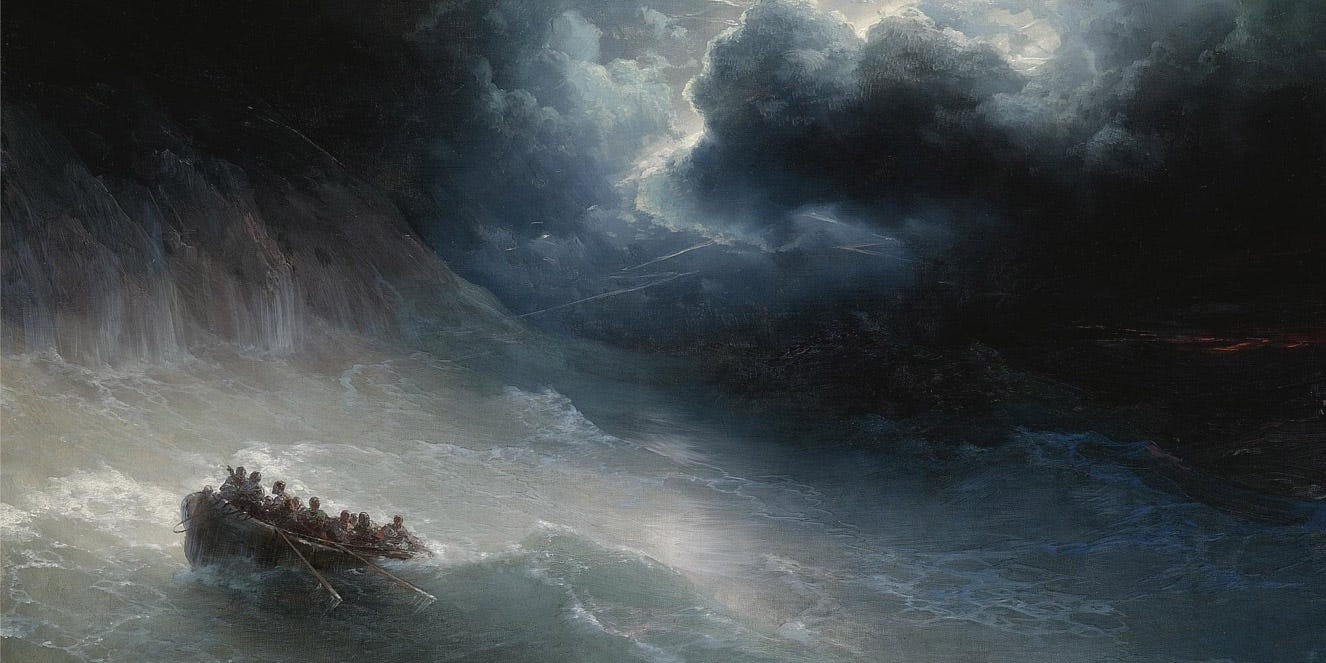
Peace and quiet are what sailors pray for,
When they are caught out on the open Aegean,
With a black cloud hiding the moon
And smothering the stars.

They pray for peace in war-torn Thrace,
As do the famous archers of Parthia,
But it can’t be bought, Grosphus—not with gems,
Not with purple, not with gold.

A consul is wealthy, protected by lictors,
But no wealth or lictors can clear the mobs
In his mind, or disperse all the worries beneath
His fine, paneled ceiling.

Live well with little—as does the good man
Whose father’s salt cellar is his only heirloom,
His table offers little, but he sleeps without nightmares,
Free from fear and from greed.

Our strength is short. Why do we aim
At so much? Why do we sail across the sea?
Does the man who flees his country in truth
Just flee himself?

Worry haunts everyone. That anxious vice
Boards armored ships, chases down
The horseman, outrunning all deer,
Outrunning the wind.

Find contentment in this moment. Decline obsession
With the future. And when hard times come to you,
Temper bitter things with laughter, knowing
Life is imperfect.

Life is imperfect—Achilles died,
Immortal Tithonus was crushed by age,
And while I do not have your wealth,
I have other things.

The sounds of your sheep and your cattle surround you;
Your team of mares strain at the chariot;
You are draped in twice-dyed wool of Africa,
The richest of all colors.

But Fate has not deceived me. I have
A small estate, the gift to write
My slender songs, and freedom to spurn
The envious crowd.
Commentary
I have previously introduced Horace, a not-officially-Epicurean poet of Augustan Rome. To recap: he definitely studied Epicurean philosophy, had Epicurean friends, and was largely sympathetic to the philosophy, but occasionally strikes notes that are not in complete agreement with the school’s formal doctrines. Overall, he is still often quoted as an eloquent articulator of central Epicurean themes such as the value of simple living, the dangers of ambition, the importance of friendship, and the appreciation of the present moment’s pleasures. Today’s poem touches on all of these.
The basic structure of this ode is to alternate between portraits of various kinds of stressed, unhappy people, and alternative portraits of more contented ways of being. In the course of that alternation, we are given a virtual tour of the different ways the seemingly prosperous go wrong in their search for happiness, contrasted with affecting, highly Epicurean visions of what it would look like for that search to go right. Let’s take the whole poem in order.
[Unhappy people #1]

Peace and quiet are what sailors pray for,
When they are caught out on the open Aegean,
With a black cloud hiding the moon
And smothering the stars.

They pray for peace in war-torn Thrace,
As do the famous archers of Parthia,
But it can’t be bought, Grosphus—not with gems,
Not with purple, not with gold.

A consul is wealthy, protected by lictors,
But no wealth or lictors can clear the mobs
In his mind, or disperse all the worries beneath
His fine, paneled ceiling.
The first three stanzas introduce three different kinds of people: sailors, soldiers, and politicians. All are worried; none are happy. First up, we have the sailor (which in Roman poetry often means “wealth-seeking merchant”—see Odes 1.31 or 3.29, for example). But wealth won’t help you when you face the dark and dangerous sea. Second, educated young men (as Horace was) might join up with a military campaign (as Horace did, fighting against the future Augustus at Philippi) in order to pursue glory, political ideals, or eastern wealth, but the military life also guarantees a lack of tranquility. Third, consul was the highest political office in the Roman state. Being consul guarantees wealth, influence, and a personal crew of “lictors,” bodyguards/street-rabble-clearers armed with staffs. But, as we can see today as well, politicians do not lead peaceful lives.
[Happy man #1]

Live well with little—as does the good man
Whose father’s salt cellar is his only heirloom,
His table offers little, but he sleeps without nightmares,
Free from fear and from greed.
In contrast, a life that is not oriented around securing wealth, glory, or power does offer the possibility of peace. Even in his sleep, the good man is free from fear and greed—this is a good indicator of progress towards ataraxia. The opening line of this stanza, incidentally, is one of those felicitous, compact phrases for which Horace is famous (carpe diem, dulce et decorum est pro patria mori, the golden mean, etc.). Here he says vivitur parvo bene: “life is well lived with little,” or for greater concision and directness, “live well with little.” Ancient Epicureans loved repeating memorable maxims as a form of philosophical practice, and this is an excellent one. Recall it regularly to your mind and the frugal mindset will become ever more natural and instinctive. I say vivitur parvo bene all the time, even if my wife often completes the words before I can finish, followed by “yeah, yeah, yeah, I know.”
[Unhappy people #2]

Our strength is short. Why do we aim
At so much? Why do we sail across the sea?
Does the man who flees his country in truth
Just flee himself?

Worry haunts everyone. That anxious vice
Boards armored ships, chases down
The horseman, outrunning all deer,
Outrunning the wind.
Next, Horace turns back to consider a few more versions of the worried life. Here, the emphasis is not so much on acquisition (of wealth, power, etc.), but on movement. Those who are discontented cannot stand still, just as in the passage from Lucretius that I shared earlier this month. “Travelling is a fool’s paradise.” Fast ships and fast horses give us the distraction of speed, but vicious worry (vitiosa Cura) always walks us down.
[Happy man #2]

Find contentment in this moment. Decline obsession
With the future. And when hard times come to you,
Temper bitter things with laughter, knowing
Life is imperfect.
The remedies to such insatiability for stuff and movement are primarily mental. As Pierre Hadot argues, perhaps the central spiritual exercise of all Epicureanism is one of relaxation, of letting go of worries in favor of contentment in the present. This doesn’t deny that painful moments sometimes occur, but those also we can soften by adopting the right perspective. As Epicurus says in Principal Doctrine 4, pain is temporary. It will pass. And so Horace issues yet another of his rolling phrases: amara lento temperet risu—may the happy man “temper bitter things with calm, easy laughter.”
[Unhappy people #3]

Life is imperfect—Achilles died,
Immortal Tithonus was crushed by age,
And while I do not have your wealth,
I have other things.

The sounds of your sheep and your cattle surround you;
Your team of mares strain at the chariot;
You are draped in twice-dyed wool of Africa,
The richest of all colors.
Our last turn to the world of unhappiness contains two ends of the spectrum. First, Horace offers us a more distant, zoomed-out perspective from the world of mythology. Achilles obtained more glory than anyone in the world—but he died, and his glory became worthless. Tithonous asked for and received eternal life, but neglected to request eternal youth, with the result that he became very miserable and decrepit before ultimately being turned into a cicada. Then Horace zooms in, at last directly addressing his friend Grosphus, who was briefly invoked at the beginning of the poem. From the mythological past to the immediate and contemporary, people do the same futile thing in their desire for happiness: they always search for more.
[Happy man #3—Horace!]

But Fate has not deceived me. I have
A small estate, the gift to write
My slender songs, and freedom to spurn
The envious crowd.
Horace, in contrast, has what he needs. Not an ascetic lifestyle, but a modest one: his farm is parva (little) and the breath of his poetic muse is tenuem (slight, delicate—a reference to Horace’s specialization in short lyric poems about friendship and living well and so on, rather than some weightier genre like epic—rendered loosely here as “my slender songs”). The closing scorn for the general populace might strike some modern readers as jarringly elitist, given Horace’s criticisms of the rich: malignum spernere volgus could arguably be rendered even more strongly as “to despise the spiteful masses” or the like. But I think that Horace’s sentiment here is also ultimately compatible with an Epicurean perspective and suggests an important position that is not very prominent today: philosophers are not on the side of the rich (they are ignorant about what matters), but that does not necessarily mean they are on the side of the poor (they are ignorant too, often desiring the same things as the more unrefined and unreflective of the upper classes).
I never desired to please the masses, for I did not learn the things that pleased them, while the things I did know were alien to their way of thinking. (Epicurus, Usener fragment 187)
Live well with little. Be content with the present. Temper bitter things with gentle laughter. Do all of these and you will achieve some portion of that peace that so many seek without finding—at sea or in war, abroad or at home, in the midst of the crowd or surrounded by wealth. We have what we need.
Original Text
Horace, Ode 2.16

Otium divos rogat in patenti
prensus Aegaeo, simul atra nubes
condidit lunam neque certa fulgent
sidera nautis,

otium bello furiosa Thrace,
otium Medi pharetra decori,
Grosphe, non gemmis neque purpura ve-
nale nec auro.

non enim gazae neque consularis
submovet lictor miseros tumultus
mentis et curas laqueata circum
tecta volantis.

vivitur parvo bene cui paternum
splendet in mensa tenui salinum
nec levis somnos timor aut cupido
sordidus aufert.

quid brevi fortes iaculamur aevo
multa? quid terras alio calentis
sole mutamus? patriae quis exsul
se quoque fugit?

scandit aeratas vitiosa navis
Cura nec turmas equitum relinquit
ocior cervis et agente nimbos
ocior Euro.

laetus in praesens animus quod ultra est
oderit curare et amara lento
temperet risu: nihil est ab omni
parte beatum.

abstulit clarum cita mors Achillem,
longa Tithonum minuit senectus
et mihi forsan tibi quod negarit
porriget hora.

te greges centum Siculaeque circum
mugiunt vaccae, tibi tollit hinnitum
apta quadrigis equa, te bis Afro
murice tinctae

vestiunt lanae: mihi parva rura et
spiritum Graiae tenuem Camenae
Parca non mendax dedit et malignum
spernere volgus.