
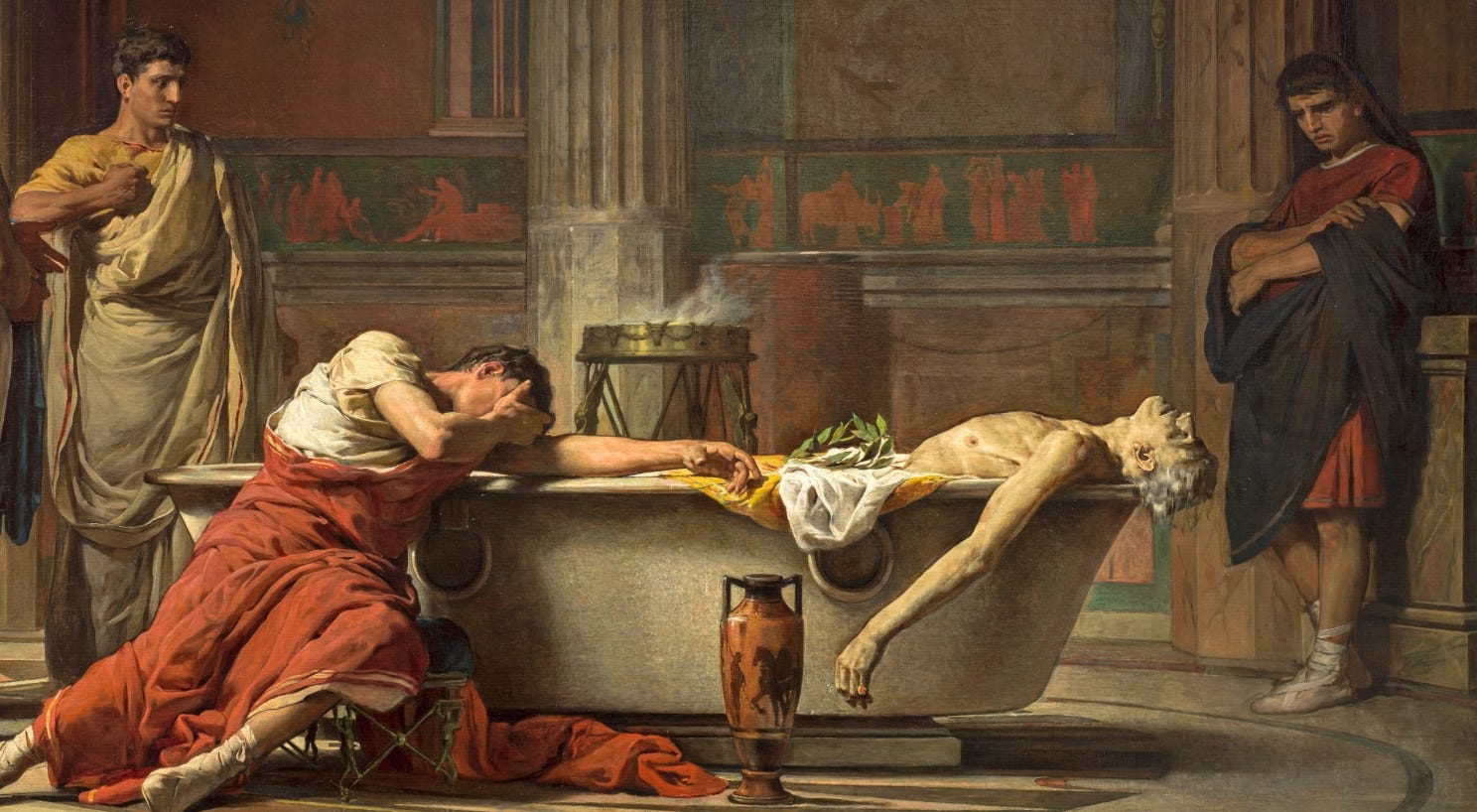
Seneca, Letter 2.6 (Usener fragment 475):
What I find in my reading today is this, from Epicurus—for I make it a habit to cross over into the other camp, not as a deserter, but as a sort of scout. “Cheerful poverty is an honorable thing,” he says. In truth, it is no poverty at all if it is cheerful. It isn’t having too little, but wanting more, that makes a man poor. What does it matter how much he piles up in his strongbox and storehouses, how large his flocks and dividends are, if he covets his neighbor’s belongings? If he spends his time counting, not what he has acquired, but what he could acquire? And so what, you might ask, is the proper limit of wealth? First: to have what you need. Second, to have enough.
Seneca, Letter 4.10 (Usener fragments 200 and 477):
This too is a cutting from another’s garden: “Poverty is great wealth, when it is organized according to the law of nature.” And do you know what requirements that law of nature imposes on us? “Not to be hungry, not to be thirsty, not to be cold.” And to drive away hunger and thirst, there is no need to hang about in the doorways of the powerful, enduring the weight of their arrogance and the condescension of their kindness. There is no need to sail out on the sea or head out on campaign. Nature’s needs are easy to obtain and have been set before us.
Men sweat for useless things. For these our robes grow threadbare, we wake up old in army tents, we are cast up on foreign shores. But all we need is here at hand. The man who finds poverty agreeable is rich.
Commentary
Lucius Annaeus Seneca the Younger was a Roman statesman and Stoic philosopher of the 1st century AD, living over 300 years after Epicurus. Despite these gaps of time, space, and philosophical allegiance, he remains a valuable source for Epicurean material. This is particularly the case in his Letters (also known as the Letters to Lucilius, Epistles, or Moral Epistles), a set of 124 short philosophical essays that quote Epicurus frequently, especially in the early installments. Sometimes we know the Greek originals of his Latin renderings, but often we don’t, making Seneca a legitimate and sometimes unique source for Epicurean aphorisms.
Unlike other later sources (such as Cicero or Plutarch), these quotes are usually not deployed polemically, but in general approvingly. The most common form they take in the letters is as a closing “gift,” a valuable piece of philosophical advice that Seneca endorses and briefly expands upon to end each letter. As such, Seneca’s framing sentences usually offer some sympathetic eloquence that occasionally adds substantive clarity to the meaning of the original maxim, but more often just supports and reiterates it, in a manner not too dissimilar to what I do here at Untroubled. Perhaps I’ll discuss Seneca’s relationship with Epicureanism more at a future date, but for now let’s jump right in with the first two examples from the Letters.
What I find in my reading today is this, from Epicurus—for I make it a habit to cross over into the other camp, not as a deserter, but as a sort of scout. “Cheerful poverty is an honorable thing,” he says. In truth, it is no poverty at all if it is cheerful. It isn’t having too little, but wanting more, that makes a man poor. What does it matter how much he piles up in his strongbox and storehouses, how large his flocks and dividends are, if he covets his neighbor’s belongings? If he spends his time counting, not what he has acquired, but what he could acquire? And so what, you might ask, is the proper limit of wealth? First: to have what we need. Second, to have enough. (Letter 2.6)
Romans like punchy aphorisms perhaps even more than the Greeks. This one from Epicurus comes across well in Latin: honesta res est laeta paupertas, or “cheerful poverty is an honorable thing.” While Seneca himself was famously wealthy (and has faced many accusations of philosophical hypocrisy for those who like to dwell on such things), his official position is that the Epicurean embrace of the simple life is a basically admirable trait. At other moments, he will soften this stance—perhaps to justify his own enormous wealth—arguing that one can still be virtuous while being rich. In practice, Epicurus would probably be rather skeptical of this position, seeing great wealth as something more likely to bring envy and encourage insatiable desires than it is productive of genuine improvements in security or happiness. Seneca’s prominent position, of course did not end well: under suspicion of conspiracy, he was ordered to kill himself by Nero.
As stated here, however, Seneca’s exposition of the life of cheerful poverty is entirely consistent with Epicurean principles. He identifies the problems with wealth: a constant “wanting more,” envy of one’s neighbors, obsessing over future gains. All of these activities are counterproductive to contentment. What we need to do instead is meet our real needs (i.e. to meet our necessary desires, to have quod necesse est), and then to be content with what we have (i.e. to have “enough”—quod sat est).
This too is a cutting from another’s garden: “Poverty is great wealth, when it is organized according to the law of nature.” And do you know what requirements that law of nature imposes on us? “Not to be hungry, not to be thirsty, not to be cold.” And to drive away hunger and thirst, there is no need to hang about in the doorways of the powerful, enduring the weight of their arrogance and the condescension of their kindness. There is no need to sail out on the sea or head out on campaign. Nature’s needs are easy to obtain and have been set before us.
Men sweat for useless things. For these our robes grow threadbare, we wake up old in army tents, we are cast up on foreign shores. But all we need is here at hand. The man who finds poverty agreeable is rich. (Letter 4.10)
Seneca’s praise of poverty continues in an orthodox Epicurean vein. The main quoted maxim appears to draw from Vatican Saying 25, while his recognition of the law of nature as demanding “not to be hungry, not to be thirsty, not to be cold” is based on VS 33, both of which I have translated and discussed previously. His examples of the consequently unnecessary behaviors stem from the Roman political world, where petitioning the powerful or joining the military in pursuit of foreign glory were standard parts of accessing or climbing the ladder of power.
Another effective Senecan aphorism: ad supervacua sudatur. This is a common impersonal construction in Latin, more literally “one sweats for” or “there is sweating for” superfluous things, but English calls for some syntactical revision with a more natural subject, like “we,” “men,” or “people.” “People sweat for pointless things,” we might observe as we see the latest jockeying for celebrity or wealth. “Why are we doing this?” we might usefully ask ourselves when finding ourselves entangled in some arduous or competitive pursuit which we find neither enjoyable nor admirable.
“Cheerful poverty is an honorable thing,” said Epicurus. “Poverty is great wealth, when it is organized according to the law of nature,” he also argued. Remember this message, in all its starkness: poverty, as the world conceives the word, defined by some arbitrary number, can be good. It can be honorable, not shameful. It can be more than ample to meet our real needs. Go ahead and read library books and play with a basketball you found on the side of the road. The wealthy are often unhappy misers. The ambitious wear themselves out in the service of empty goals.
Nothing is either good or bad, but thinking makes it so. The thing that makes poverty cease to be poverty—that dreadful bogeyman of the respectable—is simple. If you can maintain this one thing, and be reasonably confident of retaining it, then the number of digits in your bank account dwindles to insignificance. That one essential quality that makes poverty a state of pleasure is cheerfulness. By all means, defend yourself against real insecurity that threatens your peace of mind, and make efforts to increase your security going into the future. But as a diagnostic tool for measuring the quality of one’s life, the quantity of one’s wealth has far less importance than the skill with which we use it, the skill with which we live. If your true needs have been satisfied, and you can reflect with pleasure on all the good you have obtained, rather than pass your days in dreaming of all the things you have yet to acquire, then consider your goal fulfilled: you have reached the ends of wealth.
Original Text
Seneca, Letter 2.6 (Usener fragment 475):
Hodiernum hoc est, quod apud Epicurum nanctus sum; soleo enim et in aliena castra transire, non tamquam transfuga, sed tamquam explorator. “Honesta,” inquit, “res est laeta paupertas.” Illa vero non est paupertas, si laeta est. Non qui parum habet, sed qui plus cupit, pauper est. Quid enim refert, quantum illi in arca, quantum in horreis iaceat, quantum pascat aut feneret, si alieno inminet, si non adquisita sed adquirenda computat ? Quis sit divitiarum modus, quaeris ? Primus habere quod necesse est, proximus quod sat est.
Seneca, Letter 4.10 (Usener fragments 200 and 477):
Sed ut finem epistulae inponam, accipe, quod mihi hodierno die placuit. Et hoc quoque ex alienis hortulis sumptum est. “Magnae divitiae sunt lege naturae composita paupertas.” Lex autem illa naturae scis quos nobis terminos statuat? Non esurire, non sitire, non algere. Ut famem sitimque depellas, non est necesse superbis adsidere liminibus nec supercilium grave et contumeliosam etiam humanitatem pati, non est necesse maria temptare nec sequi castra; parabile est, quod natura desiderat, et adpositum. Ad supervacua sudatur. Illa sunt, quae togam conterunt, quae nos senescere sub tentorio cogunt, quae in aliena litora inpingunt. Ad manum est, quod sat est. Cui cum paupertate bene convenit, dives est.