
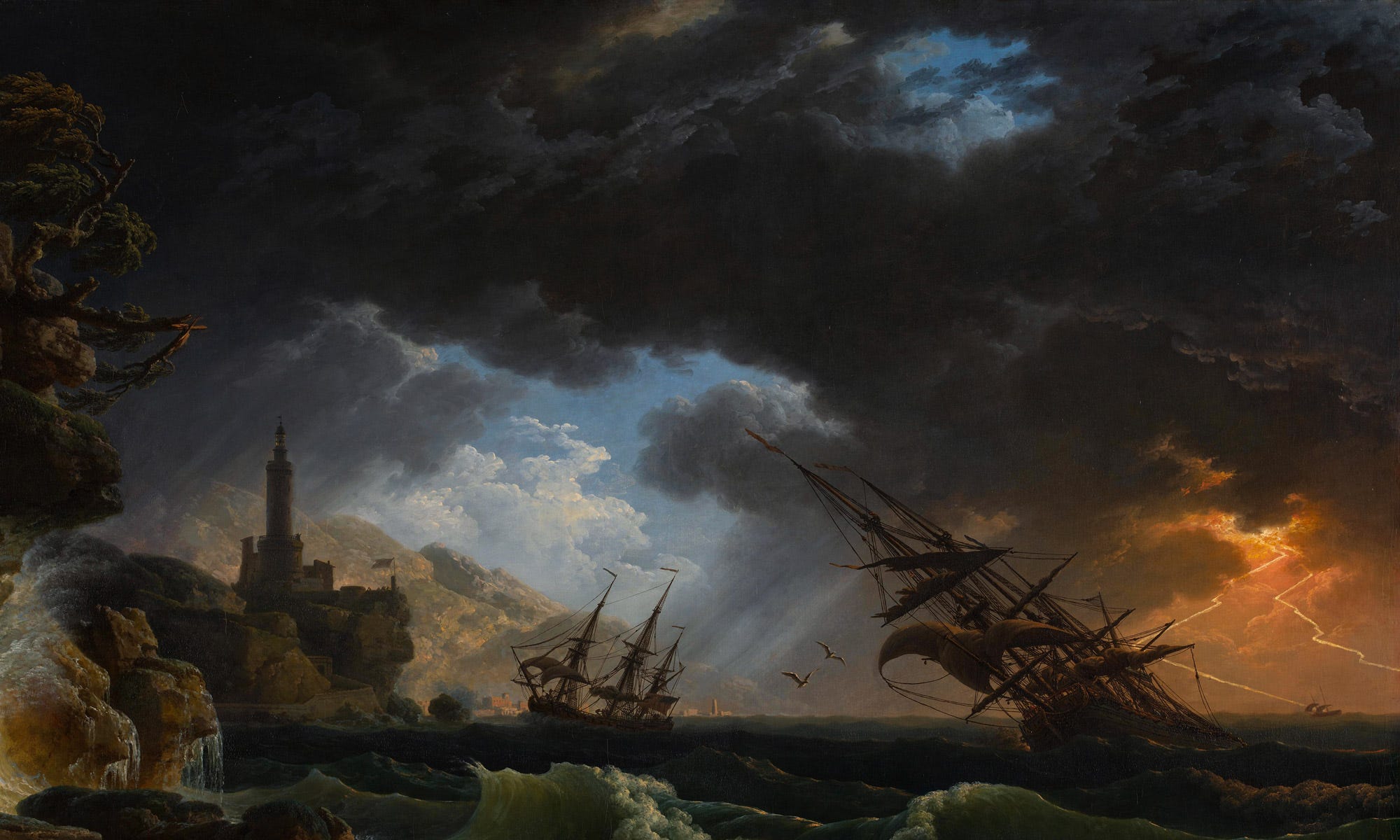
There is a pleasure to be found in the midst of storms,
When ships struggle in the wind and the waves,
But you are safe on land. Not that trouble
Is a source of joy—but freedom from trouble is.
Likewise, it is pleasant to watch great armies
Positioned for battle, while you are in safety.
But sweetest of all is the high, serene dwelling,
Fortified only by the doctrines of the wise.
From there you can see the wandering of the many,
See them roaming, seeking a pathway through life,
Competing in talents, contending for fame,
Day and night striving with unceasing labor
To reach the peak of wealth and of power.

The distress of men’s minds! The blindness of their hearts!
Amid what darkness and dangers is passed
The short span of their lives! They fail to see
How little it is that nature requires:
That the body be free from pain, and the mind
May rejoice in the absence of worry and fear.

Few things are needed for our bodily nature—
A few things suffice to take away pain,
And also provide us abundant delight—
Nature asks for nothing more pleasing.
It has no need of golden statues of youths,
Spread through the house with lit torches in hand,
That light may not be lacking for feasts into the night.
It cares not for silver, nor for glittering gold,
Nor for gilded panels resounding to the lyre.
Our nature is happy if we stretch out on the soft grass,
By the banks of a river, beneath a tall tree,
Refreshing our bodies at no great expense—
Even more so when the weather is smiling,
And spring sprinkles the grass with its living flowers.

The fever will leave a sick body no sooner
Covered with purple and surrounded by tapestries,
Than if one lies ill beneath a poor, common blanket.
Wealth does our body not the least bit of good.
Noble birth does no better, nor the glory of kings.
And all are equally futile at curing the ills of our mind.

Unless the sight of your legions on the Campus,
Seething to and fro in their imitation battle,
Fitted out with weapons, acting in unison,
Supported by auxiliaries and a strong force of cavalry,
Can frighten your fears, drive away superstition,
Cause the terrors of death to depart from your mind,
And leave your heart unburdened, liberated from worries.

But if we can see how foolish are such efforts,
Can see that the fears and dogging cares of men
Are not frightened off by the sound of clashing weapons
And the savagery of spears, but traffic most boldly
Among the high and the mighty, with no respect given
To the glimmer of gold or the rich splendor of purple,
Then why have any doubt that the power that dispels fear
Belongs only to reason? All life struggles in darkness—
And just as children tremble and fear
Everything lurking in the blindness of night,
So do we sometimes fear things in the brightness of day,
Things no more worth fearing than the nightmares of children.
The shadows and terrors that lurk in our minds,
Must be dispersed, not by the bright shafts of the sun,
But by the understanding of nature’s true working.
Commentary
Lucretius’ On the Nature of Things is an epic poem with an unusual subject: Epicurean natural science. Throughout its tour of physics, meteorology, biology, and anthropology, the poem periodically acknowledges the ethical implications of its teachings, tying the whole project of understanding the world to the underlying Epicurean mission of achieving peace of mind and a pleasurable life. This is especially the case in the “proems,” the introductory passages that begin each of the poem’s six books. I have previously shared the proem to Book III. Today’s translation, the proem to Book II, is one of the poem’s most famous (and somewhat controversial) passages.
The most-discussed moment arrives immediately, as Lucretius discusses the pleasure found in contrasting one’s own safety with the discomforts and dangers of others. To many, this seems like a rather harsh and cold attitude. If it were actually presented as baldly as some people hastily take it to be, with the whole statement being “it is pleasant to watch ships sink and people drown,” then Lucretius’ attitude would indeed seem to be quite lacking in sympathy. That wouldn’t, however, be a very accurate summary of the passage, which is a substantively important one for understanding the Epicurean attitude towards the world of struggle. Keep in mind a number of points:
1. First, don’t exaggerate the actual harshness of the analogical vehicles. Even in his first two analogies (ships at sea, a battlefield), Lucretius is not yet actually witnessing any human death or injury. He is instead witnessing situations of distant and still impending difficulty, of relatively abstract ships yet to founder and armies yet to clash. He is too far off to see individuals and their vivid physical suffering has not yet commenced. Lucretius is not claiming to take pleasure in watching a woman drown or a soldier bleed to death.
Furthermore, these are preliminary, weaker versions of the real situation of relief: seeing people struggle in the rat race of everyday life, while you stay fortunately clear of it. This is the scenario that gives the “sweetest” pleasure—the pleasure is greater when the contrasting pain is more diffuse and more obviously self-inflicted than in the cases of direct physical danger.
2. Second, we should note precise differences in Lucretius’ terms for this pleasant feeling. What I have rendered as “there is a pleasure” and “it is pleasant” is in Latin suave est, which is I think a little tricky. The most common and obvious way to translate this is “it is sweet.” Latin, however, has another word for “sweet” as well (dulce). This is what is used for the third situation (my “sweetest of all,” nihil dulcius est).
Prose translations which focus on conveying Lucretius’ meaning most precisely therefore try to soften suave relative to dulce. Rouse chooses “pleasant”; Smith chooses “comforting.” “Sweet” has too much active relish in English, as is made clear by Lucretius’ immediate disclaimer: the struggles of others are not a source of joy (my compact rendering of iucunda voluptas, “joyful pleasure”).
The feeling Lucretius is claiming therefore is not one of relish, delight, or jubilation in the misfortunes of others. Seeing struggling ships at sea or armies about to clash gives us a comparable but more attenuated form (suave est) of the sweeter (dulcius), thankful relief that we feel when wisdom takes us out of the pointless struggles of the world. Neither of these feelings constitutes active joy or delight (iucunda voluptas).
3. Third, keep in mind the larger project. The (misplaced) criticism of this moment is often cited as evidence of the “selfish” orientation of Epicureans. As with all such accusations, we need to remember the overarching diagnosis and efforts of both Epicurus and Lucretius: they think the greatest sources of pain and suffering are incorrect opinions (kenai doxai) and put enormous effort into teaching and writings that they hope will alleviate those struggles. The message of this passage, as with the poem as a whole, is clearly not “ignore the people in pain.” The message is “people are suffering—but there is a way out.”
4. Fourth, focus on the real object of the analogy. People get hung up on the idea of watching an impending shipwreck. But analogy is not a one-way street: we should remember the thing to which the struggling ships (not “drowning people,” remember!) are being compared, and make sure we are interpreting the significance of the analogy in a plausible way, given the real-world situation which is being evoked. That situation is this: people are painfully struggling for fame, wealth, and power, while we—who perhaps in the past once felt the lure of such things—can see the futility of such efforts, and feel the relief of no longer suffering from such illusions.
There is certainly a kind of pleasure or mild sweetness in this—we can imagine that if we were immersed in those delusional struggles, our lives would be more painful, and so our present state is by definition comparatively more pleasurable. But seeing people struggle endlessly to secure pointless wealth or vain applause evokes commiseration and sympathy, not some kind of cruel delight. I don’t see any reason to attribute the latter sentiment to Lucretius or Epicurus, and plenty of evidence for the former.
Such are my sentiments on the notorious “sweet” emotions Lucretius felt when watching struggling ships. Let me turn more briefly to a few other notes on the rest of the passage.
The main topic under discussion throughout is the futility of wealth (all those fancy statues) and power (the well-equipped troops). What we actually need to focus on, Lucretius explains, are the simple things that nature requires: that which alleviates pain in the body and fear and worry in the mind. This passage is a particularly good example of what that means. When in the past I have noted that Epicureans emphasize the reduction of pain, some people have insisted that such a claim implies a strict, ascetic minimalism. The reduction of pain is clearly Lucretius’ own choice of framing and emphasis (as it was for Epicurus), but here he makes clear what “pain reduction” means. It doesn’t have anything to do with eliminating or even reducing the easy-to-obtain pleasures. Picnics are encouraged!
Our nature is happy if we stretch out on the soft grass,
By the banks of a river, beneath a tall tree,
Refreshing our bodies at no great expense—
Even more so when the weather is smiling,
And spring sprinkles the grass with its living flowers.
The main goal entailed by “reducing pain” is to drive out fear and worry through a correct understanding of the world, attaining that which actually
Can frighten your fears, drive away superstition,
Cause the terrors of death to depart from your mind,
And leave your heart unburdened, liberated from worries.
The closing of this proem is one of the most powerful illustrations of this Epicurean liberation. Today, we are the inheritors of much Epicurean scientific innovation, but we still have farther to go. Ungrounded fears of the afterlife and of divine displeasure are on the wane. But misunderstandings about human nature and what truly brings happiness continue to abound. Does clearing away superstition and error seem like a meager goal, an unambitious aspiration? Lucretius doesn’t see it that way.
And just as children tremble and fear
Everything lurking in the blindness of night,
So do we sometimes fear things in the brightness of day,
Things no more worth fearing than the nightmares of children.
The shadows and terrors that lurk in our minds,
Must be dispersed, not by the bright shafts of the sun,
But by the understanding of nature’s true working.
People are haunted by nightmares, are scared of ghosts in the shadows. These phantoms cause them to struggle, like ships laboring against the wind. They cause them to suffer, like armies assembled to die for the pointless whims of tyrants. But wisdom is like a bright shaft of sunlight, that illuminates the night and disperses all darkness.
Original Text
De Rerum Natura, Book II, Lines 1–61
Suave, mari magno turbantibus aequora ventis
e terra magnum alterius spectare laborem;
non quia vexari quemquamst iucunda voluptas,
sed quibus ipse malis careas quia cernere suave est.
suave etiam belli certamina magna tueri
per campos instructa tua sine parte pericli;
sed nihil dulcius est, bene quam munita tenere
edita doctrina sapientum templa serena,
despicere unde queas alios passimque videre
errare atque viam palantis quaerere vitae,
certare ingenio, contendere nobilitate,
noctes atque dies niti praestante labore
ad summas emergere opes rerumque potiri.

o miseras hominum mentes, o pectora caeca!
qualibus in tenebris vitae quantisque periclis
degitur hoc aevi quod cumquest! nonne videre
nihil aliud sibi naturam latrare, nisi ut qui
corpore seiunctus dolor absit, mente fruatur
iucundo sensu cura semota metuque?

ergo corpoream ad naturam pauca videmus
esse opus omnino: quae demant cumque dolorem,
delicias quoque uti multas substernere possint;
gratius inter dum neque natura ipsa requirit,
si non aurea sunt iuvenum simulacra per aedes
lampadas igniferas manibus retinentia dextris,
lumina nocturnis epulis ut suppeditentur,
nec domus argento fulget auroque renidet
nec citharae reboant laqueata aurataque templa,
cum tamen inter se prostrati in gramine molli
propter aquae rivum sub ramis arboris altae
non magnis opibus iucunde corpora curant,
praesertim cum tempestas adridet et anni
tempora conspergunt viridantis floribus herbas.

nec calidae citius decedunt corpore febres,
textilibus si in picturis ostroque rubenti
iacteris, quam si in plebeia veste cubandum est.
quapropter quoniam nihil nostro in corpore gazae
proficiunt neque nobilitas nec gloria regni,
quod super est, animo

si non forte tuas legiones per loca campi
fervere cum videas belli simulacra cientis,
ornatas armis statuas pariterque animatas,
subsidiis magnis et equum vi constabilitas,
his tibi tum rebus timefactae religiones
effugiunt animo pavidae mortisque timores
tum vacuum pectus lincunt curaque solutum.

quod si ridicula haec ludibriaque esse videmus,
re veraque metus hominum curaeque sequaces
nec metuunt sonitus armorum nec fera tela
audacterque inter reges rerumque potentis
versantur neque fulgorem reverentur ab auro
nec clarum vestis splendorem purpureai,
quid dubitas quin omnis sit haec rationis potestas,
omnis cum in tenebris praesertim vita laboret?
nam vel uti pueri trepidant atque omnia caecis
in tenebris metuunt, sic nos in luce timemus
inter dum, nihilo quae sunt metuenda magis quam
quae pueri in tenebris pavitant finguntque futura.
hunc igitur terrorem animi tenebrasque necessest
non radii solis neque lucida tela diei
discutiant, sed naturae species ratioque.