
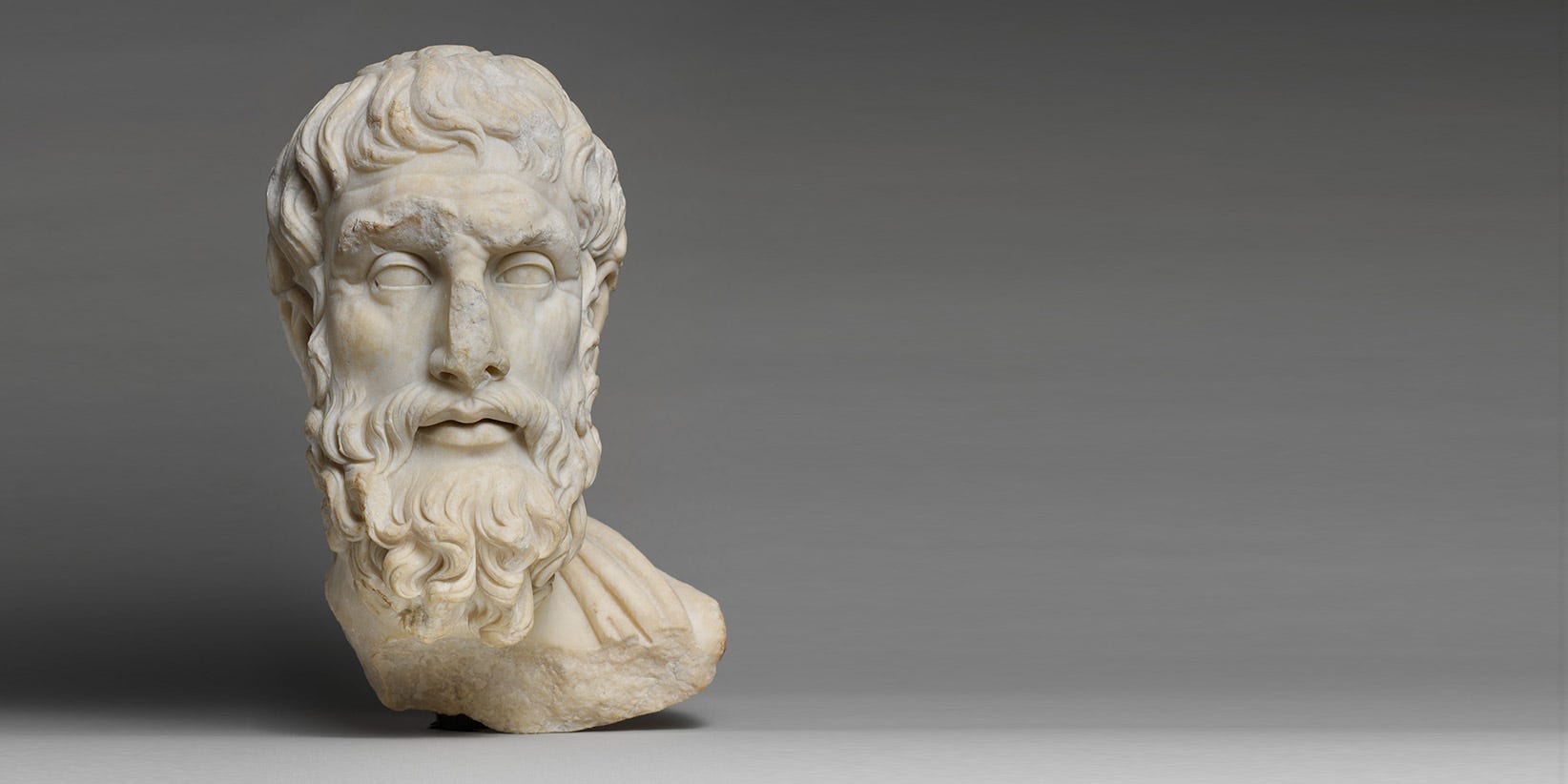
Epicurus to Menoeceus, greetings,
The young must not delay the practice of philosophy, and the old must not grow weary of the love of wisdom: it is never too early or too late to seek the health of one’s soul. To say that it is not yet time for philosophy, or that the time for philosophy has passed, is like saying that it is not yet time to be happy, or that the time for happiness is over. And so both the young and the old must practice philosophy—the old, so that they may be young again in their enjoyment of the good things of life, grateful for all that has come to pass, and the young, so that they may have the confidence of maturity, fearless about what will be. We all must study what truly produces happiness, for when we possess happiness, we wish for nothing else, but when we lack it, all our efforts go to its pursuit.
Remember all that I have taught you—study and practice these precepts, knowing them to be the foundation of a noble life. First, understand that the gods are immortal and blissful beings—this is what all conceive a god to be. Do not, therefore, attribute to the gods anything inconsistent with immortality and blessedness, but rather make sure that your beliefs keep their immortality and blessedness in mind. There are gods; we have a clear conception of them. But they are not as the many believe them to be, nor indeed do the many maintain a consistent account of them.
And so the impious man is not the one who does away with the gods of the many, but the one who attaches to the gods the opinions of the many. For the assertions of the many about the gods are not based on that universal and innate conception, but on false assumptions, according to which it is from the gods that the greatest harms come to the wicked, and the greatest benefits to the good. Since the many are familiar only with their own human virtues, they believe in gods that are similar to themselves, and find anything that is not like themselves alien and difficult to conceive of.
Commentary
For our second installment of Tuesday Translations, I’ll be starting a multi-part series on the best short introduction to Epicurean ethics, the Letter to Menoeceus (we’ll be returning to the rest of the Principal Doctrines later). Preserved in Diogenes Laertius’ Lives of the Eminent Philosophers, along with the Letter to Herodotus (on physics), the Letter to Pythocles (on celestial phenomena), and the Principal Doctrines, this letter is the longest continuous piece of Epicurus’ own writings on ethics that survives, with his full, book-length treatises all lost.
Over the next five weeks, we’ll cover this five-page letter at a moderate pace, taking enough time to clear up vague passages and appreciate the implications of what he’s saying. In this opening segment, Epicurus introduces the goals of philosophy and briefly lays out his understanding of the gods, a foundational teaching that underlies his ethical advice.
A note on my approach to translation: In translating Epicurus, and philosophy generally, I think our first priority has to be clarity. This means fidelity to the meaning, to the philosophical argument, rather than fidelity to the original syntax. Accordingly, if a word-for-word translation would result in obscure translationese, I generally don’t hesitate to adjust the sentence structure. Sometimes a word present in the Greek will therefore be omitted from my English rendition, while conversely I will occasionally expand a single Greek word into a short phrase or a few alternative possibilities if I feel a single English word cannot capture all the connotations of the original.
Let’s go through some highlights:
The young must not delay the practice of philosophy, and the old must not grow weary of the love of wisdom: it is never too early or too late to seek the health of one’s soul. To say that it is not yet time for philosophy, or that the time for philosophy has passed, is like saying that it is not yet time to be happy, or that the time for happiness is over. And so both the young and the old must practice philosophy—the old, so that they may be young again in their enjoyment of the good things of life, grateful for all that has come to pass, and the young, so that they may have the confidence of maturity, fearless about what will be. We all must study what truly produces happiness, for when we possess happiness, we wish for nothing else, but when we lack it, all our efforts go to its pursuit.
Remember all that I have taught you—study and practice these precepts, knowing them to be the foundation of a noble life.
It’s easy to breeze over these introductory sentences as mere pleasant filler, but a number of distinctive and important features of Epicurean philosophy are actually present here:
1. “The health of the soul”: Epicurus frequently describes his philosophic mission as one of achieving health, a pleasurable and by no means impossible state. This is more grounded than idealist traditions (Platonism, Christianity) that suggest our bodily state is inherently flawed and that perfect happiness must be postponed to a future state of existence. It is more achievable than the Stoic ideal of sagehood. It is “merely” health, a mental and spiritual state that should be normal, and that can be normal, if certain specific errors are corrected.
Note that what is typically translated “the health of the soul” (τὸ κατὰ ψυχὴν ὑγιαῖνον) could also be translated as “the health of the mind” or even “mental health”—a great deal of Epicurus’ therapeutic activity is engaged in correcting intellectual error, and so this would not be inaccurate. Overall, however, “soul” better captures the grand and all-encompassing nature of the object of philosophical therapy.
2. Eudaimonism: Epicurus very directly states the objective of his philosophy: to secure happiness, or eudaimonia. (The Greek concept is somewhat broader than a merely momentary sense of contentment, so some prefer “well-being” or even “thriving.”) Epicurus is often quickly categorized as a “hedonist” while a thinker such as Aristotle is traditionally labelled a “eudaimonist,” giving some the erroneous impression that Epicurean hedonism is pursuing some less worthy goal than overall well-being. Don’t make that mistake—Epicurus is clearly a eudaimonist as well.
3. An exoteric—not esoteric—philosophy: What is the primary point of the opening lines? That philosophy is for everyone. This openness was one of the defining characteristics of the Epicurean Garden, which welcomed foreigners, wives, courtesans, and slaves. Some philosophical schools (such as the Platonic Academy) were intrinsically elitist. In Epicureanism, you won’t find any “noble lies” excluding the less worthy from the truth—just an open invitation to happiness.
4. How should one look back? With gratitude. The old should practice philosophy “so that they may be young again in their enjoyment of the good things of life, grateful for all that has come to pass.” A strictly literal translation can distract from the meaning:
ὅπως γηράσκων νεάζῃ τοῖς ἀγαθοῖς
so that being old, one may be young in good things
“To be young in good things” is not a standard or even meaningful expression in English. Epicurus’ underlying point, however, is clear from other writings: we should be grateful for everything we have experienced, and continue to derive pleasure from both our memories and our awareness of current blessings.1
5. How should one look forward? Without fear. The advice directed towards the young employs a parallel structure, again somewhat awkward in a literal English rendering:
ὅπως νέος ἅμα καὶ παλαιὸς ᾖ
so that being young, he may at the same time be old
Here again, “so that the young may at the same time be old” is not a comprehensible rendering. What is enjoined is fearlessness about the future, derived from both prudence regarding the true necessities of life and and an accurate understanding of what comes after death. In what sense is this equivalent to “being old”? I have attempted to suggest it with my “so that they may have the confidence of maturity.” In terms of strict word-for-word correspondence, this is an invention, but I think this is the best way to understand the underlying meaning.
6. Living nobly: The closing phrase of my translation (“a noble life”) is often rendered simply as “living well” (Inwood and Gerson2) or “the good life” (Strodach3, Bailey4). The Greek is καλῶς ζῆν. Kalos is one of the classic examples of a Greek word that is not perfectly aligned with modern English. “Good” and the adverbial “well” are perfectly defensible translations. In some contexts, “beautiful” would be most appropriate, while in others, “noble” or “honorable” would better express the primary emphasis. What I would point out here—again in preemptive defense against accusations of a lower form of hedonism—is that Epicureanism does not aim at a base satisfaction of low desires, but at an overall existence that is not merely “good” but does in fact deserve the appellation of “noble”—one characterized by fearlessness and imperturbable tranquility.
On to the gods:
First, understand that the gods are undecaying and blissful beings—this is what all conceive a god to be. Do not, therefore, attribute to the gods anything inconsistent with immortality and blessedness, but rather make sure that your beliefs keep their immortality and blessedness in mind. There are gods; we have a clear conception of them. But they are not as the many believe them to be, nor indeed do the many maintain a consistent account of them.
And so the impious man is not the one who does away with the gods of the many, but the one who attaches to the gods the opinions of the many. For the assertions of the many about the gods are not based on that universal and innate conception, but on false assumptions, according to which it is from the gods that the greatest harms come to the wicked, and the greatest benefits to the good. Since the many are familiar only with their own human virtues, they believe in gods that are similar to themselves, and find anything that is not like themselves alien and difficult to conceive of.
In the second half of today’s extract, Epicurus summarizes his teachings on the proper understanding of divinity. We were introduced to this basic concept last week in Principal Doctrine 1. Here it is given slightly more elaboration (with a similar elaboration of PD 2 to follow in next week’s continuation of the Letter to Menoeceus). Still, the justification of Epicurus’ position is given quite briefly and controversially:
θεοὶ μὲν γὰρ εἰσίν· ἐναργὴς γὰρ αὐτῶν ἐστιν ἡ γνῶσις.
There are gods. For our understanding of them is clear.
A few lines below, he employs another term relevant to this “clear understanding,” contrasting a true “prolepsis” (πρόληψις) with the “false assumptions” of the many. A prolepsis is a central yet much-disputed term in Epicurean epistemology, which I have translated as “universal and innate conception.” There is significant debate over what exactly a prolepsis is. Diogenes Laertius describes it as being the result of past experience (from seeing many horses, we come to have a clear idea of a horse—probably what Inwood and Gerson are thinking when they translate it as “basic grasp”).5 However, we have four extant uses of the word by Epicurus, all of which refer to subjects for which we don’t have empirical experience (the gods, justice). More could be said in defense of my translation, but my brief position in this dispute is that I believe Diogenes Laertius did not accurately report Epicurean use of the term.6
I may write more on this in the future, but for now, the narrow takeaway is that Epicurus’ argument is that if everyone has a clear, innate, and uniformly-agreed upon idea of something, then we should accept that understanding as sufficiently evidenced. If everyone agrees that gods are immortal and lead lives of perfect bliss, then let us speak of them in a way consistent with that agreed-upon understanding—not by telling stories that portray them as petty, insecure beings who throw tantrums over peer slights or human misbehavior.
Now, even if we accept that this is what Epicurus means by “prolepsis,” we may still find this to be quite weak justification for the blank assertion that “the gods exist.” I agree! I myself lean towards the interpretive camp that is skeptical about Epicurus’ belief in literal gods and favors understanding his statement mostly as a rhetorical strategy to defend against accusations of atheism on the one hand, while defanging religion of all its actually harmful elements on the other. “Can we all agree that gods are perfect beings? Great. Would a perfect being really get so upset at Lizzie the slave-girl for not keeping her word last week that he would strike her with lightning? No? That doesn’t make sense? Good—it sounds like we agree that we don’t need to worry about divine displeasure, because we all agree that gods are perfect.”
Before I wrap up, I will note that the final lines have caused some translators difficulty. I rendered them like this:
For the assertions of the many about the gods are not based on that universal and innate conception, but on false assumptions, according to which it is from the gods that the greatest harms come to the wicked, and the greatest benefits to the good. Since the many are familiar only with their own human virtues, they believe in gods that are similar to themselves, and find anything that is not like themselves alien and difficult to conceive of.
This understanding is in accord with the old translations of Bailey and Strodach, but the popular modern translation of Inwood and Gerson rather makes a meal of the passage:
For the pronouncements of the many about the gods are not basic grasps but false suppositions. Hence come the greatest harm from the gods to bad men and the greatest benefits [to the good]. For the gods always welcome men who are like themselves, being congenial to their own virtues and considering that whatever is not such is uncongenial.
Some of the confusion is from a somewhat unconventional use of the word ἒνθεν for “according to which.” Bailey notes it as a “slightly forced” use of the word in his commentary, but the subsequent claim about the gods harming bad men is distinctly not Epicurean, so it seems necessary to understand this claim as existing only in reference to the preceding “false assumptions” of the many. The next sentence does not explicitly state the subject or the object (“they accept those who are similar to their own virtues,” says the Greek); I believe that Inwood and Gerson make a mistake in understanding this as “the gods welcome men.” Instead, I agree with Bailey that the subject is “the many” from the preceding sentence, which generates a more comprehensible meaning. The argument could be paraphrased like this: “The many are most willing to imagine gods who are like them, since that is what they can understand most easily. But this is not consistent with our formally agreed upon understanding of the gods as perfect and blissful beings, so obviously hoi polloi are wrong.”
That’s the entirety of Epicurus’ discussion of the gods in this text (if only we had his lost book On the Gods!). Does it prove their existence? Not very convincingly. But does it reveal the fallible, vengeful, spiteful, and capricious gods of traditional Greek religion—some of which characteristics could certainly be seen as surviving into the Judeo-Christian monotheism of the Old Testament—as internally inconsistent and unsuitable to be taken seriously? I think this point still stands.
Original Text
[122] μήτε νέος τις ὢν μελλέτω φιλοσοφεῖν, μήτε γέρων ὑπάρχων κοπιάτω φιλοσοφῶν. οὔτε γὰρ ἄωρος οὐδείς ἐστιν οὔτε πάρωρος πρὸς τὸ κατὰ ψυχὴν ὑγιαῖνον. ὁ δὲ λέγων ἢ μήπω τοῦ φιλοσοφεῖν ὑπάρχειν ἢ παρεληλυθέναι τὴν ὥραν, ὅμοιός ἐστιν τῷ λέγοντι πρὸς εὐδαιμονίαν ἢ μὴπω παρεῖναι τὴν ὥραν ἢ μηκέτι εἶναι. ὥστε φιλοσοφητέον καὶ νέῳ καὶ γέροντι, τῷ μὲν ὅπως γηράσκων νεάζῃ τοῖς ἀγαθοῖς διὰ τὴν χάριν τῶν γεγονότων, τῷ δὲ ὅπως νέος ἅμα καὶ παλαιὸς ᾖ διὰ τὴν ἀφοβίαν τῶν μελλόντων·
μελετᾶν οὖν χρὴ τὰ ποιοῦντα τὴν εὐδαιμονίαν, εἴ περ παρούσης μὲν αὐτῆς πάντα ἔχομεν, ἀπούσης δέ πάντα πράττομεν εἰς τὸ ταύτην ἔχειν. [123] ἃ δέ σοι συνεχῶς παρήγγελλον, ταῦτα καὶ πρᾶττε καὶ μελέτα, στοιχεῖα τοῦ καλῶς ζῆν ταῦτ’ εἶναι διαλαμβάνων.
πρῶτον μὲν τὸν θεὸν ζῷον ἄφθαρτον καὶ μακάριον νομίζων, ὡς ἡ κοινὴ τοῦ θεοῦ νόησις ὑπεγράφη, μηθὲν μήτε τῆς ἀφθαρσίας ἀλλότριον μήτε τῆς μακαριότητος ἀνοίκειον αὐτῷ πρόσαπτε, πᾶν δὲ τὸ φυλάττειν αὐτοῦ δυνάμενον τὴν μετὰ ἀφθαρσίας μακαριότητα περὶ αὐτὸν δόξαζε. θεοὶ μὲν γὰρ εἰσίν· ἐναργὴς γὰρ αὐτῶν ἐστιν ἡ γνῶσις· οἵους δ’ αὐτοὺς οἱ πολλοὶ νομίζουσιν, οὐκ εἰσιν· οὐ γὰρ φυλάττουσιν αὐτοὺς οἵους νομίζουσιν. ἀσεβὴς δὲ οὐχ ὁ τοὺς τῶν πολλῶν θεοὺς ἀναιρῶν, ἀλλ’ ὁ τὰς τῶν πολλῶν δόξας θεοῖς προσάπτων.
[124] οὐ γὰρ προλήψεις εἰσίν ἀλλ’ ὑπολήψεις ψευδεῖς αἱ τῶν πολλῶν ὑπὲρ θεῶν ἀποφάσεις. ἒνθεν αἱ μέγισται βλάβαι τε τοῖς κακοῖς ἐκ θεῶν ἐπάγονται καὶ ὠφέλειαι <τοῖς ἀγαθοῖς>. ταῖς γὰρ ἰδίαις οἰκειούμενοι διὰ παντὸς ἀρεταῖς τοὺς ὁμοίους ἀποδέχονται, πᾶν τὸ μὴ τοιοῦτον ὡς ἀλλότριον νομίζοντες.
See, for example, Vatican Saying 19: “One forgetting the good that has been today becomes an old man.”
The Epicurus Reader: Selected Writings and Testimonia, ed. and trans. Brad Inwood and Lloyd P. Gerson (Indianapolis: Hackett Publishing Company, 1994), 28. The same material is also included in the authors’ Hellenistic Philosophy.
The Art of Happiness, trans. George K. Strodach (New York: Penguin Books, 2012). Translation originally published 1963.
Epicurus: The Extant Remains, ed. and trans. Cyril Bailey (New York: Hyperion Press, 1979). Originally published Oxford: Clarendon Press, 1926. My Greek text is that of Bailey, unless otherwise noted.
Lives of the Eminent Philosophers, X.33.
For a full discussion of the concept of prolepses, see Norman W. DeWitt, Epicurus and His Philosophy (Minneapolis: University of Minnesota Press, 1954), 142.
You may be interested in my own work at a new translation of Menoikeus, posted to the Epicurean Friends forum: https://www.epicureanfriends.com/wcf/filebase/file/67-epicurus-s-letter-to-menoikeus-a-new-translation-with-commentary/