
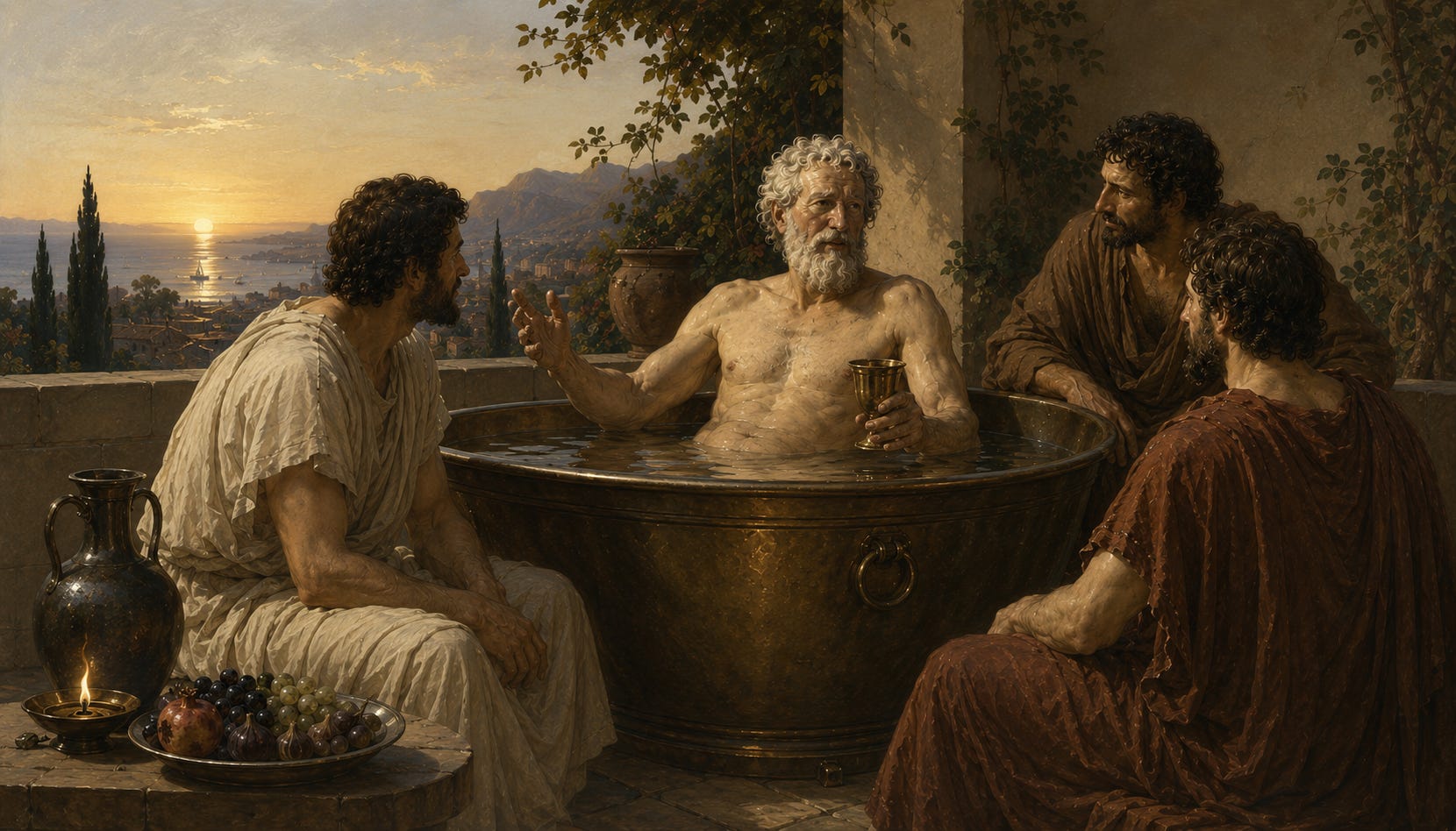
At the final approach of his death, Epicurus wrote a letter to Idomeneus:
On this blessed day, the last of my life, I write these words to you. The strangury has tight hold of me and I experience no relief from the painful dysentery that never relaxes in its severity. But against these things I weigh the joy that fills my heart when I remember the conversations I have shared with you and your companions. Since your youth, you have ever acted in devotion to me and to philosophy, and so I entrust the children of Metrodorus to your worthy care.
Commentary, Part 1: Overcoming Pain
All of my Epicurus translations so far have been core doctrinal texts—which are important! But focusing only on the doctrines might give an excessively dry and impersonal impression, when really this is a very human and humane philosophy. In that spirit, today we’re looking at a very short yet revealing text that gives us one of our most affecting portraits of Epicurus, showing us a man who was simultaneously a very imperfect bodily creature and a rousingly successful incarnation of his philosophic principles.
Diogenes Laertius gives us the Greek text of this letter and Cicero quotes it in full in Latin—both of these guys writing hundreds of years after the death of Epicurus—because this was one of the famous deaths of antiquity. I am in unsurpassable levels of pain, Epicurus wrote. And I am happy. Even Cicero—who could be very self-important and petty when it came to critiquing Epicurus—had to admire Epicurus’ “blessed day”:
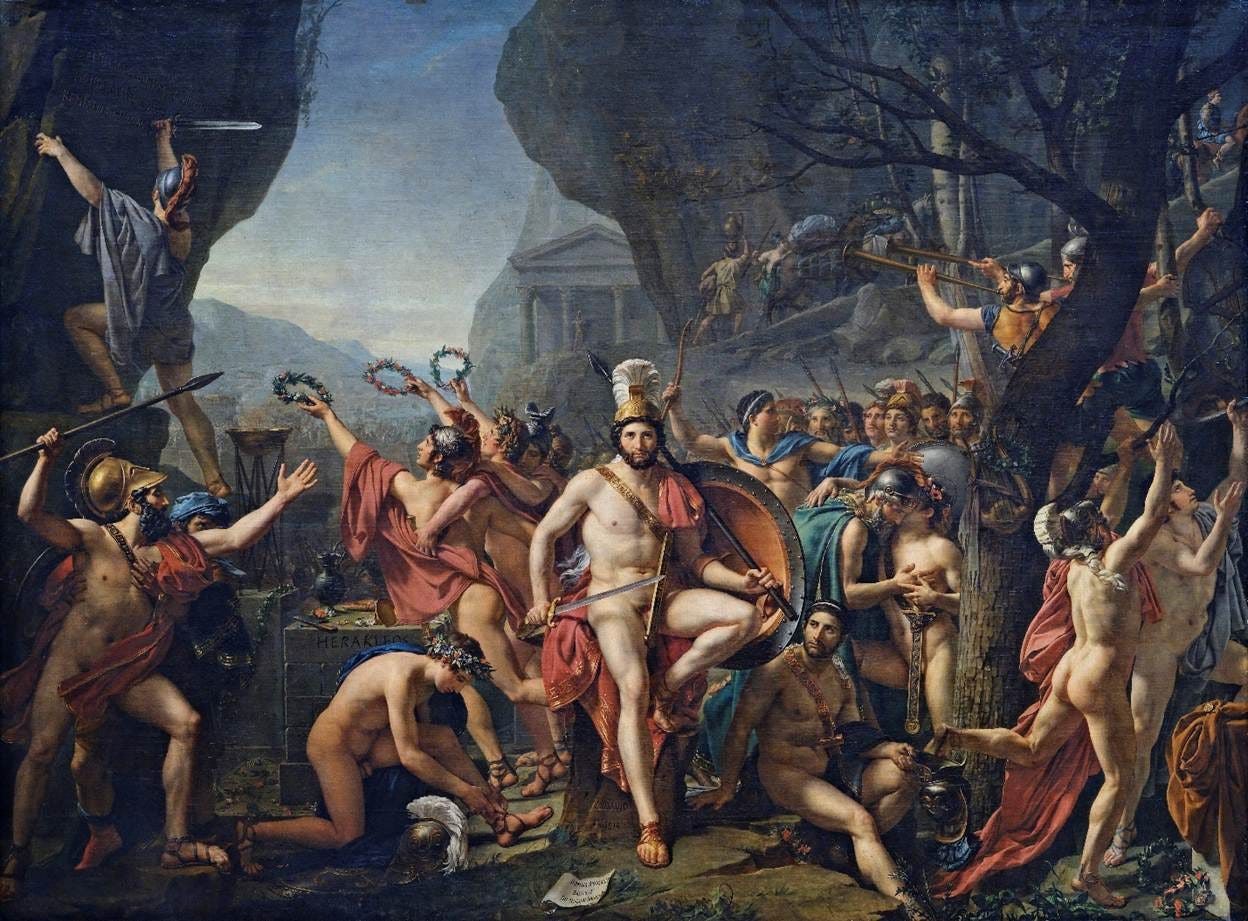
When I read this, I do not put the deaths of Epaminondas or Leonidas before that of Epicurus. (De Finibus, 2.97)
This dying statement still impresses us today. How many other philosophers make it into the World Journal of Urology?1 Most people aren’t happy even when they are in sound health, let alone when they are dying from an untreatable case of urinary calculus. Do you know what “strangury” is? Google describes it as “an intense, urgent need to urinate, followed by the slow, agonizing passage of only a few drops of urine.” Do you know what “unsurpassable dysenteric suffering” is? Unrelenting bloody diarrhea accompanied by wrenching abdominal cramps. It’s all very bad stuff.
The point is: if some Stoic tells you that Epicureanism is for soft people who can’t handle pain, they are very wrong. Epicureanism is for reasonable people who acknowledge that kidney stones are painful and bad and that if you can treat them, you should. In the wise words of my mother-in-law when asked for pregnancy advice,
Get the epidural.
If we Epicureans do encounter unavoidable pain, however, then we will deal with it better than other people.
I’ve already introduced one Epicurean strategy for getting through difficult circumstances, as described in Principal Doctrine 4: we will be rational and calculating and recognize that pain has limits. Diogenes Laertius tells us that Epicurus’ fatal illness lasted for fourteen days. For decades, Epicurus had taught awareness of the finite nature of intense pain: he knew it would be over soon.
This letter gives us a second therapeutic technique: step back and add up all the pains and pleasures of your life, the mental as well as the physical, before declaring your current hedonic balance to be in a deficit. It usually isn’t, especially if you’ve arranged your life prudently. In his case, Epicurus thought above all of his friends:
But against these things I weigh the joy that fills my heart when I remember the conversations I have shared with you and your companions.
One of the most obvious obstacles preventing people from being happier is a kind of shortsightedness about pain (or, more often, about minor discomforts and annoyances). Something happens that we would prefer not to happen—we spill our drink, get a papercut, buy something that doesn’t work as we envisioned—and then we get upset. But if we were to add up all the pleasures and pains of our lives, the pleasures would almost always come out on top. And if you have more pleasure than pain, then you are in a state that is, on net, pleasurable. And if your life is pleasurable, then you have everything you need to be happy.
The main philosophical proposition of this letter, then, is that pain has little influence over the happiness of the wise. Think of all the sources of pleasure in the world—the bodily functions that are available to you, food and drink, nature and art, music and beauty, laughter and friendship. How many have actually been cut off by your current misfortune? If Epicurus can handle fourteen days of unsurpassable physical torture, we can handle whatever little problems we have.
Commentary Part 2: The Philosopher of Friendship
This letter is addressed to Idomeneus. Unless you read the version in Cicero, where he says it was addressed to Hermarchus. The text itself actually uses a second-person plural pronoun—“I write these things to y’all,” Epicurus actually writes. Then it ends with a reference to Metrodorus’ children. Who are all these people? Epicurus’ friends.
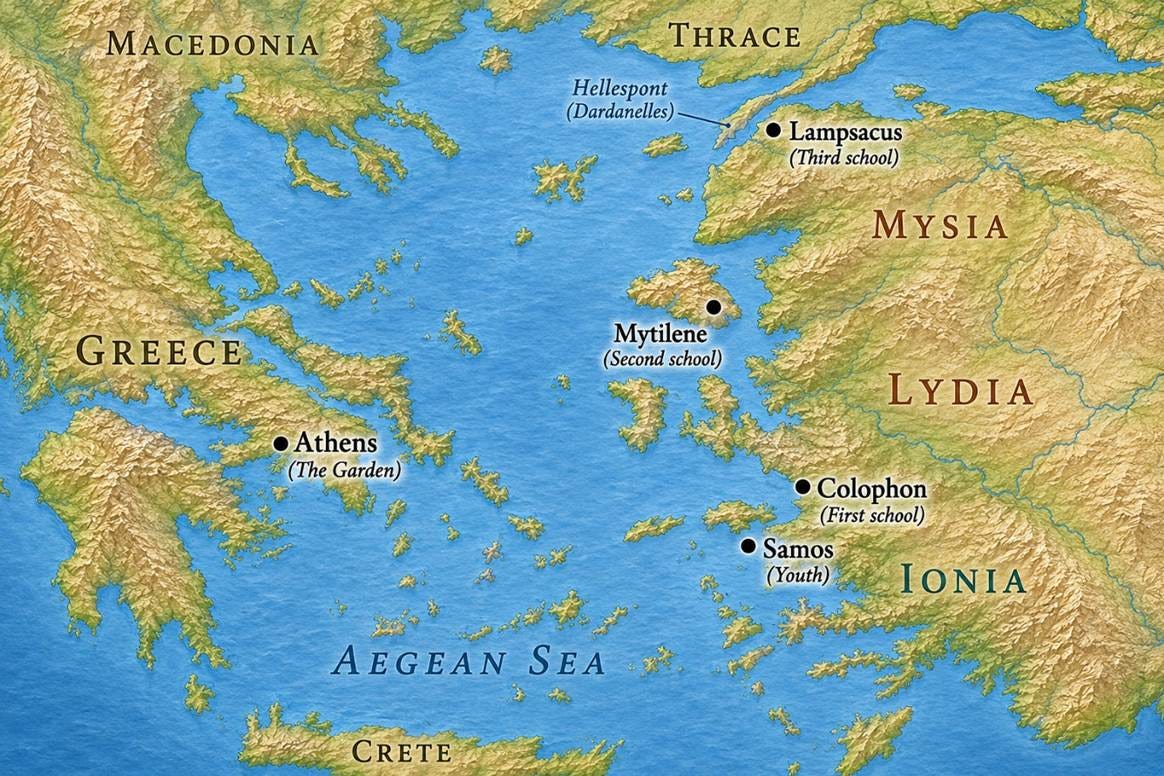
If you’re new to the life and times of Epicurus, this letter actually is a good compendium of some of the chief players. Metrodorus was his best friend, a companion since Epicurus’ time in Lampsacus, who accompanied Epicurus to Athens and died several years before him. Idomeneus was another Lampsacene, who seems to have stayed there as a leader of a secondary branch of the school, along with Themista and Leonteus, the famous Epicurean couple. Hermarchus, the alternative addressee, was a presumably even earlier follower from Mytilene who succeeded Epicurus as head of the Athenian Garden.
These names will recur. Many wrote philosophical works in their own right, although only small fragments remain. For now, what is important to note is that these were not just mere acquaintances or members of a modern alumni club, but real friends, the kind who will be there for you, the kind who will entrust you with their children and whom you can leave children to.
Since your youth, you have ever acted in devotion to me and to philosophy, and so I entrust the children of Metrodorus to your worthy care.
Some pedants don’t understand why Epicurus is concerned about things that will happen after he is gone, since he is a strict materialist who has no belief in consciousness after death. I think the answer lies in the preeminent importance he places on friendship. Reliable friends so far surpass all other means of increasing our overall security, that it is vital to practice faithful friendship without quibbling over petty, momentary self-interest. (For more on this “two-level” conception of friendship, see Tim O’Keefe’s “Is Epicurean Friendship Altruistic?”) Epicurus promised to take care of the children of Metrodorus, and he will pass on that obligation as part of an undying web of mutual support, because that is what friends do.
Lastly, it’s worth noting another difference between Epicurean friends and “friends” as we commonly use the term. In addition to providing practical assistance, Epicurus’ friends were his fellow philosophers. Such friends are people who agree with us about the most important things in life, but are also willing to speak frankly and listen humbly in our shared pursuit of the good life. There are often people who will reject your views out of hand—in dealing with them, circumspect neutrality might be the best you can achieve. Then there are people who would reject your views out of hand if you weren’t only saying things that they agreed with—that’s an echo chamber, not a real forum for deep discussion.
Idomeneus, Hermarchus, and all the rest were devoted both to Epicurus “and to philosophy.” To have an abundance of such friends as these would indeed outweigh a great deal of pain.
Original Text
From Diogenes Laertius’ Lives of the Eminent Philosophers, 10.22
Ἤδη δὲ τελευτῶν γράφει πρὸς Ἰδομενέα τήνδε ἐπιστολήν:
Τὴν μακαρίαν ἄγοντες καὶ ἅμα τελευταίαν2 ἡμέραν τοῦ βίου ἐγράφομεν ὑμῖν3 ταυτί. στραγγουρία τε παρηκολούθει4 καὶ δυσεντερικὰ πάθη ὑπερβολὴν οὐκ ἀπολείποντα τοῦ ἐν ἑαυτοῖς μεγέθους. ἀντιπαρετάττετο δὲ πᾶσι τούτοις τὸ κατὰ ψυχὴν χαῖρον ἐπὶ τῇ τῶν γεγονότων ἡμῖν διαλογισμῶν μνήμῃ. σὺ δ᾽ ἀξίως τῆς ἐκ μειρακίου παραστάσεως πρὸς ἐμὲ καὶ φιλοσοφίαν ἐπιμελοῦ τῶν παίδων Μητροδώρου.
This is indeed a real article.
The manuscripts have τελευτῶντες (dying), but I accept the widespread emendation of τελευταίαν (final), which fits better syntactically and matches Cicero’s Latin version.
This pronoun is plural: I am writing to you all. In my main translation, I used the undiscriminating “you,” because I thought it sounded better, but this is my justification for my later insertion “conversations I have shared with you and your companions.” Those final words were not literally in the text, but the letter seems to have been directed to multiple recipients—Cicero quotes the same letter as being addressed to Hermarchus, not Idomeneus—and so seems like a formal address to the members of the school, rather than a purely personal letter.
The mss. have a pluperfect παρηκολουθήκει, but I accept the nearly universal emendation to the expected imperfect παρηκολούθει.
For Greek students: the letter is written in such “epistolary imperfects,” which I have rendered into our standard present tense. For instance, Epicurus literally writes “I was writing to you,” rather than “I write” or “I am writing,” a practice that presumably reflects an adoption of the original reader’s temporal perspective after the letter’s time of transit. For instance, if the recipient receives the letter a month after its composition, “I was writing” makes sense from the recipient’s point of view.
Excellent article! I don't know why it didn't hit me before but, yes, Epicurus is passing on the responsibility for the children because HE was the one who had responsibility for them currently. (Slaps forehead with open palm)
I've also seen people try to say Epicurus alleviated all his pain using his memories of past pleasures, but you've done a good job in explaining it was more a matter of perspective. He still felt his pain, but he could also still feel blessed and fortunate. Well done!