
Last week, I introduced the work of Michel Onfray, one of the most vigorous contemporary voices for a revival of materialist, hedonistic philosophies. In his book Les Sagesses Antiques (Ancient Wisdoms, unpublished in English) and lecture series Une Contre-Histoire de la Philosophie (A Counter History of Philosophy), Onfray focuses specifically on ancient Epicureanism as one of the first and most successful iterations of these evergreen ideas. In Part One, I covered Onfray’s discussion of Epicurus himself. Today, I’ll present the highlights from his presentation of the later Epicureans (Philodemus, Lucretius, and Diogenes of Oenoanda), and then offer some overarching thoughts on Onfray’s approach and primary theses.
Structurally, my discussion will simply trace the next six lectures from the Counter History series, enhanced occasionally by relevant elements from Ancient Wisdoms, which closely parallels the lectures.1 If you missed last week’s installment, you may want to start there for an introduction to Onfray and these works.

7. Under the Ash, Philodemus (Sous la cendre, Philodème)
With this lecture, Onfray turns from the original philosophy of Epicurus to its Roman incarnation. Often, these are treated as largely synonymous, with the testimonies of Cicero, Lucretius, and Philodemus assumed to be essentially entirely compatible with the original teachings of the Garden, despite their geographic and temporal remove (all three of those sources wrote some 200 years after the death of Epicurus). Onfray is not so sure, suspecting that the version of Epicureanism popular among the Roman upper classes was distinctly more luxurious in material terms than the initial incarnation of Epicureanism.
Here, Onfray opens his discussion of Philodemus, whose philosophic works are known to us only from what has been recovered from the Villa of the Papyri at Herculaneum. He describes the opulent villa, its location, and its suspected owner Lucius Calpurnius Piso, leading to a discussion of how we might square such riches with what Epicurus had presented as a philosophy characterized by habits of material simplicity. It is certainly arguable that the asceticism of “original” Epicureanism is sometimes overstated, while the riches of Piso are presumably not reflective of the average Epicurean philosopher of the late Republic, but I think Onfray has a point: if you accept, as I do, the general thesis that philosophic affiliation in the ancient world had strong implications for one’s way of life, then it seems that anyone working out of the Villa of the Papyri would likely have a relatively looser interpretation of “reasonable” luxury. (The original villa is still mostly underground, but you can look at its recreation at the Getty Villa in LA for an idea of its extravagance.)
Another distinct trend we can perceive from an initial glance at Philodemus’ recovered writings is a tendency towards the practical (as is the general prejudice about Roman thinking compared to Greek): his subjects include property management, anger, death, frank speech, and rhetoric. While we still do not know the full extent of his works, there seems to be a general trend away from physics and epistemology, towards what we might today call applied ethics. What those writings teach is the subject of the next lecture.
8. Epicureanism in Campania (L’épicurisme campanien)
Turning to Philodemus’ writings themselves (which are highly fragmentary and difficult to study), Onfray proposes four areas in which he thinks this “second Epicureanism” distinguishes itself from that of the founders. Each of these constitutes a difference of emphasis, rather than an outright abandonment or contradiction of any of the original teachings. Philodemus and his contemporaries may well have seen themselves as essentially faithful to Epicurus, but the themes of their writings and their way of life reflect, according to Onfray, a “less heroic,” more relaxed and pragmatic kind of philosophy, one relatively more interested in the pursuit of acceptable pleasures than in the systematic elimination of pains and fears.
First, in the ethical domain, Onfray considers Philodemus to reflect a less austere conception of Epicurean simplicity. Notably, for instance, both Philodemus’ poetic epigrams and the work of other Epicurean-adjacent poets of the time, such as Horace, seem to depict a significantly more enthusiastic attitude towards casual romances than can be found in Epicurus himself. Epicurus emphasizes the avoidance of pain; the Romans emphasize carpe diem. Likewise, Epicurus’ Garden seemed quasi-monastic, while Philodemus’ base was distinctly more opulent.
Second, Onfray notes that Philodemus’ descriptions of the gods offer several features that are absent from our surviving texts of Epicurus: Philodemus says that the gods “love philosophers” and are therefore seemingly more interested in human affairs, have male and female sexes, are physically beautiful, and have social interactions analogous to those of humans. (I have not studied these texts myself.) Third, Philodemus gives distinctly more attention to the arts than Epicurus: he writes poetry himself, discusses Homer without disapproval, and recognizes the pleasures of music. Onfray is sympathetic towards this view, as many moderns might be—it is entirely possible to think that for those in search of wisdom, culture could reasonably be seen “less as a trap and more as an ally” (Les Sagesses Antiques 12.9). More generally, Philodemus’ interests seem to extend to topics that were not of great importance for Epicurus: he also wrote on the history of philosophy, rhetoric, and logic.
Fourth and lastly, Onfray thinks we can find a kind of “rehabilitation of the political” in Philodemus. While Epicurus himself was famous for his skepticism towards politics, founding a school that was widely recognized as setting itself apart from Athens’ political life, Philodemus worked out of the famous “Villa of the Papyri” at Herculaneum, one of the most sumptuous and extravagant of all Roman villas, under the patronage of Piso, the father-in-law of Julius Caesar. It is unknown to what degree, if any, Philodemus influenced the political priorities of Piso or his peers, but from his writings it appears that he did not reject the possibility that Epicurean philosophers could have a beneficial impact on the governance of the state.
9. Divine Lucretius! (Divin Lucrèce!)
As with Epicurus and Philodemus, Onfray dedicates multiple lectures to Lucretius, beginning with an entry of biography and context before diving into the writings proper. Since we know essentially nothing about Lucretius’ life, Onfray turns to a consideration of the dubious testimonies and ungrounded speculation that makes up the corpus of Lucretian biography, starting with the account of Saint Jerome, which was penned some 400 years after the life of Lucretius. In that influential narrative, whose core elements have often been repeated with varying amounts of historical awareness, Lucretius was the victim of a love potion which destroyed his mind, wrote his poem in the intervals of lucidity, and then killed himself at the age of 44.
We have no reason to believe that any of that is true. Onfray brings it up, however, because the history of Lucretian biography and commentary reveals the same kind of antagonism which Epicurus has often faced. Idealist thinkers (i.e. Christians) had an unshakeable antagonism to Lucretius, whose poem was a manifesto of materialism that denied divine providence, benevolent creation, mind-body dualism, and all the rest of the “Christian intellectual baggage.” Onfray considers this early calumny of Lucretius to have then influenced modern reactions: he discusses feminist writer Agnès Lagache who considers Lucretius a misogynist (an accusation which Onfray thinks is completely off-base) and an obscure mid-20th century psychiatrist who claims that Lucretius was a depressive, repressed mystic who was predestined to suicide (likewise totally unfounded in our historical knowledge or the text of the poem). Such narratives make more sense, Onfray argues, when seen as the modern inheritance of the ancient slander.
What, in broad strokes, does Onfray think is the reality? To the Idealists, who thought all materialist accounts were reductive and incomplete, he would argue for Lucretius’ “vitalist materialism,” which is full of life and energy. To the feminists, he would note Lucretius’ positive portrayal of an “ataraxic couple” and eminently modern recognition of female sexual pleasure. To the psychiatrist, he would argue that Lucretius was not depressive, but an impassioned advocate for life, not someone suffering from pessimism, but rather a poet characterized above all by a kind of hyper-lucidity, that values above all else seeing things as they truly are.
10. Caprices of Atoms (Caprices d’atomes)
Following his introductory contextual lecture on Lucretius, and preceding his lecture on Lucretian hedonism and ethical advice, is an entry on the implications of Lucretian physics (the “caprice” in question is the famous “swerve”). The workings of the natural world are, after all, the main subject of the poem. For my largely ethical purposes here at Untroubled, the topics covered in this lecture are somewhat less central, but Onfray still has a few interesting observations worth noting for general readers. One of the most valuable is his summation of the Lucretian mission, which applies equally well to his ethical advice as to his cosmology:
We have invented so many things that are illusory, fictions that enable us not to look reality in the face. We are going to die, we are going to grow old, we are going to suffer, we are going to disappear—we are filled with negativity. And Lucretius says, “Well, we’re going to look at things very carefully, we’re going to dissect everything with a scalpel, we’re going to employ a method of reasoning that will spare nothing.” Rarely, I think, has anyone pushed farther towards the deconstruction of fictions than Lucretius.
In the book, Onfray finds even more pungent formulae for this mission:
Lucrèce assassine les fictions. (Les Sagesses Antiques 13.3)
The poem recounts a martial odyssey against everything that prevents enjoyment and therefore living: fears, dread, illusions, fictions, fables. In its crosshairs are all mythologies both secular and religious. (13.8)
Lucretius argued for empirical observation, the testing of hypotheses, and the withholding of certainty when the evidence is insufficient. Do all this, and the result is not some dry, inert materialism, robbed of all order and majesty. The result is a greater perception of the true laws of nature, and a sense of wonder that is not based on groundless fears and fictions.
11. Tragic Hedonism (L’hédonisme tragique)
In Onfray’s sense, the tragic perspective is an alternative to both optimism and pessimism, which are both ways of distorting reality. As mentioned in the previous lectures, he views Lucretius’ most distinguishing feature as being a kind of hyper-lucidity that is concerned above all with the way things really are. Importantly, however, that does not mean that Lucretius is joyless, austere, or cruel (Onfray joins me in considering those who take the famous “struggling ship” proem of Book II to be evidence of sadistic pleasure to be severely misreading the actual text).
On the contrary, Lucretius is clearly still a hedonist: his descriptions of the pleasures of social intercourse, shared meals, music, nature, and so on are direct evidence of this. His account of the development of human society (which anticipated many aspects of later social contract theorists) is based around the central impetus to reduce dangers and pains while increasing our opportunities for pleasure. A topic to which Onfray gives particular attention is that of sexual relationships, on which Lucretius has again often been misinterpreted.
In shallow misreadings, Lucretius is represented as being “against love.” In reality, he warns against “l’amour-passion,” or passionate love. Erotic obsession leads to a loss of self-control, psychological weakening, imprudent neglect of our affairs, and—most seriously of all—a loss of touch with reality. Under the influence of such passion, the ugly appear beautiful, the bitter appear sweet, and the foolish appear wise. This has its ridiculous side (Onfray compares it to Moliere’s The Misanthrope), but the consequences are ultimately painful, even if one attains the object of one’s desire: these are illusions and will not last.
Lucretius proposes two counter-visions (in addition to his surgical dissection of romantic passion). The first is the more notorious: men could visit prostitutes. I think Onfray is right, however, in seeing this as a part of a very modern perspective, in which sexual pleasure is divorced from the economic needs of marriage (Lucretius acknowledges the existence of female sexual pleasure, which of course has often not been the case in western cultural history). The second is the “ataraxic couple.” In a few often-overlooked lines at the end of Book IV, Lucretius describes a different vision of romantic partnership, one which seems perfectly compatible with the friendship that Epicureanism so often praises. A happy marriage is not produced by extraordinary beauty or an intense and immiserating passion, but instead is built from pleasant habituation, which arises factis morigerisque modis—through one’s actions and obliging behavior. Such a partnership is a prudence-enhancing alliance amidst the challenges of the world, rather than a reality-distorting imprudence. It is a source of pleasure that strengthens, rather than weakens.
12. Upon the stone, Diogenes of Oenoanda (Sur la pierre, Diogène d’Œnanda)
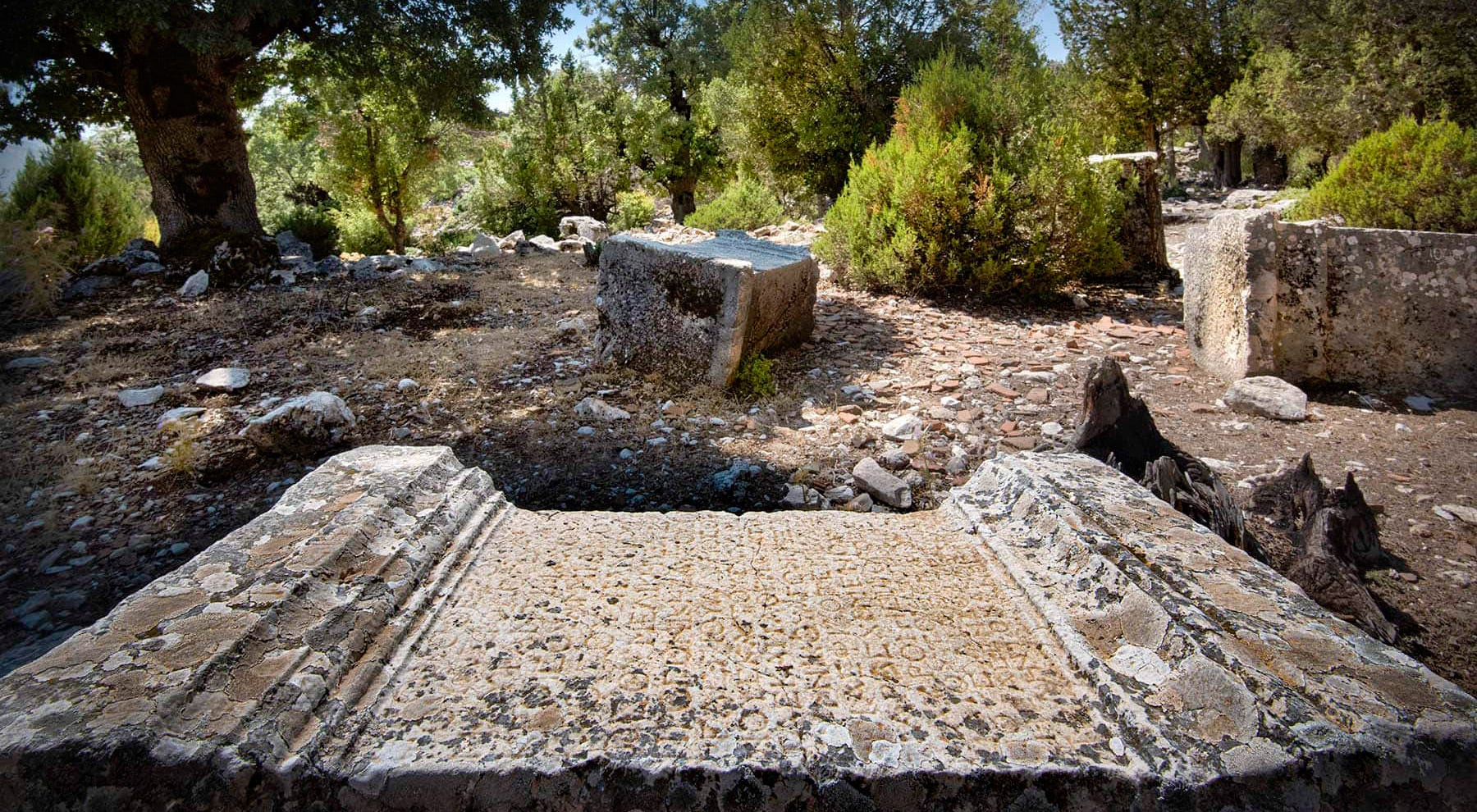
There is less one can easily say about Diogenes of Oenoanda, the author of a later Epicurean inscription (c. 130 AD) found in very fragmentary condition in modern-day Turkey. The majority of the text has not been recovered, and much of what survives either reproduces Epicurus verbatim or is otherwise very faithful to the known doctrines. (The most up-to-date English translation of the inscription is that of Martin Ferguson Smith, available for free online.) Still, Onfray notes a few unique points before rounding out this lecture cycle with some comments on the transition to the Christian age and its destruction of Epicurean and other materialist texts.
Among other things, Diogenes makes a positive case for old age as the time when our desires are on the wane, so that tranquility is more easily attainable. Another interesting fragment contains his contention that statues of the gods should show them “genial and smiling,” rather than impassioned or frightening. Most interesting to Onfray is Diogenes’ hint of utopian aspirations, imagining a world in which Epicurean wisdom becomes universal:
… then truly the life of the gods will pass to human beings. For everything will be full of righteousness and mutual love, and there will come to be no need for fortifications or laws or all the things we devise on account of one another. (Fr. 56, Smith translation)
To Onfray, this is one more entry in the evidence against simplistic accounts of Epicureanism as entirely disinterested in political questions, particularly when it comes to the later manifestations of the school: Philodemus and Lucretius were both in contact with the world of power, and seemingly hoped to influence it. To cultivate an Epicurean disregard for personal aggrandizement does not necessarily imply an apathy towards the well-being of the world.
Conclusion
The history of this great adventure was written by the conquerors—that is to say, it was the destroyers of these works who wrote the history, it was the enemies of the corporeal ideal, the sensual ideal, and the Epicurean ideal who constructed the story, including that of philosophy. We live under the written regime of this history of philosophy. This seminar proposes and will propose a history of the conquered. (Lecture on Diogenes of Oenoanda)
Onfray has a philosophical ambition and passion which I cannot help but admire. The experience of actually listening to an opinionated individual, well-rehearsed but unscripted, speak about Epicureanism for twelve enthusiastic hours is a unique one that is seldom granted to modern philosophy students. This is true first in simple volume of coverage: the median holder of an undergraduate philosophy degree probably discussed Epicureanism over one or two class sessions, embedded in a larger survey of ancient philosophy in which clear preference was given to Plato and Aristotle.
But even beyond this, there is something unique about listening to Onfray. One can, of course, find specialist books about Epicureanism that equal his page count. But his partisan passion is very rare in such books. (The closest English-language analogue would be Norman DeWitt’s Epicurus and His Philosophy—imagine getting to hear DeWitt lay into the Platonists, and Stoics for twelve hours! That would be a treat.) This isn’t to say that the lectures are angry harangues. They are substantive and positive, periodically leavened with French sex jokes. But they give listeners a hint of the experience of philosophical like-mindedness which must have been a part of ancient Epicureanism, a hint of the immersiveness that continues to draw people together through commonality of political or religious beliefs. While listening to these lectures, a modern Epicurean can feel at home.
There are plenty of more specific insights that even those already familiar with the texts can gather from Onfray’s discussion. I have catalogued many of them above and in the first installment of this essay, and so won’t bother repeating them. Overall, however, their cumulative force boils down to this: a revitalized conviction that hedonism and materialism need not be marginal philosophical positions, but could in fact constitute a widespread, common basis for human interaction. There are many people in the world who are ready to leave idealist fictions behind, who are ready to discard the intellectual baggage of guilt, sin, and shame over the corporeal. And when such people come to this perspective in the living of their modern life, they will likewise be glad to turn to the ancient teachings and learn that these wisdoms were discovered long ago, and have adherents still.
For those who know French, the book is Les sagesses antiques, while the Epicurean lectures from the Contre-histoire de la philosophie can be found from Audible across these three volumes.