
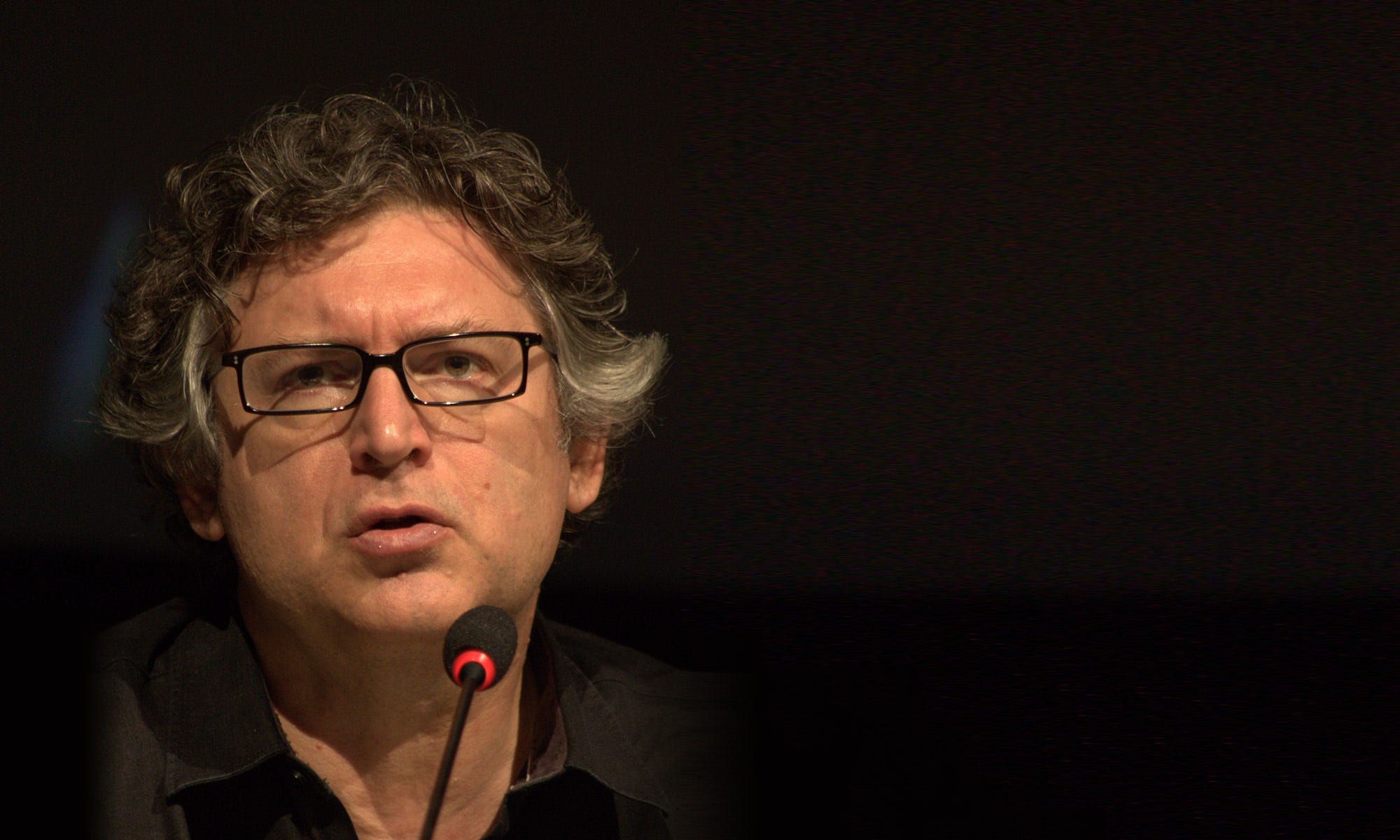
Back in Epicurus’ day, philosophy felt like a battleground. Read Diogenes Laertius’ biography of Epicurus and you will be impressed by the amount of vitriol flung back and forth by the rival schools. Epicurus insulted the Platonists (and most of his own philosophic precursors); the Platonists (and most later philosophers) insulted the Epicureans. These days, most of our scholars of ancient philosophy decline to announce a firm affiliation and conduct tamely non-partisan research. But there is one contemporary writer who is very happy to wade into the ancient fray again, waging verbal battle against Christianity, Stoicism, Platonism, and all other idealist and anti-hedonist philosophies. His name is Michel Onfray.
Unfortunately, the majority of Onfray’s work has not been translated from French into English. A few of his most popular polemics have been (Atheist Manifesto is the most notorious), but his works specifically on Epicureanism and ancient philosophy have not been published in English. Which is a shame—he takes the teachings of the Garden far more seriously than most of the modern anglophone world, radically reshaping the standard story of western philosophy to recenter on the materialist and hedonist thinkers that he argues have been suppressed by ideological opponents for millenia. Today, in the first of a two-part series, I’ll introduce Onfray and his most directly relevant work—his history of ancient philosophy Les Sagesses Antiques (Ancient Wisdoms) and the parallel installments of his lecture series, Une Contre-Histoire de la Philosophie (A Counter History of Philosophy)—while next week I’ll conclude my review of these works and offer some overarching thoughts.1
Since Onfray’s presentation of these ideas is probably unfamiliar to most of my audience, I’m going to take a fairly straightforward approach, proceeding through his twelve lectures on Epicureanism, supplemented by a few relevant passages from Les Sagesses Antiques, to convey the scope of his thinking and highlight some of his most penetrating arguments. If you are comfortable in French, I encourage you to check out the source materials yourself.2 If you aren’t, I hope this piece will, at the least, let you know that these ideas are out there and have their champions—Epicurus may seem like a comparatively minor thinker if you come from the standard academic approach to ancient philosophy, dominated by Plato and Aristotle, but that characterization is not an objective reflection of his importance in the history of thought, or of the value of his ideas.
Whether you read French or not, Onfray’s central message is a compelling one that I am happy to amplify: the hedonists have always been right, the pleasure-hating idealists have always been wrong, our philosophic curriculum has been overly influenced by the historical success of Christian fabulists, and it’s long past time that the world corrected this.
The Counter History of Philosophy
From 2002 to 2015, Onfray recorded a long series of lectures on his version of the history of philosophy through the Popular University of Caen, an alternative educational institution of his own co-founding that charged no fees, gave no grades, and recentered neglected ideas. This project, entitled Counter History of Philosophy, was a massive undertaking, totaling over three hundred lectures running in parallel with a twelve-volume book series that covers the history of western philosophy from its origins to the 20th century.
Twelve lectures focus specifically on Epicurus and his direct philosophical successors. (Though there is a great deal of other material that would also be of interest to Epicureans: pre-Epicurean atomists and hedonists, Pierre Gassendi, the Utilitarians, Jean-Marie Guyau, and Pierre Hadot all merit dedicated lectures as well.) Today, I’ll cover the first six lectures, dealing with Epicurus himself. Next week, I’ll discuss the subsequent six on the later Epicureans (Philodemus, Lucretius, and Diogenes of Oenoanda), as well as offer some concluding thoughts on Onfray’s contributions to Epicurean study.
1. What’s at Stake in Epicurus (Les enjeux d’Épicure)
In his opening lecture on Epicurus, Onfray lays out one of the central conflicts in the history of ideas, the dramatic “stakes” over which many historical philosophers have wrestled: Idealism vs. Materialism. In ancient philosophy, the emblematic contrast was between Plato (and his Neoplatonist and Stoic descendants) and Epicurus. The main purpose of this lecture, then, is to take Epicurus out of a dry, merely historical chronology of figures (as he is often treated in introductory ancient philosophy classes) and mark him out as the great anti-idealist of Greek philosophy, which is to say both the great opponent of Platonism in his day, and the still vivid opponent of much wrongheadedness that continues in the present.
Onfray thinks the Idealist claims of Plato and his heirs were clearly wrong: there are no transcendent Forms, there is no immortal soul, reasonable explanations of the cosmos require empirical data, and moral claims cannot be derived through a priori reasoning rather than through reference to hedonistic outcomes. Of course, such ideas still have their defenders. Across the general population, however, the intense Idealism of Plato has clearly been losing ground—no one thinks there is a “true form” of a horse of which all material horses are imperfect reflections—so why does Plato continue to be accorded so much prestige in the history of philosophy in comparison to Epicurus? Onfray will touch on this throughout the whole series, but his main historical villain is Christianity, whose idealist sympathies led to the preservation of much Plato and the loss of most Epicurus.
Also in this introductory lecture is a helpful synthesizing analogy: while previous sessions discussed the many “islands” of Pre-Socratic philosophy, Epicurus is the unifying figure in whose light we can see those predecessors as making up a larger archipelago—the “Epicurean archipelago.” From Leucippus and Democritus came Epicurus’ physical materialism. From Aristippus and the Cyrenaics came a hedonistic ethics. From Antiphon came the emphasis on philosophy as therapy. From Diogenes and the Cynics came a certain degree of ascetism, rejecting the heedless hedonism of the Cyrenaics in favor of material simplicity. From the Sophists came a distinction between nature and law, recognizing the mutability of human law and custom and preferring to refer to nature as a better guide. And against Plato came Epicurus’ rejection of a self divided between a “bad” body and a “good” soul, instead favoring a unitary conception of human existence in which the corporeal was no longer something to despise.
2. The Physiology of Epicurus (Physiologie d’Épicure)
In this lecture, Onfray introduces Epicurus biographically and argues that such biographical details have significant relevance for understanding his philosophy. For example, Epicurus’ poor family background and provenance from the cultural backwater of Samos presumably influenced his philosophical direction towards egalitarianism, anti-elitism, and a skepticism of the grandeur and importance of the state, all aspects in which he differed strikingly from the philosophy of the aristocratic Athenian Plato. As Onfray puts it in the book:
Poor, exiled, provincial… Epicurus would pay no homage, we may be sure, to the Platonic fantasies: the superiority of Athens, a visceral sense of the aristocratic, reactionary elitism, political conservatism, pedagogic esoterism, dualist spiritualism, architectonic theism, a closed and fixed political society, the advising of princes, the philosopher-king and other such trinkets of a Plato he nicknamed “The Golden” and constantly objected to, as the contents of his philosophy bear witness. (Les Sagesses Antiques 10.1)
More broadly, there are aspects of the ancient Greek cultural and technological context that we shouldn’t forget: their concept of free will and choice were very different than that of the Christian era (there was no such thing as “guilt,” Onfray contends), while the near total absence of medical remedies for pain can’t help but have influenced Epicurus’ version of hedonism.
Rather uniquely, Onfray places a large emphasis on the physical body of Epicurus himself—thematically suitable for the arch-materialist of his day! He notes a record we have that Metrodorus wrote a book On the Poor Health of Epicurus. This fact, combined with some other scattered testimonies to Epicurus’ weak constitution, seems to Onfray to constitute a crucial insight into the development of his philosophy. In Onfray’s words, Epicurus was “incapable of excess”—and so all the slanders of sensual indulgence are false and the truth was as it is seen in the texts of Epicurus himself: Epicurean hedonism was “an art of not suffering.” I largely agree with Onfray that this huge emphasis on avoiding suffering is easy to neglect from our historical position and needs to be remembered.
3. A Pig’s Philosophy? (Une philosophie cochonne?)
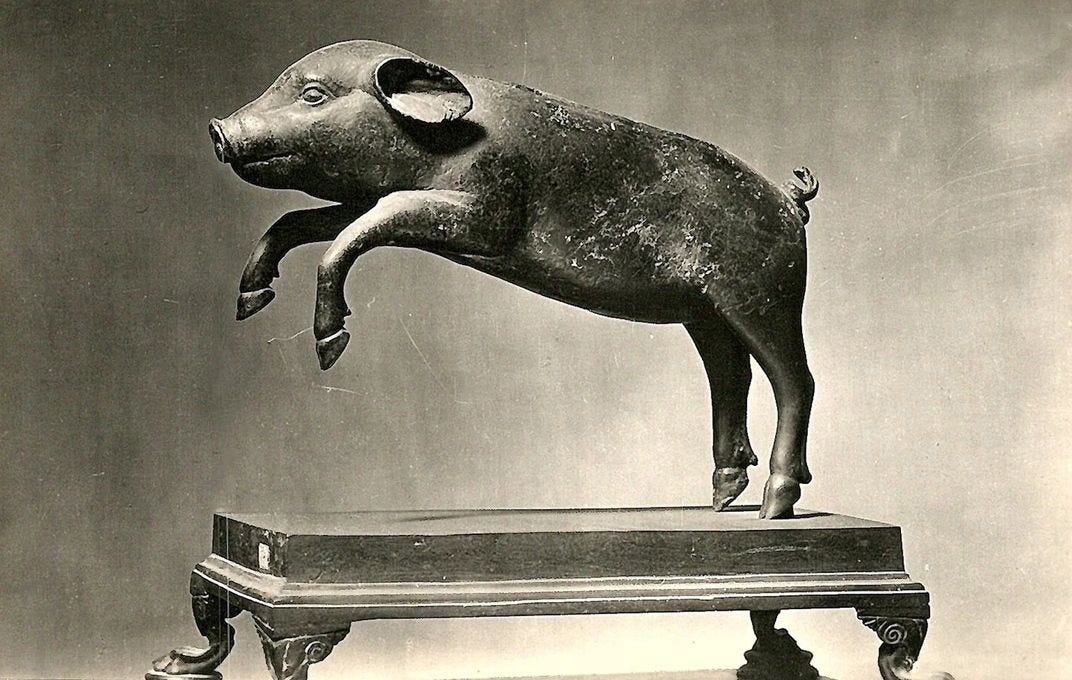
Epicureanism was often accused of being a “piggish” philosophy, with critics of hedonism (falsely) asserting that Epicurus encouraged some kind of low sensualism that denied the existence of more elevated feelings and ideas. In this lecture, Onfray first summarizes the ancient instances of this pig motif, including its willing adoption by the Epicureans themselves, then turns to consider the broader realm of ancient criticism of Epicureanism.
Diogenes Laertius, our principal biographer, reports an impressive array of ad hominum accusations: that Epicurus led a life of constant sexual debauchery, ate and drank excessively, was arrogant towards his philosophic predecessors, was a foreigner, and was a political opportunist. Onfray goes through them all, denying the factual truth of most and undermining the critical substance of the remainder (for instance, it’s true he was from the colonies, rather than being a blue-blooded Athenian, but this has little invalidating force today).
While it might seem like Onfray spends a lot of time introducing Epicurus’ historical context before getting to his actual writings, this is important for his overarching polemical thesis: the anti-materialist, anti-hedonist, body-hating schools of philosophic and religious thought have always hated, attacked, and suppressed Epicureanism. Egoistic hedonism’s low contemporary reputation is not a sign that its ideas are less worthwhile, but a result of this historical opposition and Idealists’ ongoing psychological legacy of “self-hatred, concentrated, transformed, displaced, reversed, and directed onto a fantastical object able to take on all of that internally-accumulated negativity: pleasure” (Les Sagesses 10.10).
4. Tranquil Atheism (L’athéisme tranquille)
Onfray frames this lecture as dealing with the first two subjects of the tetrapharmakos: the gods and death. For readers of this site, most of his discussion will be familiar, explaining how Epicurean materialism denies that either of these traditional sources of fear and worry deserve to be the subject of such negative emotions.
The part that might raise some eyebrows is his choice of title, drawing on a phrase from Gilles Deleuze. Onfray recognizes that Epicurus is not, formally and officially, an atheist. Nonetheless, he points out, with some justice, that he in many ways falls outside of the traditional categories: Epicurus does not believe in the pantheism of early societies, the mythological polytheism of his culture, or the all-powerful monotheism that would become dominant in the future. Instead, he believes in “lazy gods” who have no influence on our world, who do not have the flaws and pettiness of the traditional Greek gods, and who do not merit either our prayers or our fears. Epicurus’ worldview is one of “gods without religion,” one that postulates an ethics based on philosophy rather than divine law, and so in this sense approaches something that is in practice more like a “tranquil atheism” than it is similar to the standard polytheism of his day.
5. Ascetic Hedonism (L’hédonisme ascétique)
Here, Onfray turns to the second half of the tetrapharmakos: the good is easy to obtain and the bad is easy to endure. Much of this lecture is occupied with the classification of the desires, a topic which Onfray cover with some insight, albeit also with some oversimplification. (His description of the necessary desires omits any discussion of the desires “necessary for happiness” that Epicurus mentions as distinct from the simple physical desires which Onfray discusses.)
Correctly, however, Onfray emphasizes the Epicurean focus on the reduction of pain, rousingly summarized in Les Sagesses:
Epicurus takes up arms against everything that generates fear, pain, suffering. The whole of his work proceeds from this sole concern: to eradicate the negative and define the positive as the realization of that peace of the soul and the body. Nothing else. (10.4)
Two universes oppose each other on the question of suffering: [the Platonists and Stoics] grant it a positive value, for it renders possible the triumph of the sage’s will, while [the Epicureans] place it clearly on the negative side, make it in fact the absolute negative. Here, hedonism presents its most beautiful certificate of nobility: do not compromise with that which harms the body and the soul, never compromise… (10.10)
While Onfray may perhaps somewhat overrate Epicurean ascetism, his broader point remains valid: Epicureanism is clearly “more ascetic” than the image usually summoned up by the word “hedonism,” giving the bulk of its attention to the reduction of pain rather than the accumulation of positive pleasures. He does a better job than many at clarifying that while Epicureanism is not limited to “katastematic” (static) pleasures, the “kinetic” (active) pleasures Epicureans do endorse are not really contrary to “asceticism,” if that term is taken to mean “materially restrained” or “lacking in luxury.” Instead, Epicurean kinetic pleasures are things like the pursuit of philosophy and friendship, with perhaps a little light enjoyment of the arts on the side (this is increasingly prominent in the Roman period). All of these can be pursued under material conditions that many might consider austere.
Onfray’s extended comparison of the Garden to early Christian monastic communities has significant truth: being a member of an Epicurean community did involve the voluntary limitation of many common desires, material simplicity, the cultivation of social virtues like kindness and cooperation, egalitarianism, shared spiritual exercises, and a renouncement of many worldly goals and pleasures. Many people read Pierre Hadot and theoretically understand the concept of “philosophy as a way of life,” but Onfray’s portrait makes this rather more vivid: Epicureans live differently than the world at large.
6. The Philosophy of the Garden (La philosophie du jardin)
For his final lecture on Epicurus (as opposed to his later followers in Italy and beyond), Onfray takes one more opportunity to crystalize what he sees as the extreme contrast between Epicureanism and Platonism. Metaphorically, at least, he considers that the Garden of Epicurus can be considered to be an almost point-by-point “anti-Republic,” denying the preferences and positions embodied in that Platonic dialogue and in the practices of the Academy writ large. For example, he notes how the Republic’s Kallipolis promotes a society of fixed classes and suppressed individuality, while the Garden seems to have operated on a principle of equality and with no direct control over private life. The Academy was largely closed to women; the Garden was open to all. The Garden—and Epicureanism overall—endorsed a contractual view of justice, in which mutual hedonistic benefit was the only basis for law, rather than an ideal form of justice implemented by force, as emphasized in the Republic.
While more subtle analyses of the Republic might dispute Plato’s degree of endorsement for some of the practices of Kallipolis, I would agree with Onfray’s overall argument: Epicureanism is more open, more egalitarian, and less enthusiastic about grand political projects than Platonism, all of which are reasons to prefer the school of the Garden.
Next week, I’ll return to Onfray, discussing his six lectures on later Epicureanism in Italy and beyond. We’ll cover his interpretations of the Epicurean circle of Philodemus in Campania, Lucretius, and Diogenes of Oenoanda. While many of Onfray’s central themes should already be becoming evident, I’ll wait until I’ve discussed those lectures and book chapters to offer my full evaluation of his approach. When reading Onfray, there may be certain ideas that call for an asterisk. You can perhaps expect some exaggeration. But you can also expect fireworks.
Onfray is hugely productive across a wide variety of subjects and I cannot claim familiarity with all of his work. These days he seems to be most engaged by contemporary political disputes where he critiques everyone and declares himself a man without a party. He is, in other words, not first and foremost a specialist scholar of ancient philosophy, but rather a vigorous modern polemicist who nonetheless has made a fairly deep study of Epicureanism and champions many of its values with a forcefulness that is often lacking among more polite academics.
The book is Les sagesses antiques, while the Epicurean lectures from the Contre-histoire de la philosophie can be found from Audible across these three volumes.
I've heard that Onfray also has a positive impression of Pyrrhonism.