
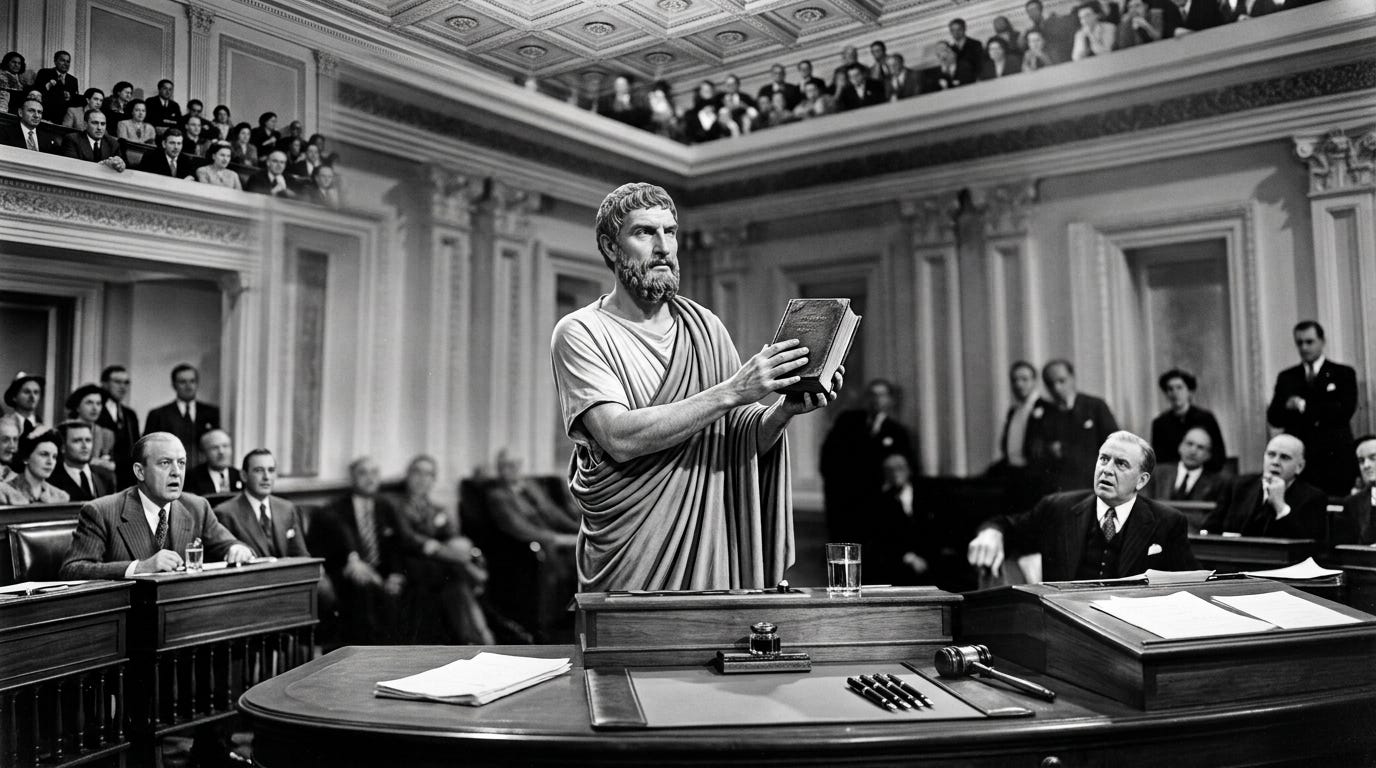
In recent weeks, we’ve been discussing the Epicurean theory of justice. Contrary to some oversimplifying narratives, Epicureans do have opinions about the best way to establish laws and run a polity. So what would you get if you tried to reconstruct Epicurean political advice for the contemporary United States? Such a thought experiment would inevitably involve lots of speculative extrapolation, but I think it’s still worth doing. One of the great benefits of studying past thinkers is to get some distance from contemporary debates and to see our current issues from entirely different perspectives. Many people theoretically praise this virtue of studying the past. Fewer are willing to let the ancient world actually give its unvarnished opinion of modern ways of life. I am!
Most clearly, I think Epicurus would think that modern people demand lots of unnecessary things from their governments. He thought happiness was widely accessible at far lower levels of both material abundance and political protections. I don’t have any illusion that contemporary political institutions will adopt a more Epicurean stance anytime soon, but I think that the exercise of applying a philosophy-from-first-principles to current political questions is still highly valuable for its effect on one’s personal mindset. If you are convinced that all the heated political debates of the current moment are relatively unimportant to your life—as I firmly believe Epicurus would assert—then you will find it much easier to follow the core Epicurean advice: Don’t Worry About Politics.
Let’s do some time travel.
America has had its election. Seeing the need for wise counsel on how to meet the country’s true needs, Congress summons Epicurus to give them his honest advice, sans sugarcoating. In his typically terse style, he resolves most of the nation’s issues in a few sentences. Here are his responses to a dozen questions from the newly inaugurated members of Congress, desperate for guidance.
1. O wise Epicurus, here’s how we’ve been managing our resources [handing over a one-page summary of the federal budget]. How are we doing?
I have rarely seen such obvious imprudence: you clearly need to close your deficit. I always advise prudence, and there are few things more straightforwardly imprudent than spending more than you earn, year after year. For a household to pay 10 obols a month in interest tends to indicate poor management; for a state to pay $1 trillion in annual interest seems likewise problematic.
2. I know it seems bad. But how should we fix it? Some of us think taxes are self-evidently still too high, while others think a just society requires more spending.
Remember: there is no such thing as abstract justice. The most just course is whatever your society is able to agree is most beneficial overall. Hmm, let me take a little look at this paper and see what might plausibly secure agreement…
Your government expenditures are currently 23% of GDP, while your tax revenues are 17%. You’ve never collected even 20% of GDP in taxes, even during the height of your second World War, so it seems unlikely that your country will agree to increase taxes by a third to all-time record levels in order to meet current expenditures. I think you’ll need to cut spending. Meanwhile, it looks like you haven’t had spending as low as your current revenue level of 17% for over 50 years, so it seems unlikely that the people will have much appetite for a 25% cut in spending either. Looks like you’ll need to raise taxes too!
Overall, what you need is less rhetoric and more sober weighing of your options, or what we Epicureans call a symmetrisis kai sympheronton kai asymphoron—a weighing of advantage and disadvantage.
3. [A Republican Senator] What do you mean by spending cuts? I don’t want to cut our military spending.
Let me see… you’re currently spending about 15% of your budget on the military, or about a trillion dollars a year. That’s about a third of the world’s military spending to protect 4% of its people. $50 billion on a war of choice with Iran, as of October. That does seem excessive.
I’m all for self-defense. That’s why I think people came together in groups in the first place. But I am not in favor of glory-seeking on foreign campaigns (that’s Plutarch’s thing) or trying to dictate to other states what they should consider just. So yes, it seems like you could cut this.
4. [A Democratic Senator] What do you mean by spending cuts? I think we should expand our social spending on things like education, healthcare, childcare, and home-buyer assistance.
That is a lot of desires. Remember, the desires that are truly necessary for happiness are very few. Keep in mind that no particular level of subsidy for education or medical care is inherently just, while a lower level is inherently unjust—from an individual perspective, any net benefit from such programs should be treated as a welcome bonus. Some of my happiest friends are slaves and women who can’t even own property! Never postpone your happiness until you get a subsidy!
Now, if you all agree that it is more advantageous to band together and pay for some of these services collectively through taxes, then you are perfectly free to do so. But if your country does not agree to raise taxes a sufficient amount to pay for all of your wish list, then some of these things will also need to be cut.
5. [All the Senators] At least we can agree not to cut spending on our cherished elders!
Yes, on them too. Old people are not exempt from the classification of desires or the contractual nature of justice. It looks like your Social Security and Medicare programs make up a huge part of your spending, so you probably need to rein them in. The desire to use a more generous formula for calculating cost-of-living increases rather than a more conservative one, or to receive maximum benefits at 67 rather than 69, or to pay a specific low Medicare premium even if you have a high income—none of these are necessary desires, which doom an individual to unhappiness if not fulfilled. Happiness is usually equally possible under either policy regime. And if a state collectively decides not to fulfill those desires as arbitrarily quantified, it is not inherently unjust in its decision.
Such reforms should therefore be on the table like any others, as part of a sober comparison of advantages and disadvantages.
6. [A Republican Congressman begins to pontificate] I heard you say that we should raise taxes. That seems like a straightforwardly bad thing to do, taking money out of people’s pockets!
Ah, you seem to be fundamentally mistaken, even though my words have come down to you in Vatican Saying 81 and elsewhere: “Great wealth… does not resolve the troubles of the soul or produce joy worthy of the name.” Your wealthy people—and they are incomprehensibly wealthy compared to my experience—are not all happy. But their obstacle to happiness is not lack of wealth. You can increase their taxes and they will be fine.
7. [A progressive firebrand exclaims] Ha, I knew you’d agree with us! Let’s soak the rich!
Well, most of you are rich. As I understand it, your country’s median income is now $87,000, higher than any point in the history of mankind. I’m sure you have some poor people, but it seems like you could ask the majority of the country to pay somewhat more if they are indeed benefiting from those public expenditures.
How about a broad-based consumption tax? I hear that all 37 other members of the OECD have a VAT. After all, buying stuff is never very important and seeking to maximize the number of objects one owns is a fundamentally poor strategy for pursuing happiness. If things cost 5% more and people consequently have 5% fewer things, they will be fine. You know what I say: Nothing is enough for one to whom enough is little.
8. Let’s move on from the current budget and address some other topical questions. How should we reform education? We obviously need to help more people go to college.
Is that like the Platonic Academy? No, I wouldn’t recommend that. For the general populace, the sciences only need to be understood sufficiently to dispel fears. Education should teach people how to live good and happy lives. Securing material sufficiency is a fine goal too, but the wish to achieve great wealth or to plume oneself on one’s educational attainments are both empty desires and we shouldn’t fan such unnatural wishes under the noble-sounding name of “education.”
9. How should we practice policing and address urban disorder?
The most fundamental principle of justice is avoiding harm from others. Laws exist to protect the wise. We should avoid harassing innocent citizens, but law and order is generally a very understandable priority in human societies.
10. How should we reform healthcare?
I am confused by this notion of “healthcare.” People should take care of their health and avoid pain, for instance by not eating too much and doing some exercise. Forgoing immediate pleasures to avoid future pain is the essence of prudence, as is accessible to everyone.
We largely mean health insurance: sometimes people have injuries or illnesses which are very expensive to treat.
Ah, insurance. In my day, we called this “friends and family,” but that’s rather clever of you to pool together in larger groups to support each other in times of trouble. Some things are indeed “up to chance,” so in an ideal world, I think I’d favor some kind of universal catastrophic coverage. I’m afraid these “Medicare for All” proposals look far too expensive for your country’s appetite for taxes. Anyways, for most people’s everyday maintenance, individual prudence should be sufficient.
11. The people are struggling! They can’t make ends meet!
They don’t look poor to me. Many appear to simply be imprudent and confused. I suspect they have been the victims of unscrupulous sophists. Looking at your statistics, not only is your median income higher than ever before, per person living space has gone from around 200 square feet to around 1000 over the last century, the share of income spent on food has fallen in half over the same time period even while people eat out more than they used to, the majority of households own multiple $25,000 transportation machines with the power of two hundred horses, and almost everyone has an inconceivably powerful computer in their pocket.
You seem to have quite dysfunctional markets for medical treatment and housing construction in high-demand areas, so if you can fix such issues, that would make a lot of sense. But overall the people need to be wiser, not richer. Remember what I said about Pythocles: if you want to make him wealthy, do not increase his riches, but reduce his desires. It looks like you’ve been trying the “increase his riches” strategy for a long time. But feeding unnatural desires tends to make them grow.
12. But aren’t the people always right? We’re a democracy!
No, the people are often foolish. You thought I would give you popular answers? There’s a reason I don’t go proselytizing in the public square like that imprudent Socrates—democracies have no particular sympathy for wisdom. You happened to invite me here, so I’m happy to let you know my thoughts. But “I prefer to speak with an oracle’s frankness, sharing things that benefit all men, even if no one understands me, rather than to conform to popular opinion and so enjoy the mob’s ready praise” (VS 29).
Having uttered his oracular opinions, Epicurus leaves his congressional hearing and rejoins Metrodorus and Leontion for a meal. They discuss the latest silly things the Stoics are saying in the 21st century and give no further thoughts to whether Congress acts on his advice. They don’t. Epicurus, however, remains untroubled.
A form of insurance existed in Epicurus' time for shipping. It was called "bottomry." It was one of the sources of Zeno of Citium's great wealth.
Love this, Jack, thanks!