

Principal Doctrine 27:
Of those things that the wise acquire to secure a blessed state throughout life, the most important by far is friendship.
Principal Doctrine 28:
The same judgment that gives us confidence that nothing terrible lasts forever, or for very long, perceives that when it comes to those short-lived evils of life, there is no security more complete than that which stems from friendship.
Commentary
As a philosophy of egoistic hedonism, Epicureanism grounds a large part of its enthusiasm for friendship in practical benefit. Friends are not merely people with whom we like to sit and watch the game on the weekend; they are people whom we can trust to be there when we need help. Looking at some other texts will help flesh out what Epicurus has in mind:
[Epicurus’ rationale for friendship is] that he may have someone to sit by his side when he is sick, someone to aid him when he is faced with imprisonment or poverty. (Seneca, Letter 9)
All friendship is worth choosing for its own sake, but it finds its beginning in mutual utility. (VS 23)1
The true friend neither constantly asks for help, nor separates friendship entirely from practical support. The first is mercantile, offering gratitude as a payment for services, while a man of the second type necessarily abridges our confidence about the future. (PD 39)
Importantly, emphasizing the importance of “utility” or “help” does not imply a constant calculation of material advantage, as disingenuous critics like Cicero claim. Epicurean friendship is grounded in practical benefit, but it is not oriented around maximizing the amount of money, goods, or services you can extract from others. Instead, feeling confident of assistance in the case of real need is a kind of guarantee and indicator of the solidity of the relationship: if a friend wouldn’t help you in the case of sickness, imprisonment, or poverty, then that is a weaker and less valuable kind of bond. What we are after is not stuff—it is “confidence about the future.”
Given this background knowledge, we can evaluate the claims of today’s two Principal Doctrines more fully.
Of those things that the wise acquire to secure a blessed state throughout life, the most important by far is friendship. (PD 27)2
Some modern readers will encounter a phrase like “blessed state” and find it decidedly unmodern and hyperbolic (perhaps even more so if translated as “bliss” or “blessedness”). Many people have friends, but few people feel like complete bliss has thereby been achieved. The first thing that I think you need to do to properly calibrate your reading of this maxim is recognize that while, yes, Epicurus is very enthusiastic about the merits of friendship, he is also very insistent that the requisites for a completely happy life are few. Remember what he said about blessedness in the Letter to Menoeceus:
Keeping these facts in unwavering focus allows us to refer every choice and avoidance to the health of the body and the serenity of the soul, for to secure these is the object of a blessed life… For it is when we feel pain from the absence of pleasure that we require pleasure; when all our pain has been relieved, we need no further pleasure. This is why we say that pleasure is the beginning and end of a blessed life.
Epicurus is constantly reminding us that we don’t need most of the things we think we need. The truly necessary desires are few, and very achievable. When it comes to making sure you won’t starve to death or die of cold exposure, a few reliable friends do indeed provide a huge boost to your security. This limited nature of the problems we are aiming to forestall is indicated in the second of today’s Principal Doctrines:
The same judgment that gives us confidence that nothing terrible lasts forever, or for very long, perceives that when it comes to those short-lived evils of life, there is no security more complete than that which stems from friendship. (PD 28)3
You may remember the doctrine about the short duration of pain from back in PD 4. This is a claim that frequently arouses skepticism among non-Epicureans when stated bluntly. Even I would hesitate to tersely assert that “pain never lasts long” without further explanation and qualification. But I think that such explanation and qualification is quite available, if we are interested in a good-faith search for therapeutically valuable advice. Consider a few suggestions:
If you don’t like the seeming hyperbole of nothing terrible lasting for very long, simply think of it as “very few terrible things last for very long”. The majority of sources of pain clearly don’t. You stub your toe, break a wine glass, lose some money—and you get over it. Advice that applies 99% of the time is good advice. (You may set it aside if you have some rare medical condition that causes immense pain for many years with no way of amelioration.)
What constitutes a “long” time is very subjective and context-dependent. Some things are not resolved in minutes, but are resolved in days or weeks. For those kinds of stressors, I agree with Epicurus’ point: we should keep in mind that they will be over soon. For things that last for years, we should think about how to change our situation and resolve them. Usually, we can. Epicurus would agree with that as well.
Note here that Epicurus says that “nothing terrible” lasts for a long time. This doesn’t deny the empirical reality that people can cause themselves pain over a long period of time. They do! But the objective source of their pain is usually not equivalently enduring. People suffer from mentally-created envy, anxiety, fear, and depression. These things can be remedied, and Epicurus offers help for them.
The point about bad things not lasting a long time boils down to this: the wiser you are, the quicker you shake things off. Realize your causes of pain or sadness are finite. This mindset will make you feel better than if you spend your time thinking up reasons why your current sources of sadness are so big and imposing and seemingly permanent. Don’t be like the sad, ruminating kids. Write it in your heart: the wiser you are, the quicker you shake things off.
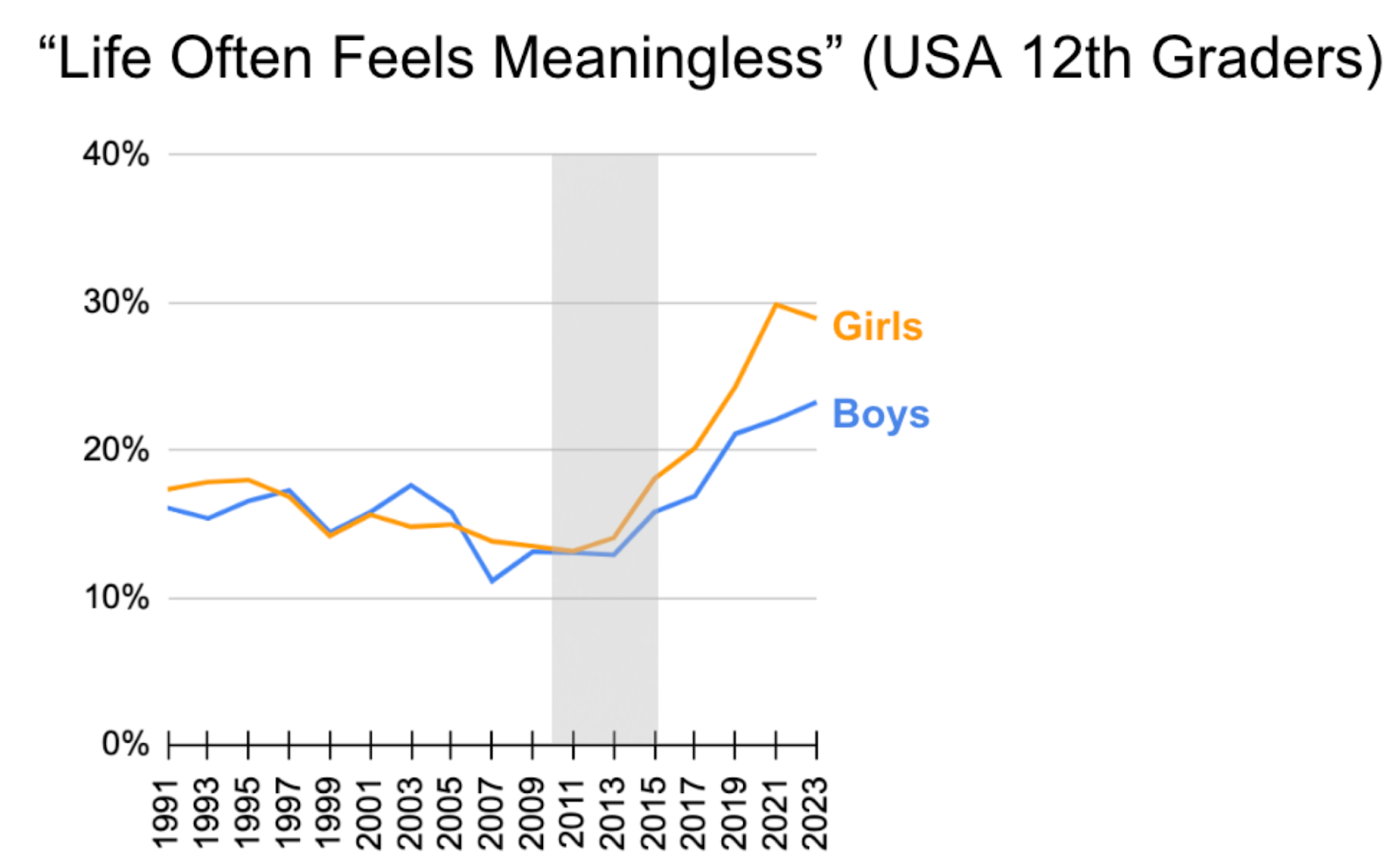
So, given that the typical long-lasting sources of pain (existential dread, religious guilt, unsatisfiable desires for impossible objects, etc.) are all ultimately insubstantial things with no independent existence, which you can cast aside as soon as you start thinking reasonably, the remaining sources of disquiet are indeed things which friends can help a great deal with. What external, objectively existing problems would really be an obstacle to happiness? Starvation. Homelessness. A dangerous environment. Perhaps loneliness—the lack of friends itself. All of these can be alleviated by friends worthy of the name.
There are two more points I’d like to make. First, I think a large part of the gap between Epicurean enthusiasm for friendship and the relatively muted response from some readers stems from confusion about the word itself. Greek philia (φιλία) is commonly rendered “friendship,” because this is on average the closest English equivalent. But the Greek concept is broader. In some Epicurean contexts, it might be something more like “fellowship,” like in Lord of the Rings—you know you can count on Legolas to protect the ring-bearer, but it’s not exactly because they are “friends” as we typically use the word.

Even more importantly, philia includes all family relationships: parents and children, siblings, and spouses (in their companionable, rather than erotic, dimensions). “Reciprocal affection” might work in English (I think this is probably the more accurate general translation, it’s just rather clunky). There is no reason to think that the Epicureans were dismissive of the value of such family ties. We have fragments of an affection letter from Epicurus to his mother. His brothers were members of the Garden. Epicureans—unlike all the other ancient philosophical schools—were known for their philosophical couples: Metrodorus and Leontion, Leonteus and Themista. So, if you think that Epicurus overrates “friendship,” and that you are getting along just fine without crucial contributions from unrelated friends, make sure you extend his arguments to all of your relationships with other people. I don’t know anyone who is happy with zero people they can count on in their lives.
Second, talk about the “insurance” value of Epicurean friendship might incline one to ask, “what about real insurance?” People often have health insurance, home insurance, car insurance. They also have access to government social safety nets: old-age pensions and healthcare, unemployment and disability payments. These kinds of benefits overlap with those that Epicurus praises in friendship. In much of the modern world, medical bills and houses can cost so much that it is hard for a local network of friends to absorb those costs if disaster strikes—our larger scale of political organization is good for that. We should be grateful for such things and take comfort in the security they add to our lives.
On the other hand, of course, these systems are colder and more bureaucratic. They don’t feel as nice. They don’t come with the ancillary pleasures of company and conversation; they come with paperwork. Such modern schemes of insurance are therefore supplements, not replacements, for friends and family.
So, how should you live by these rules? First of all, remember to cultivate this sort of solid, helpful friendship, including spouses and family members. Contrary to some shallow readings of Epicurus, that just see the word “friend” and assume this entails a blanket advocacy for gregarious sociability, I think the implication of Epicurean practicality is actually that you should deprioritize your efforts at socializing that don’t seem promising for real, trustworthy, dependable relationships. This doesn’t mean you shouldn’t be agreeable—Epicurus says that you should. But the right goal for a given relationship is not always friendship. Sometimes it is neutrality. Sometimes it is avoidance.
The man who manages the insecurity of the outside world in the best way does three things. The forces he can render friendly to himself, he does. If this is not possible, he makes them at least not hostile. And if even that is not possible, he avoids contact, and expels from his life that for which it is best to do so. (PD 39)
Second, remember that Epicurean friendship does not mean that you need to constantly evaluate current and prospective relationships through a calculating lens of what you will actually “get out of” these people. Even scholars get that wrong. To clarify what Seneca said about help in the case of illness and poverty: it’s not as much about having someone sit by you in illness as it is about knowing that someone exists who would.
The assurance of having our friend’s help helps us more than their help itself. (VS 34)
You may or may not need to call upon your friends and family for rescue from dire misfortune. Hopefully you won’t! But if you never need great assistance, that doesn’t mean that the friendship “didn’t pencil out” for an Epicurean—it means that your life is working out well, and the fact that you had a backup network of affectionate support increased your mental comfort.
This mental aspect points to perhaps the biggest point, our third: worry less about accumulating a greater quantity of friends, and spend more time relishing the ones you do have. People worry too much. Do you have a friend or two? Good! Even in our comparatively isolated age, I suspect people who say they don’t are typically underrating their networks. Do you have parents? Do you have children? Do you have siblings? Do you have aunts and uncles? Do you have a spouse or partner? Does your spouse or partner have parents, siblings, aunts, uncles? If you lose your job, lose your savings, or lose your home, these people won’t abandon you.
Especially, that is, if you don’t abandon them. This is the last piece of Epicurean friendship that is often overlooked. Uncharitable readers think it is all about “self-interest” when Epicurus “praises friendship.” But he isn’t simply saying, “go get friends.” Just as often, he’s insisting that we need to be friends. Help others. Give them the assurance that you would help them should they ever be in need. And thus you will form a web of trust that leaves you blessedly free from fear.
Cultivate dependable friendships, including with family and partners.
Don’t focus on near-term utility. Focus on who you can trust.
Appreciate the friends and family you have, and relax in the security they give you.
Be someone others can count on.
Explore the complete series on the Principal Doctrines here.
Original Text
27: ὧν ἡ σοφία παρασκευάζεται εἰς τὴν τοῦ ὅλου βίου μακαριότητα πολὺ μέγιστόν ἐστιν ἡ τῆς φιλίας κτῆσις.
28: ἡ αὐτὴ γνώμη θαρρεῖν τε ἐποίησεν ὑπὲρ τοῦ μηθὲν αἰώνιον εἶναι δεινὸν μηδὲ πολυχρόνιον καὶ τὴν ἐν αὐτοῖς τοῖς ὡρισμένοις ἀσφάλειαν φιλίας μάλιστα κατεῖδε συντελουμένην.
This full meaning of this aphorism is somewhat debated: if Epicurean friendship is ultimately egoistic, how can it be “worth choosing for its own sake”? (Or “an intrinsic virtue”—this is the actual manuscript reading, but perhaps even less clear, while changing one letter achieves at least grammatical normality.) It has been argued, for instance, that this reflects a later development of the school as described in Cicero’s De Finibus, by which instrumental utility was held to be the original impetus to friendship, but that friendship subsequently becomes a direct source of pleasure. For more, see Tim O’Keefe’s “Is Epicurean Friendship Altruistic?”
Literally, the Greek says, “wisdom acquires,” rather than “the wise,” and most English versions retain that literal rendering. But what does that really mean? I try to translate into the words we would actually use to express his meaning—this is something that wise people do.
Over-literal translations have also hurt this one. What I translate as “judgment” (γνώμη) is sometimes rendered as “argument” or “opinion,” as if there were some very specific chain of reasoning that yields both the conclusion about the short-lived nature of pain and that about friendship. I don’t think there’s any need to take it so narrowly: I think Epicurus is talking about a general orientation and way of thinking about the world.